BoJ Preview: A number of changes expected, but no fireworks
- BoJ rate decision should include a number of changes at today's meeting.
- Markets expect "enhanced" credit easing/loan subsidies alongside an increase to corporate bond purchases.
- Currency weakness is crucial for the BoJ, bias to the upside although risk-off to cap.

The Bank of Japan (BoJ) will announce a number of changes at today's meeting, which are expected sometime after midday in Tokyo, (after 0300 GMT). The meeting, which starts at 9am Tokyo time (0000GMT), has been shortened from a two-day meeting to a one-day meeting in order resolve, as soon as possible, the economic crisis pertaining to the COVID-19 epidemic which has flared up in Japan.
Meanwhile, to ease the widespread damage, especially to small and medium-sized business, the BoJ will take into account that Prime Minister Shinzo Abe already plans to roll out a multipronged economic stimulus worth ¥117.1 trillion — by far the largest in modern Japanese history. The package will feature universal cash handouts of ¥100,000 per individual. At the same time, businesses feeling financial strain are eligible to seek out interest-free loans from public and private lenders. Tokyo has also announced an ¥800 billion relief package that includes cash payments for businesses and private institutions that acquiesce to suspension requests. Approximately ¥22 trillion of gross domestic product and 6.5 million jobs could be shed in the decade leading up to 2025 as many small and medium-size firms go out of business, according to trade ministry estimates.
Critics would say that Japan did not act appropriately nor fast enough which has lead to over 13,000 cases of infection, with the majority of infections condensed into the capital of Tokyo. According to the US’ Johns Hopkins University, at least 360 people have died of the coronavirus in the country. Prime Minister Shinzo Abe recently announced that the emergency imposed in seven provinces earlier this month has now applied to all 47 provinces. This is taking a toll on Japan's economy and the BOJ should be expected to announce a number of changes, although, change that is unlikely to rock the apple cart as far as markets will be concerned which have already ben pricing in the extent to which the central bank can realistically react.
Analysts at TD Securities, for instance, are expecting that there will be "enhanced" credit easing/loan subsidies alongside an increase to corporate bond purchases are a near certainty, as is the removal of its QE 'target' and de-emphasis of price momentum/inflation. Expect an affirmation of open-ended buying as a tacit endorsement of MOF spending."
Additionally, there had already been reports 'leaked' by the Japanese media that the BOJ was considering upping many of its existing facilities including corporate bond purchases (up to 15tn yen) and expanding its loan program to small and medium-sized enterprises. "Both of these are a near certainty and we suspect that the BOJ intentionally floated these programs in the media to see how well the market would entertain the idea," he analysts at TDS argued.
How yen might be expected to act
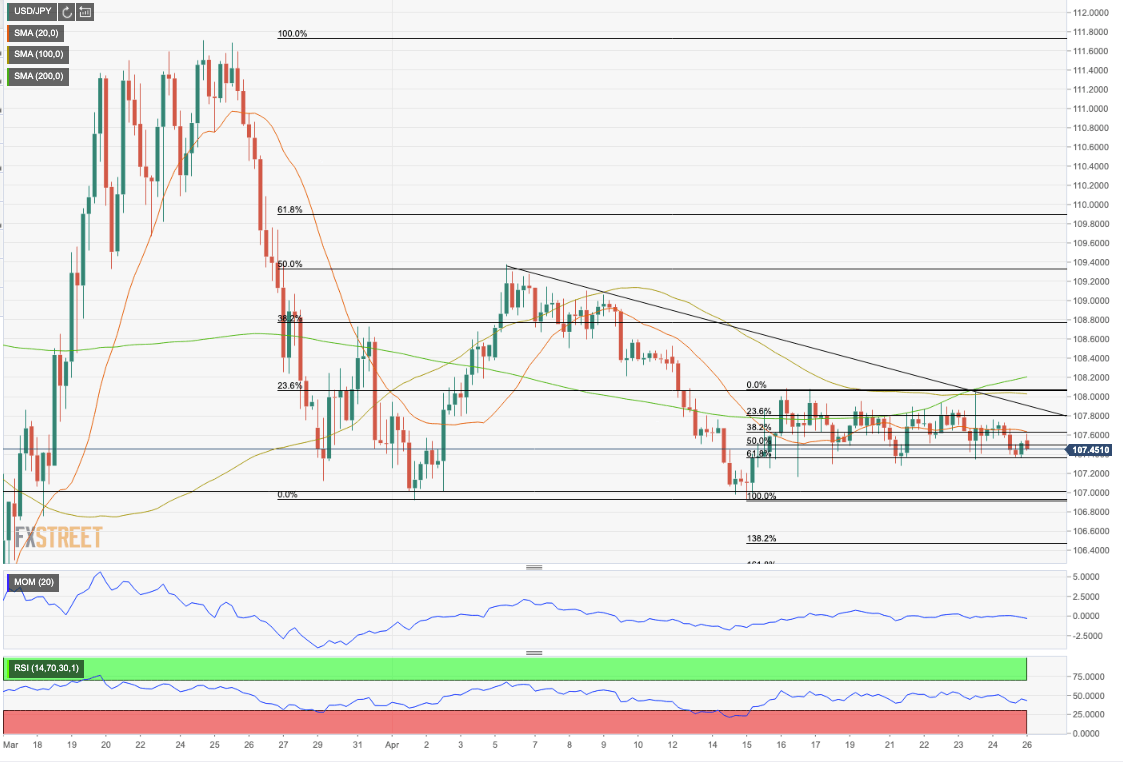
Currency weakness is crucial for the BoJ, so whatever decision they make, they will be taking into consideration how poorly markets have reacted to past policy, so the decision should be non-favourable to the currency, in whatever form it comes. In recent times, USD/JPY has been trading at 107.50 for a number of days in the consolidation of the V-shaped drop and pop since the late February highs and 9th March lows. However, the actions undertaken by Japanese officials have had little to do with the price action, and today's decision is also unlikely to affect the pair much, likely to be capped much above the 108.10/30 area.
Risk-off should keep the yen underpinned and while here could be glimmers of hope in the COVID-19 numbers and economies getting back to business with easing social distancing measures, we are far from being out of the woods. 106.92 recent lows have acted as an interim low. However, a test of that and subsequent hold, a 50% retracement at 106.71 will be on the cards. On the upside, the 111.71/112.23 are the February and March highs.
USD/JPY 4-HR chart
Author

Ross J Burland
FXStreet
Ross J Burland, born in England, UK, is a sportsman at heart. He played Rugby and Judo for his county, Kent and the South East of England Rugby team.