BoE preview: Will the macro picture force a dovish hold from the BoE?
The Bank of England is expected to remain on hold when it meets today, with only one rate cut now priced in by April 2027. There is virtually no expectation in financial markets that rates will be changed later today, with virtually 0% chance of a hike expected. The interest rate futures market is also convinced that rates won’t rise in July either, with a less than 20% chance of a hike priced in for now.
The May inflation report has shifted the dial for the Bank of England, after prices remained at 2.8% last month, defying forecasts of a rise to 3%. Core prices also rose a notch to 2.6%, from 2.5% in April. This has continued a pattern whereby UK inflation is undershooting market expectations. There is inflation in the UK system, the rise in producer input prices to 8.7% YoY attests to this, but it is not passing through to consumers.
For now, the UK is not an outlier when it comes to inflation and has lower CPI rates than the US and the Eurozone, which supports a more dvish stance by the BOE compared to the ECB and the Federal Reserve. This also suggests that the recent energy price spike is not taking us back to the surging levels of inflation that we saw in 2022.
Digging deeper into the May CPI report, transport costs rose sharply, driven by airfares and petrol prices, which is unsurprising. The more surprising element of the May CPI report was the downward contributions from 8 of the divisions, including food, non-alcoholic drinks, furniture and clothes. Meat and dairy prices also fell, which will be a welcome sign for the BOE that, for now, price pressures stemming from supply disruption in the Middle East, are not passing through to the consumer.
The inflation readings for April and May suggest that CPI will undershoot the BOE’s 3.1% forecast for inflation for this quarter. This puts a hawkish pivot from the BOE onto the backburner for now. Added to this, the latest developments in the Middle East are also supportive of a more dovish stance from the Bank. A peace deal has now been signed, and the oil price is falling rapidly, Brent crude is now trading below $78 per barrel, and is down a further 2% on Thursday. At the last BOE meeting on30th April, Brent crude was trading at $114-$115 per barrel. This massive drop surely changes the picture for the BOE, and even opens the door to a dovish hold?
At the last meeting, one member dissented and voted in favour of a hike. We could see a similar 8-1 split in favour of no change, later today. Hawks at the BOE, including Megan Greene, are likely to point to the high levels of input inflation, which could eventually boost consumer prices. Added to this, inflation will rise in July, due to the 13% rise in the energy price cap. The market will hope that the spike in price pressures caused by the energy price cap is temporary and does not lead to a wage-price spiral in the UK.
The UK’s latest labour market report suggested more softening in the jobs market, payrolls numbers continued to fall and news hires fell to its lowest level in 5 years. Regular wage growth was stable, and unchanged in the 3-months to April at 3.4%, the lowest level since 2020. This is further evidence that there are no second round effects from this wage price spiral.
Overall, the UK’s macro picture is not supportive of a hawkish stance from the BOE right now. The oil market is normalizing rapidly, even though Brent crude remains sensitive to news flow about the peace deal. Oil futures for August are rapidly declining and are back at their levels from late February. Added to this, UK GDP fell 0.1% in April, and demand remains weak. This is limiting the passthrough effects from the energy price spikes.
For now, the inflation picture should reinforce Andrew Bailey’s view that the BOE is in no rush to hike interest rates. As rates are unlikely to change today, the focus will be on the wording in the BOE’s statement. If the BOE drops its phrase that the UK has ‘persistent inflation pressures’ this will be seen as a major dovish pivot, and we would expect the market reaction to be large.
Due to the fact that the BOE is sitting on a Q2 inflation profile that is undershooting the Bank’s own forecasts, it increases the chances of a dovish-leaning hold at today’s meeting. A wait-and-see approach would be the most prudent in the current environment, especially since the oil price outlook is far less malign at this month’s meeting, and the geopolitical risks are receding.
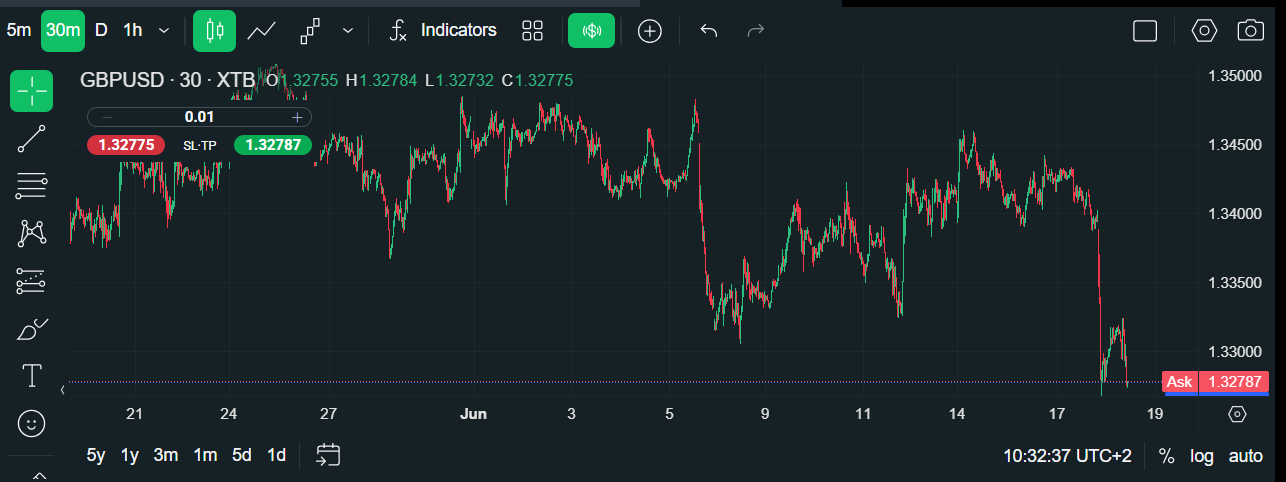
If we do get a dovish hold, then the pound could be at risk, as Gilt yields may decline. 2-Year UK Gilt yields are rising today, on the back of the ‘hawkish’ Fed meeting, but they are already lower by 22bps in the past week, so it may take a dovish tilt from the BOE to shift Gilt yields lower. GBP/USD has lost the $1.33 handle as we lead up to this meeting, and technical signals and momentum all point to further downside for GBP.. The short term key support level is now $1.32, the low from April.
GBP/USD has fallen as we lead up to the BoE meeting
Source: XTB
Author

Kathleen Brooks
XTB UK
Kathleen has nearly 15 years’ experience working with some of the leading retail trading and investment companies in the City of London.