Breaking: Bank of England maintains bank rate at 3.75% as anticipated

The Bank of England (BoE) announced on Thursday that it maintained the bank rate at 3.75% following the June policy meeting, as widely expected. Seven members of the Monetary Policy Committee (MPC) voted in favor of keeping the interest rate unchanged, while MPC members Pill and Greene voted fo raise the bank rate bby 25 basis points. Greene explained that the rate hike vote is insurance against larger second-round inflation effects.
BoE policy statement key takeaways
"MPC stands ready to act as necessary to ensure CPI meets 2% target in medium term."
"BoE cuts inflation outlook for this year, sees slightly faster underlying growth vs April projections."
"BoE notes Middle East peace deal but says outlook for energy prices remains uncertain."
"Higher energy prices of past 4 months caused some inflation pressure, our job to make sure that doesn't turn into sustained inflation."
"CPI could reach a little over 3.25% % in Q4 (April: 3.6%-3.7% in Q4 under scenarios A and B, 6% under scenario C)."
"Expected underlying Q2 GDP growth of around +0.2% (April forecast: +0.1%)."
"Would respond quickly to signs of strengthening second-round effects."
Market reaction to BoE interest rate decision
GBP/USD remains under heavy bearish pressure following the BoE event. At the time of press, the pair was trading at its lowest level since early April at 1.3215, losing about 0.6% on the day.
Pound Sterling Price This week
The table below shows the percentage change of British Pound (GBP) against listed major currencies this week. British Pound was the weakest against the US Dollar.
| USD | EUR | GBP | JPY | CAD | AUD | NZD | CHF | |
|---|---|---|---|---|---|---|---|---|
| USD | 0.98% | 1.47% | 0.48% | 0.93% | 0.55% | 1.20% | 0.91% | |
| EUR | -0.98% | 0.45% | -0.46% | -0.05% | -0.46% | 0.21% | -0.07% | |
| GBP | -1.47% | -0.45% | -1.11% | -0.50% | -0.91% | -0.26% | -0.53% | |
| JPY | -0.48% | 0.46% | 1.11% | 0.44% | 0.05% | 0.74% | 0.41% | |
| CAD | -0.93% | 0.05% | 0.50% | -0.44% | -0.42% | 0.30% | -0.02% | |
| AUD | -0.55% | 0.46% | 0.91% | -0.05% | 0.42% | 0.66% | 0.38% | |
| NZD | -1.20% | -0.21% | 0.26% | -0.74% | -0.30% | -0.66% | -0.28% | |
| CHF | -0.91% | 0.07% | 0.53% | -0.41% | 0.02% | -0.38% | 0.28% |
The heat map shows percentage changes of major currencies against each other. The base currency is picked from the left column, while the quote currency is picked from the top row. For example, if you pick the British Pound from the left column and move along the horizontal line to the US Dollar, the percentage change displayed in the box will represent GBP (base)/USD (quote).
Developing story, please refresh the page for updates.
This section below was published as a preview of the Bank of England rate decision at 05:00 GMT.
- The Bank of England is expected to hold the key interest rate at 3.75% for the fourth straight meeting on Thursday.
- UK inflation steadied in May, and hopes of peace in the Middle East have sent Oil prices tumbling.
- The Pound Sterling might come under pressure if the BoE turns dovish.
The Bank of England (BoE) is on track to leave the benchmark Bank Rate unchanged at 3.75% for the fourth consecutive time on Thursday, as the US-Iran peace deal and the softer-than-expected consumer inflation figures seen earlier in the week have eased pressures to tighten its monetary policy.

UK economy is giving worrying signs of weakening at the outset of the second quarter, and Consumer Prices Index (CPI) figures have shown inflationary pressures remained somewhat contained in May. With Oil prices in decline and a US-Iran peace deal at the table, the BoE seems unlikely to hike interest rates on Thursday and probably not in the rest of the year either.
It will not be a “Super Thursday,” and therefore, Governor Andrew Bailey will not speak after the decision. Markets will look through the minutes of the bank and analyze changes in the vote split to try to assess the bank’s forward path.
What to expect from the Bank of England policy announcements?
Recent UK data and the progress on the US-Iran peace process have significantly changed the scenario for the Bank of England, and although the bank is unlikely to alter its “wait-and-see” stance, these new circumstances might prompt BoE policymakers to adopt a more dovish stance.
Oil prices have dropped sharply from recent highs: Brent Oil is about 30% below the level it was at the previous BoE meeting. The US and Iran have advanced towards a peace deal that might lead to resuming toll-free shipping through the Strait of Hormuz, which would contribute to easing energy prices further.
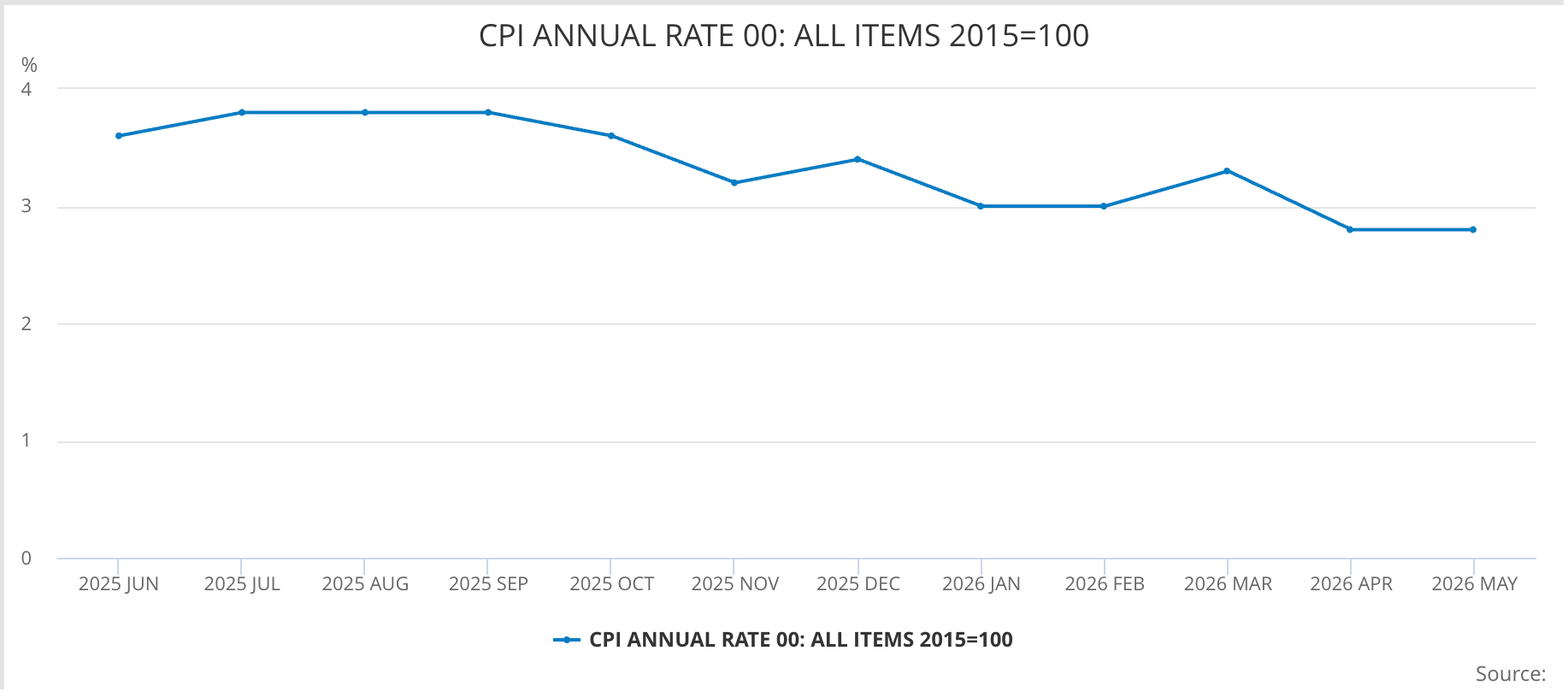
In the UK, Consumer Price Index figures released on Wednesday delivered a positive surprise. Yearly inflation remained steady at 2.8%, significantly below the 3.3% peak reached in March, with monthly inflation easing to 0.2% from 0.7% in the previous month and core inflation growing below expectations. May’s inflation figures are below the Bank of England’s February projections, easing pressure on the bank to hike interest rates in the coming months.
Beyond that, the UK economy is giving signs of exhaustion. Gross Domestic Product (GDP) shrank 0.1% in April, following a 0.3% growth in March and 0.4% in February, and Industrial Production stalled after a 0.2% contraction in the previous month. In this context, the BoE risks tipping the economy into a long-lasting recession by tightening borrowing costs.
The bank voted in April to keep interest rates on hold by 8 votes against 1, with the bank’s Chief Economist, Huw Pill, calling for a rate hike. Investors will be eager to know whether Pill has changed his mind in the new scenario, and, possibly, for any potential voices bringing rate cuts back to the table.
In conclusion, recent developments have cemented market expectations that the BoE will stand pat on Thursday, shifting the focus to the vote split to assess whether the soft inflation and economic growth data have prompted committee members to ditch hopes of interest rate hikes.
Analysts at Deutsche Bank agree that recent developments have provided some leeway for the BoE to maintain its policy unchanged: “The sting from the Iran conflict looks less than markets initially assumed. The peak in CPI could end up well below what we saw last year. This could give the BoE some pause for thought. Indeed, it could buy the MPC more time to assess the risks around so-called second round effects.”
How will the BoE interest rate decision impact GBP/USD?
The British Pound (GBP) has been trading sideways around 1.3400 against the US Dollar (USD) this week, after picking up from two-month lows near 1.3300. Reports of progress in the US-Iran peace talks have supported a moderate Pound recovery, as risk appetite undermined demand for the safe-haven USD.
The pair, however, remains halfway through the monthly trading range, with upside attempts limited below the 1.3500 area.
The risk from the BoE’s monetary policy decision is skewed to the downside, as macroeconomic data has paved the way for the bank to leave interest rates unchanged in the near-term. With this in mind, investors will be looking for hints of a dovish turn, which might increase negative pressure on the Pound.
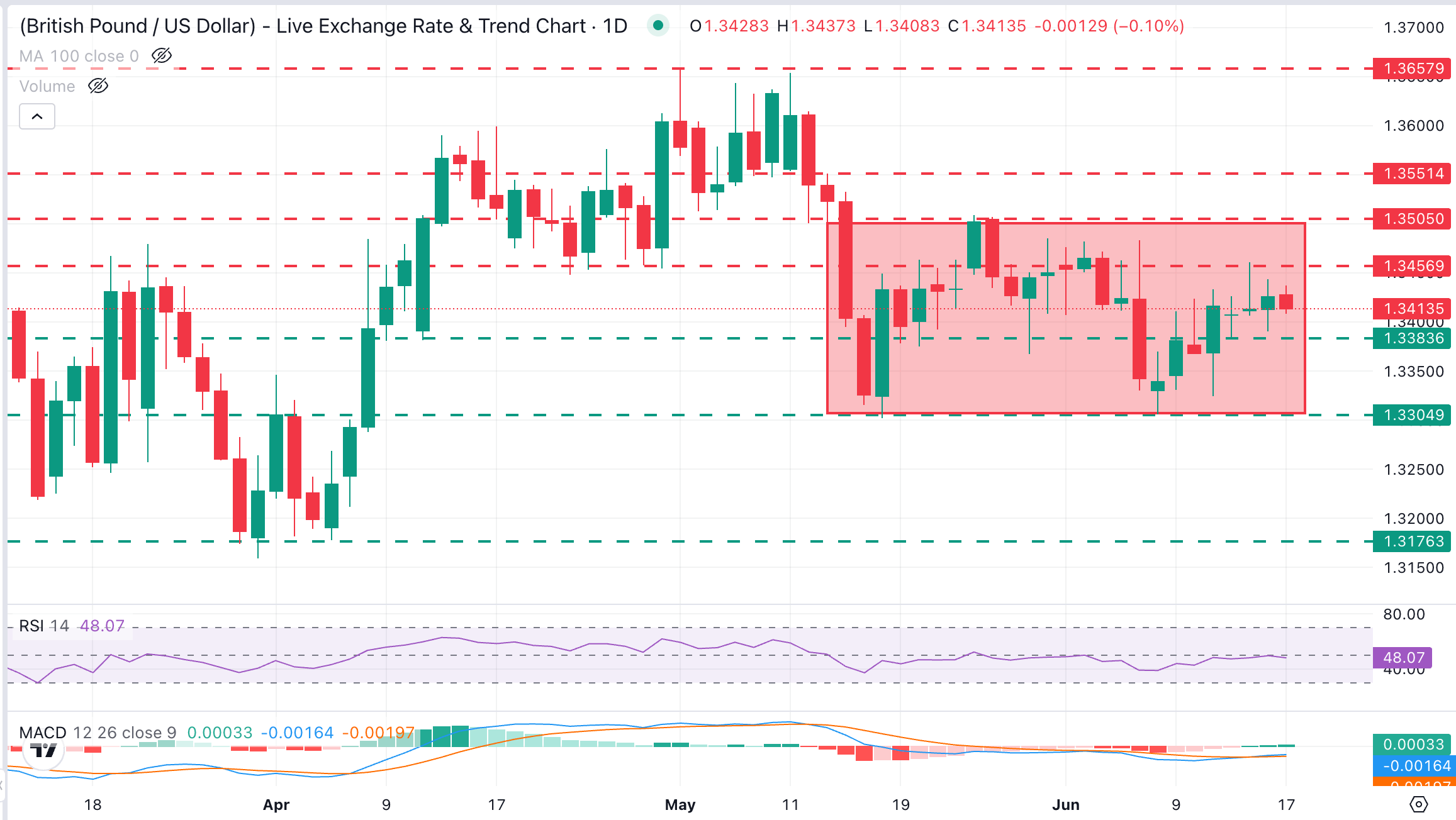
Guillermo Alcalá, FX Analyst at FXStreet, sees the GBP/USD likely to drift lower towards the 1.3300 area if the BoE delivers a “dovish hold”: “The pair lost momentum after the release of the UK CPI data and might extend its reversal if the BoE turns dovish. Immediate support at the 1.3380-1.3390 area might give way, but it might require additional impulse to breach the key 1.3300 area.”
Upside attempts remain limited for now, but Alcalá warns that the confirmation of a peace deal in the Middle East might send the GBP surging: “Pound buyers are lacking incentives right now, but we should not forget that the reaction to the US-Iran deal has been tame so far. If the peace agreement is confirmed and the Strait of Hormuz reopens, risk appetite might boost the Pound to 1.3500 and beyond.”
BoE FAQs
The Bank of England (BoE) decides monetary policy for the United Kingdom. Its primary goal is to achieve ‘price stability’, or a steady inflation rate of 2%. Its tool for achieving this is via the adjustment of base lending rates. The BoE sets the rate at which it lends to commercial banks and banks lend to each other, determining the level of interest rates in the economy overall. This also impacts the value of the Pound Sterling (GBP).
When inflation is above the Bank of England’s target it responds by raising interest rates, making it more expensive for people and businesses to access credit. This is positive for the Pound Sterling because higher interest rates make the UK a more attractive place for global investors to park their money. When inflation falls below target, it is a sign economic growth is slowing, and the BoE will consider lowering interest rates to cheapen credit in the hope businesses will borrow to invest in growth-generating projects – a negative for the Pound Sterling.
In extreme situations, the Bank of England can enact a policy called Quantitative Easing (QE). QE is the process by which the BoE substantially increases the flow of credit in a stuck financial system. QE is a last resort policy when lowering interest rates will not achieve the necessary result. The process of QE involves the BoE printing money to buy assets – usually government or AAA-rated corporate bonds – from banks and other financial institutions. QE usually results in a weaker Pound Sterling.
Quantitative tightening (QT) is the reverse of QE, enacted when the economy is strengthening and inflation starts rising. Whilst in QE the Bank of England (BoE) purchases government and corporate bonds from financial institutions to encourage them to lend; in QT, the BoE stops buying more bonds, and stops reinvesting the principal maturing on the bonds it already holds. It is usually positive for the Pound Sterling.
Economic Indicator
BoE Interest Rate Decision
The Bank of England (BoE) announces its interest rate decision at the end of its eight scheduled meetings per year. If the BoE is hawkish about the inflationary outlook of the economy and raises interest rates it is usually bullish for the Pound Sterling (GBP). Likewise, if the BoE adopts a dovish view on the UK economy and keeps interest rates unchanged, or cuts them, it is seen as bearish for GBP.
Read more.Next release: Thu Jun 18, 2026 11:00
Frequency: Irregular
Consensus: 3.75%
Previous: 3.75%
Source: Bank of England
Author

FXStreet Team
FXStreet
Composed of a group of economic journalists and FX experts, the FXStreet content team produces and oversees all content published on FXStreet. It provides a purely journalistic approach to the Forex market.