Blue or Red Wave? Or Maybe a Gold One?

Today, Americans are choosing new members of Congress. Will there be a blue wave? Or maybe red? Some people say that hot economy will help Republicans – is that true? Let's read out today's article about the latest US nonfarm payrolls and find out how could they affect the mid-term elections and the gold market.
Hourly Earnings Jump Above 3 Percent
U.S. nonfarm payrolls accelerated in October. The economy added 250,000 jobs last month, following a rise of 118,000 in September. The latter number was revised down, but that change was offset by the upward revision in August. Anyhow, job gains have averaged 218,000 over the past 3 months, or 211,000 over the prior twelve months. It means that the US labor market tightened further, adding more jobs than the Fed needs for a continuation of its monetary policy of gradual interest rate hikes.
The gains were above the expectations. And they were really widespread: education and health services added 47,000 jobs in October. Leisure and hospitality added 42,000, professional and business services – 35,000, manufacturing – 32,000, construction – 30,000, transportation and warehousing – 25,000. Other sectors also added jobs – actually, not a single major industry shed jobs.
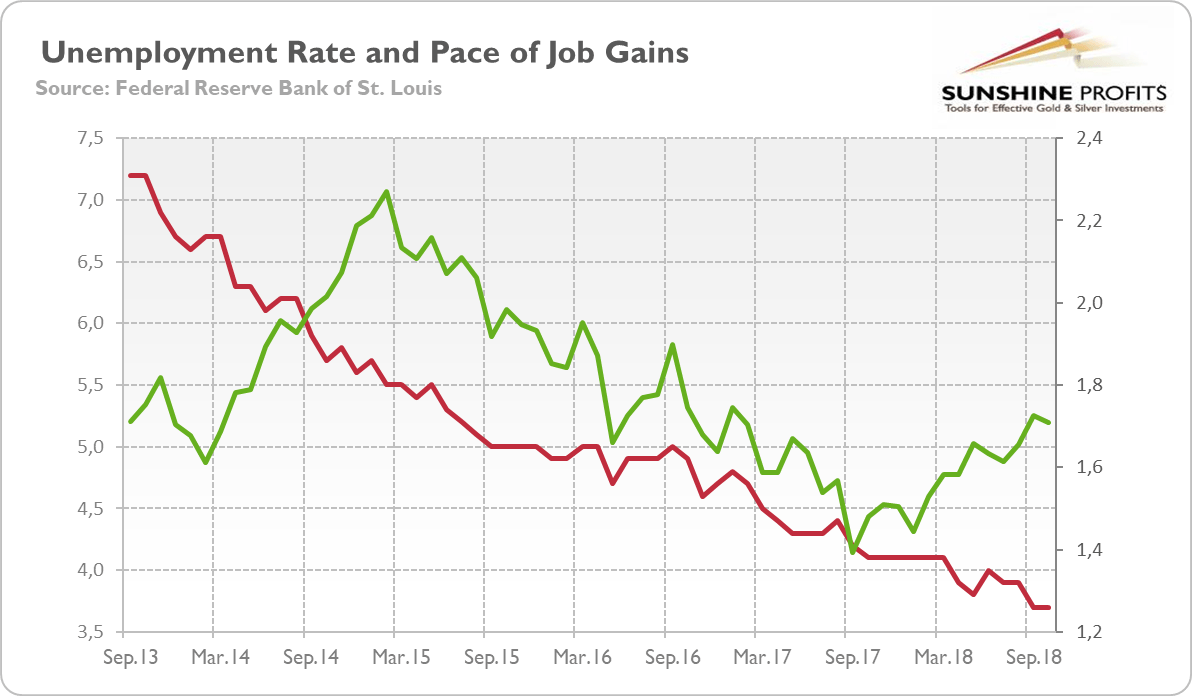
Moreover, both the labor force participation rate and the employment-population ratio increased by 0.2 percentage point, to 62.9 percent and 60.6 percent, respectively. Meanwhile, the annual pace of job creations remained positive and generally in upward trend which started in the fall of 2017, as the chart below shows. And, importantly, the strong hiring kept the unemployment rate at 3.7 percent, the lowest level in 48 years.
Chart 1: U.S. unemployment rate (red line, left axis, U-3, in %) and total nonfarm payrolls percent change from year ago (green line, right axis, % change from year ago) from September
2013 to October 2018.
Last but definitely not least, the average hourly earnings for all employees on private nonfarm payrolls rose by 5 cents to $27.30. It implies that wages increased 3.1 percent over the last twelve months. It was the fastest increase in worker pay and a first jump above 3 percent since the end of the Great Recession, as the chart below shows.
Chart 2: Average hourly earnings of all private employees (percent change from the year ago), from March 2007 to October 2018.
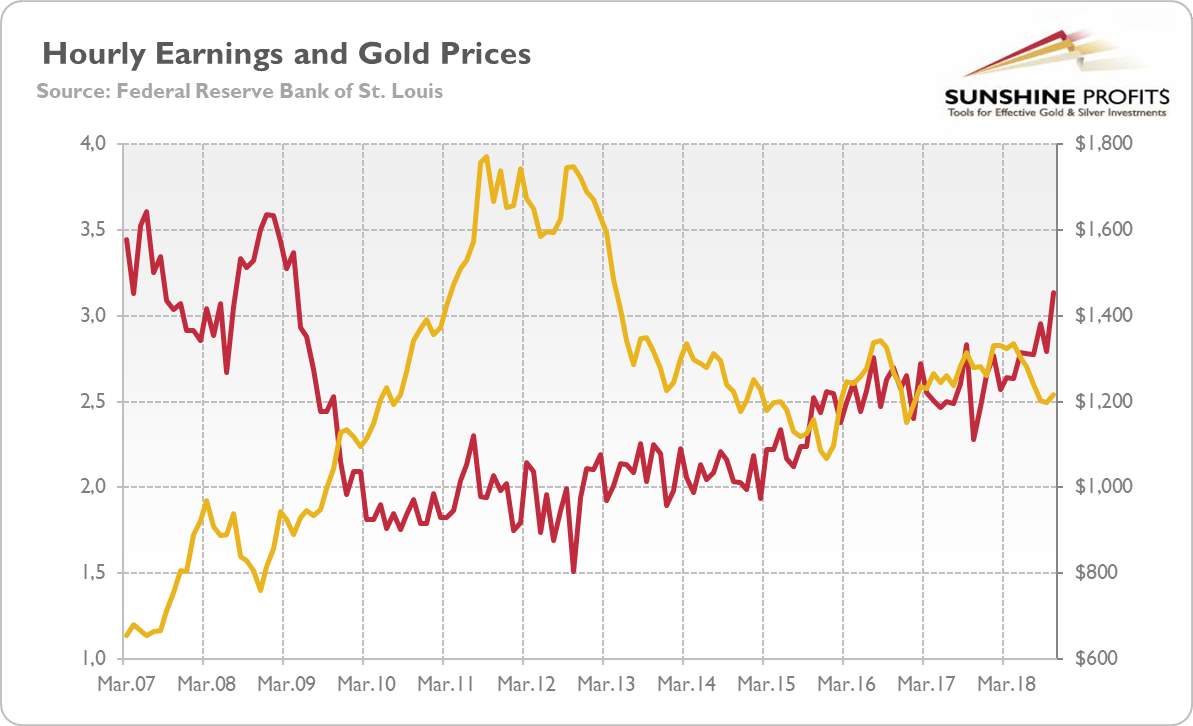
Although the jump in wages can spur some concerns about inflation, boosting the safe-haven demand for gold, we are skeptical whether the rising earnings will be fundamentally bullish for the gold market. Just look at the chart above: the price of gold soared when the wage dynamics plummeted during Global Financial Crisis. And it entered the bear market, when the wage inflation started to accelerate.
Will Strong Labor Market Helps Republicans?
Today's midterm elections mark two years since Donald Trump's shock election victory, providing a test of how the POTUS and his Republican party is faring in the eyes of the Americans. Voters are split – Trump has high disproval rating, but economy is soaring. As we have seen, the recent data indicates that the labor market is tightening. Inflation remains moderate, while the GDP is expanding at a robust 3.5 percent. In short, the economy is better and citizens' incomes are higher since the last elections.
However, the mid-term elections are not about the state of economy. They are rather a referendum on President. And here is the challenge for Republicans, because voters rate Trump lower for his overall performance than for the state of the economy. And history shows, as we have analyzed thoroughly in the latest edition of the Market Overview, that the party of incumbent president usually lose ground during mid-term elections. The strong labor market may, thus, not help the ruling party.
Hence, the consensus is that the Democratic Party will win control of the House of Representatives, while Republicans are likely to keep the Senate. As it is a widely expected outcome, it should not affect the gold market strongly. The positive surprise for the Democrats (a blue wave) could trigger an unwind of long dollar positions, which should be positive for the yellow metal (unless investors decide that the political stalemate is actually positive for the economy). But if the Republicans remain control of the both the House and Senate (a red wave), we could see selling pressure in the gold market. Actually, we could see a downward move in each scenario, as the uncertainty about the elections will be removed. Stay tuned!
Want free follow-ups to the above article and details not available to 99%+ investors? Sign up to our free newsletter today!
Author

Paul Rejczak
Gold Price Forecast
Paul Rejczak is a stock market strategist who has been known for the quality of his technical and fundamental analysis since the late nineties.