The Japanese Yen's 160 line just got its third test of the year
Japan has spent ¥27.1 trillion this year pushing the Yen away from 160.00 per US Dollar, and it is back there a third time. The interest rate gap behind the slide has barely narrowed, and the US and Japanese central banks both meet in December.
For the third time in 2026, the Japanese Yen (JPY) has weakened to 160.00 per US Dollar (USD) and drawn a warning from Tokyo. This one came from Japanese Finance Minister Satsuki Katayama, who told reporters on Friday that the moves were one-sided and too fast. In the spring and again in the summer, USD/JPY, the number of Yen one US Dollar buys, pressed on the same level until Tokyo sold Dollars to force it back.
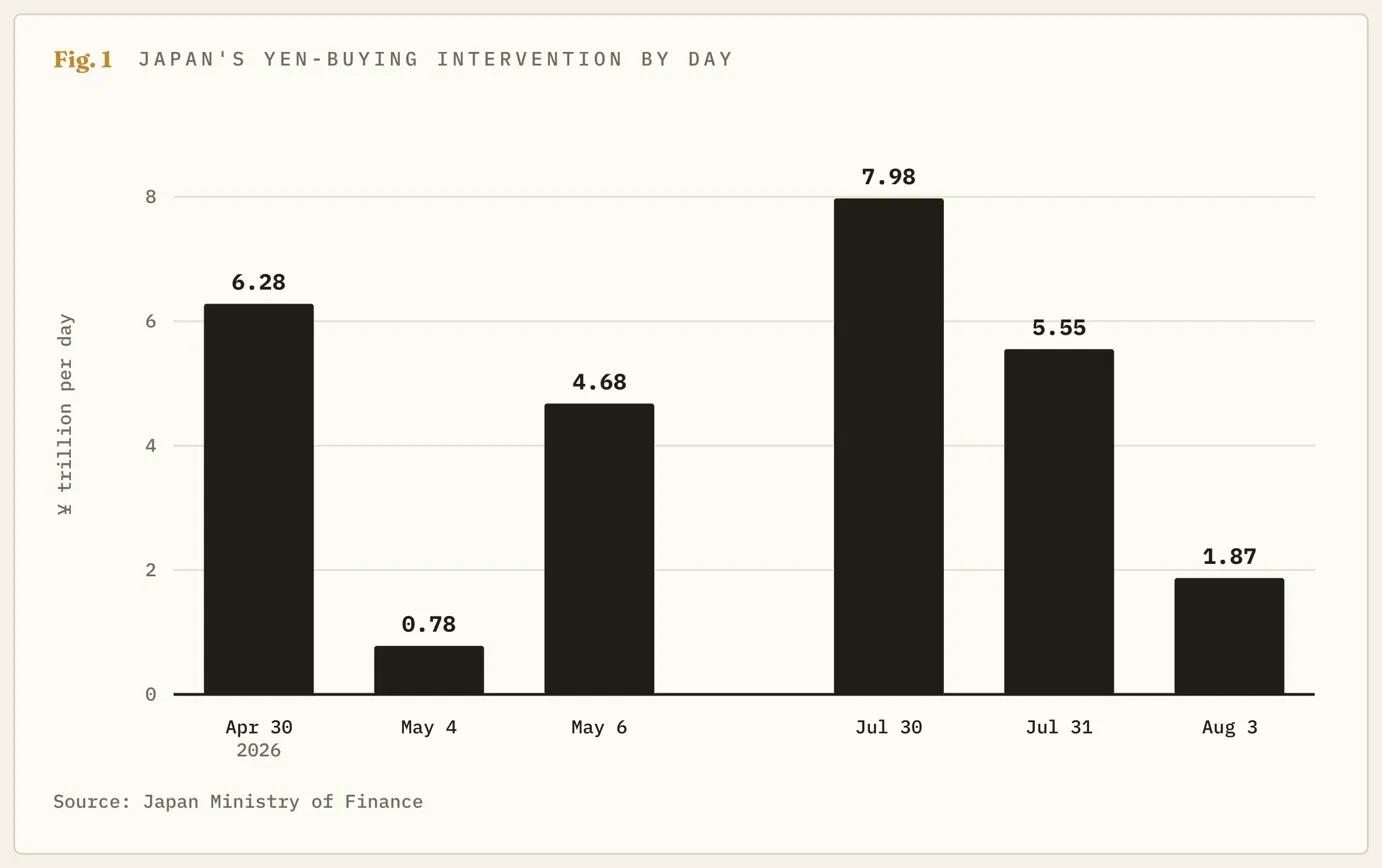
The third test arrives with the bill for the first two already published. Japan's Ministry of Finance sold Dollars on six trading days this year and set a single-day record in both rounds. The Yen is now trading at the level the ministry was defending in April. What hasn't changed is why people sell it: US interest rates are far above Japan's, and both are rising at about the same pace.
Two record rescues bought about ten weeks
The ministry answered the spring test on April 30, spending ¥6.28 trillion in a single day on what's called intervention. That means selling Dollars from the national reserves and buying Yen to push its price up. Two more days of buying brought the round to ¥11.7 trillion, and about six weeks later traders had USD/JPY above 160.00 again.
From there, the summer test went further, and the pair climbed to almost 164.00 in late July, the weakest the Yen had been in 40 years. Tokyo spent ¥15.4 trillion across three days in response, with the US Treasury buying Yen alongside it on July 31 for the first time since 1998. The Yen gained more than 5% in days, and within about a month traders had pushed the pair to 160.00 again. Bets on a Bank of Japan (BoJ) rate increase reversed that return, with no money from Tokyo.
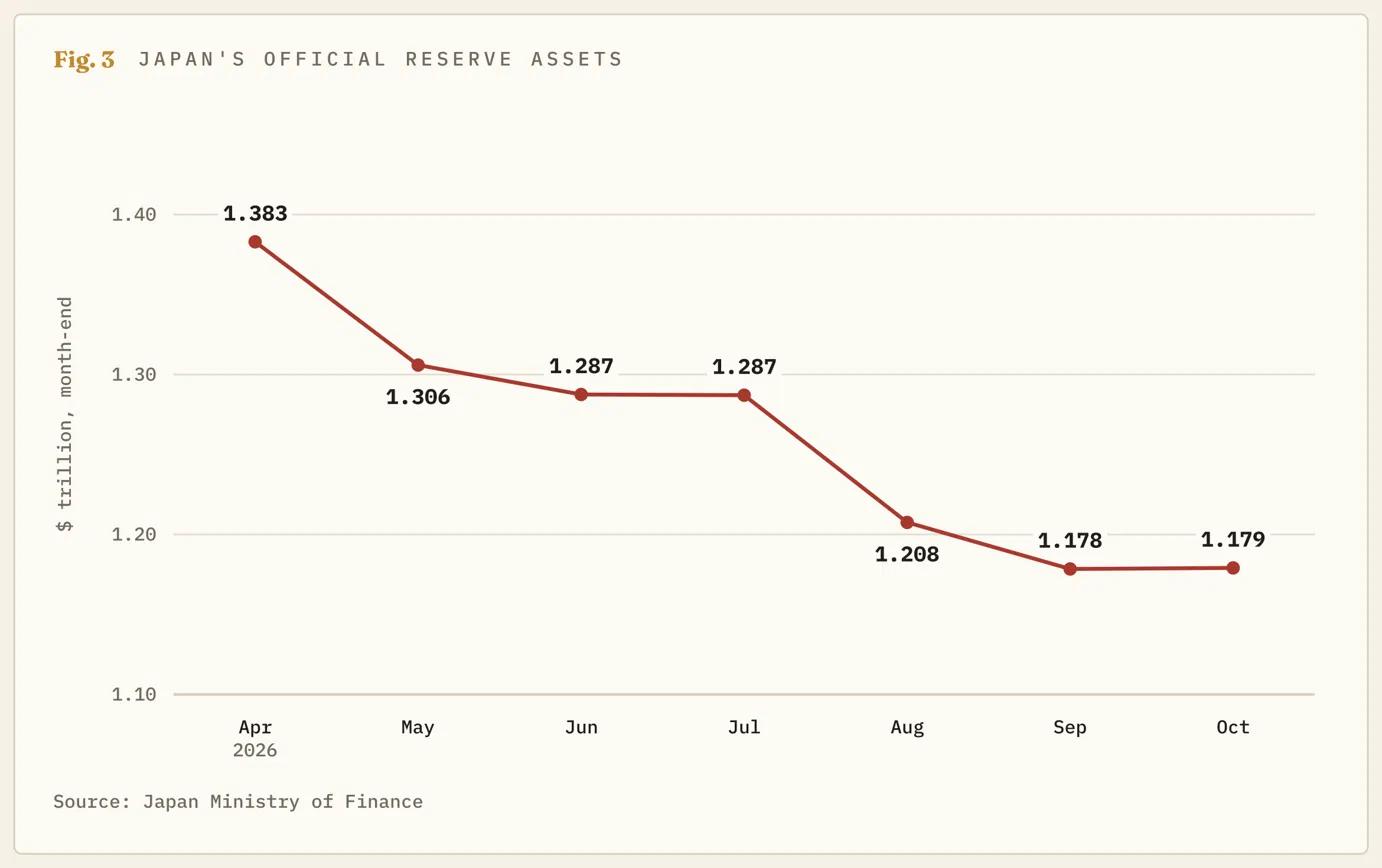
By the end of October, the reserves that paid for both rounds stood at $1.179 trillion, down $204 billion from the end of April. Some of that fall comes from US bonds in the reserves losing value as interest rates rose, though the bulk of it is intervention. Each round set a record for a day's spending, and the second bought the Yen less time than the first.
For now, the chart shows the pressure didn't start with one number. USD/JPY moved sideways around its average prices of the past 50 and 200 days from mid-September to early November. The pair's daily Stochastic Relative Strength Index (Stoch RSI), which tracks whether buying or selling is speeding up, had already turned higher before Tuesday's US inflation report sped up the move.
Japan's highest rate in 31 years narrowed the gap by a quarter-point
A currency pair mostly follows the gap between what the two countries pay on their money. An investor can borrow Yen at rates tied to the BoJ's 1.25%, swap them for Dollars and earn something close to the 3.75%-4.00% set by the Federal Reserve (Fed). While that trade pays, there is a steady supply of people selling Yen, and they come back each time the price recovers.
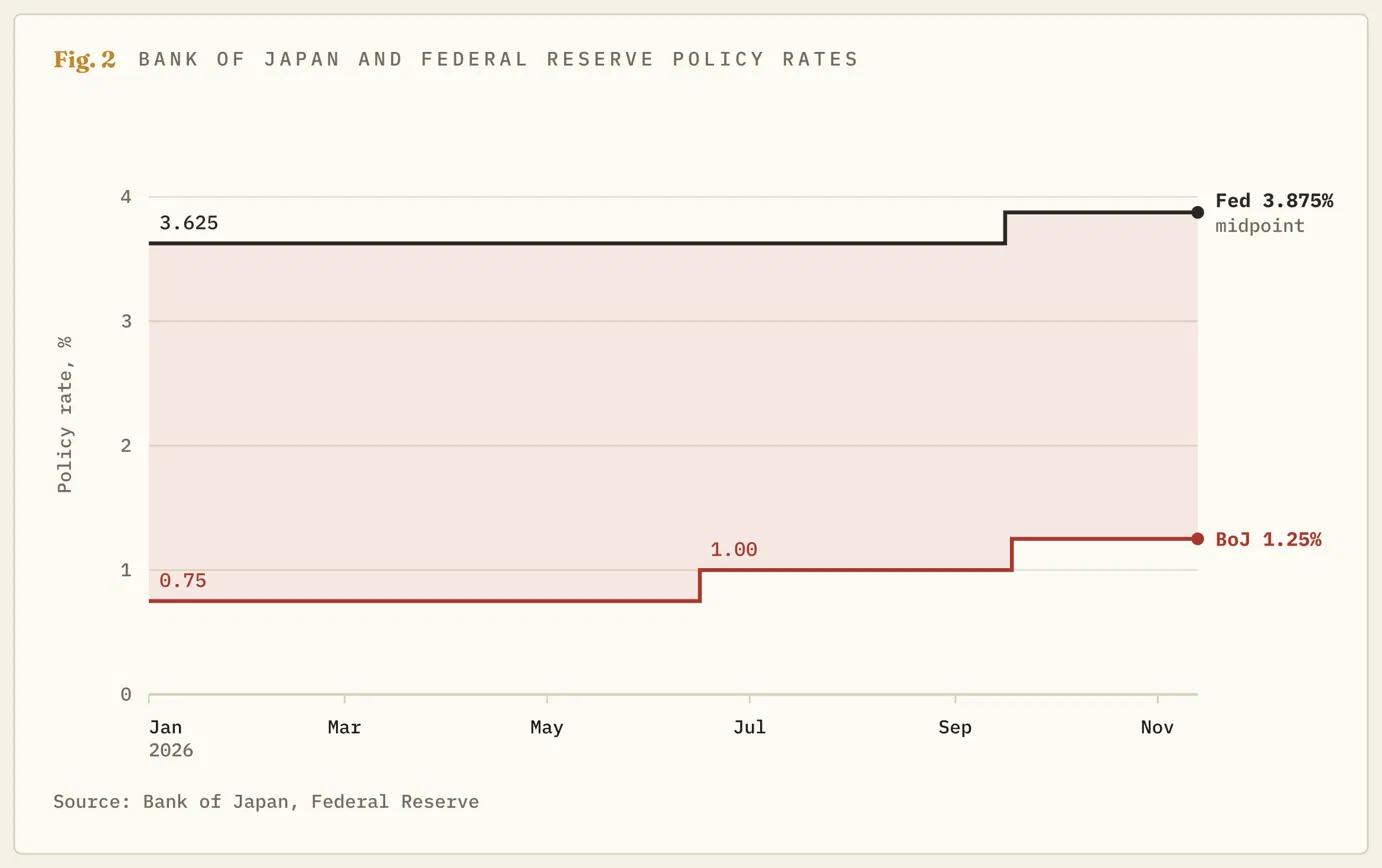
Against that trade, intervention changes the price for a few weeks and leaves the reason for selling where it was. The question for 160.00 is therefore what the two central banks have done to the gap itself. The BoJ started 2026 at 0.75% and raised its rate in June and September to 1.25%, the highest since 1995. The Fed raised its own rate once in that time, in September, for the first time in three years.
Put together, Japan's two increases and America's one have narrowed the gap by a quarter-point in eleven months. A gap that began the year just under three points is now just over two and a half. Japan's highest interest rate in 31 years has shrunk it by less than a tenth.
In December, that sum is unlikely to change, because both central banks are expected to move together. US inflation came in above forecast again on Tuesday, with the Consumer Price Index (CPI) up 0.4% in October against the 0.3% expected. Traders betting on the Fed's decision now put an increase on December 9 at 100%, and most economists polled by Reuters expect a quarter-point from the BoJ on December 18. If both deliver a quarter-point, the gap would end the year exactly where it is now.
Tokyo has $1.179 trillion and a partner who brought $500 million
The strongest case for the line holding is that Japan can afford to defend it again. A third round the size of the summer's would use less than a tenth of the reserves that are left, which are still the second-largest in the world. Traders who were betting against the Yen on July 30 lost more than 5% in a few days, and nobody wants to be caught the same way twice. That fear is already doing some of Tokyo's work, since the pair has stalled at 160.00 since Thursday, whereas in June it ran straight through.
On top of that, Finance Minister Katayama said her officials are coordinating with the US Treasury, and the two governments acted together in July. The weight of that partnership became clearer on Thursday, when the Federal Reserve Bank of New York reported the size of the US purchase. Washington bought ¥79.4 billion, or about $500 million, and paid with Euros from the Treasury's own currency reserve. Japan spent ¥15.4 trillion in the same round, so Tokyo's share of the joint operation was 99.5%.
Beyond the money, there is a limit in the ministry's own wording. Officials have never named 160.00 as a trigger and say they act against moves that are too fast, which is how its top currency official described it on Thursday. A jump through the level would likely be met with money within days. A slow drift above it is harder to call disorderly, and a slow drift suits the people selling Yen, because the rate gap pays them to wait.
December decides whether Tokyo pays a third time
The fork is the gap between the two central banks' rates once both meetings are over. Nothing about the trade against the Yen would change if the Fed raises by a quarter-point on December 9 and signals more to come, and the BoJ matches it on December 18. In that case, USD/JPY would likely keep pressing on 160.00, and a third intervention would likely buy what the first two bought, which is a few weeks.
Outside that base case, the worse branch for Tokyo is a half-point increase from the Fed, which those same traders put at roughly a one-in-eight chance. That would widen the gap for the first time this year and could force the ministry to spend into a move that US rates are still feeding. The better branch needs one of two signals, either Fed Chair Kevin Warsh raising rates and saying he'll wait, or BoJ Governor Kazuo Ueda raising and pointing to another increase early in 2027. Either signal would narrow the gap in prospect, and a narrowing in prospect is what turned the pair in September without Tokyo spending anything.
Until one of those signals arrives, the lean is that the Yen stays weak and close to 160.00, with warnings from Tokyo slowing the move more than stopping it. That view is wrong if USD/JPY falls back under its 200-day average, where it traded through October, without the ministry spending. So far, ¥27.1 trillion has bought the Yen the exchange rate it had in April.
Author

Joshua Gibson
FXStreet
Joshua joins the FXStreet team as an Economics and Finance double major from Vancouver Island University with twelve years' experience as an independent trader focusing on technical analysis.

















