Bank of Canada preview: Why trade uncertainty may matter more than interest rates

The Bank of Canada (BoC) is widely expected to leave its benchmark interest rate unchanged at 2.25% for a sixth consecutive meeting, extending what has become one of the longest pauses in the current monetary cycle.
On the surface, the decision appears straightforward. Inflation remains above the Bank’s 2% target, limiting the case for further easing, while economic growth has recovered after two consecutive quarters of contraction, reducing the need for additional stimulus. However, looking past these steady indicators reveals a more complicated reality.
Canada’s economy continues to face significant uncertainty surrounding the future of the United States-Mexico-Canada Agreement (USMCA/CUSMA). The lack of clarity over North America’s trading framework is already weighing on business investment, hiring decisions and manufacturers’ expansion plans, potentially creating a new challenge for policymakers.
With the BoC also publishing its latest Monetary Policy Report, investors will closely examine not only the interest-rate decision but also the Bank’s updated forecasts for inflation, growth and the risks stemming from international trade.
A sixth consecutive hold looks increasingly likely
According to a Reuters survey of 36 economists, every respondent expects the Bank of Canada to keep its overnight rate unchanged at 2.25%, while a Wall Street Journal survey reached the same conclusion. Most economists also believe rates will remain unchanged for the rest of the year, although opinions become more divided over 2027.
The current policy rate sits at the bottom of the Bank’s estimated neutral range of 2.25%-3.25%, following the last rate cut delivered in October. Since then, policymakers have adopted a cautious "wait-and-see" approach as they assess conflicting economic signals.
Canada technically entered a recession after GDP contracted during the final quarter of last year and again in the first quarter of 2026. However, activity rebounded more strongly than expected during the second quarter, suggesting the downturn may already be over. The labour market has also shown signs of resilience. Canada’s unemployment rate unexpectedly declined to 6.5% in June, easing concerns that the slowdown was becoming entrenched.
Inflation, however, remains the biggest obstacle to any discussion of further easing.
Headline CPI accelerated to 3.2% in May, largely driven by higher energy prices following renewed geopolitical tensions in the Middle East. Although measures of core inflation have remained relatively stable around the Bank’s target, elevated headline inflation limits policymakers’ ability to support growth through lower borrowing costs.
The upcoming Monetary Policy Report will therefore receive almost as much attention as the interest-rate decision itself. Economists expect the Bank to revise both its inflation and growth forecasts after recent oil-price volatility and continued trade uncertainty.
TD Securities strategist for Canada, Andrew Kelvin, believes the recent improvement in growth and resilient core inflation should reassure policymakers. However, he argues it would still be premature to completely dismiss the possibility of future rate cuts, given volatile economic data, easing oil prices and continued uncertainty surrounding North American trade negotiations.
USMCA uncertainty could be become a monetary policy problem
While inflation usually dominates central bank discussions, trade policy could become one of the most important drivers of Canadian monetary policy over the next year.
The Trump administration’s decision not to renew the current USMCA framework has created a prolonged period of uncertainty for businesses across North America. Although the agreement technically remains in force, annual reviews will replace the longer-term certainty companies previously relied upon when making multi-year investment decisions.
For highly integrated North American supply chains, that uncertainty matters. Nearly $2 trillion worth of goods move annually between Canada, Mexico and the United States. Many manufactured products cross borders multiple times before reaching final consumers, making predictable trade rules essential for investment planning.
While USMCA continues to shield most Canadian exports from tariffs, important industries—including automobiles, steel, aluminium and softwood lumber—remain exposed to trade restrictions. U.S. officials have also indicated that any future agreement could include permanent tariffs on some Canadian and Mexican goods rather than restoring broad duty-free access.
Businesses are already reacting. According to KPMG Canada’s latest manufacturing survey, “57% of manufacturers have paused, reduced or cancelled capital expenditure projects” because of trade uncertainty and tariff risks.
Even more concerning for Canada’s long-term growth prospects:
- 42% of manufacturers have reduced or delayed research and development spending.
- 52% say they are operating in "endurance mode."
- Four in ten manufacturers have either moved production to the United States or are considering doing so.
- 11% expect to relocate their headquarters to the U.S. within five years.
These figures help explain why Canadian business investment has now declined for five consecutive quarters, despite the recent recovery in GDP. And investment is one of the key drivers of long-term productivity growth.
When companies postpone factory expansions, technology upgrades or research spending, economic growth typically weakens over time. This creates a difficult dilemma for the Bank of Canada. Lower interest rates normally encourage borrowing and investment. However, if businesses are delaying projects because they lack confidence in future trade rules rather than because financing is expensive, monetary policy becomes less effective.
In other words, uncertainty (not interest rates) may become the main obstacle to growth.
KPMG Canada’s National Leader of Industrial Markets, Anamika Gadia, argues that manufacturers have shown remarkable resilience, but warns that businesses cannot remain in "endurance mode" indefinitely. The longer uncertainty persists, the more likely companies are to redirect future investment towards jurisdictions offering greater policy stability.
For the Bank of Canada, this means the downside risks to growth may increasingly originate from trade policy rather than domestic demand.
USD/CAD technical analysis: Bulls face key resistance
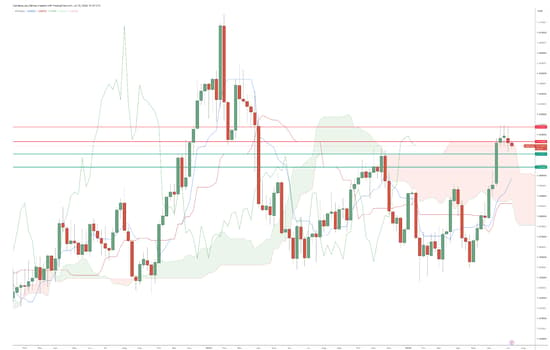
USD/CAD Weekly Chart - Source: TradingView
Based on the weekly chart, the USD/CAD pair showed an impressive recovery after finding support near 1.36 last May, with buyers pushing the pair back above the Ichimoku cloud and into a significant resistance zone. The Tenkan-sen remains above the Kijun-sen, while price continues to trade above both Ichimoku averages, reinforcing the positive outlook. However, the Forex pair is hovering at an important resistance zone: the upper part of the cloud around 1.4165.
A sustained weekly close above this level would expose the pair to the next resistance level around 1.4237 and strengthen the bullish case. It could also open the way towards the 1.44-1.45 region over the coming weeks. On the downside, a key support level is near 1.4105. Holding above this level would suggest buyers remain in control following the recent rally. A deeper pullback could push the USD/CAD towards the 1.4040 zone. A break below this zone would weaken the bullish structure and increase the likelihood of a return towards the Ichimoku cloud.
Bottom line
The Bank of Canada is widely expected to leave interest rates unchanged, but the real focus is likely to be on how policymakers assess the balance between persistent inflation and growing trade-related risks. While the recent recovery in growth and resilient labour market reduce the urgency for additional stimulus, prolonged uncertainty surrounding the future of the USMCA is increasingly weighing on business confidence, investment and long-term economic prospects. As a result, the central bank’s next policy moves may depend less on inflation alone and more on whether trade uncertainty begins to translate into a broader slowdown in Canada’s economy.
For traders, that evolving balance between domestic resilience and external risks is likely to remain the key driver of both the Canadian dollar and interest-rate expectations over the months ahead. A more hawkish tone than expected—particularly if policymakers upgrade their inflation forecasts—could support the Canadian dollar and pressure the USD/CAD lower. Conversely, if the Bank highlights growing risks from USMCA uncertainty or adopts a more cautious outlook for growth, traders may interpret this as increasing the probability of future policy easing, potentially pushing the USD/CAD closer to its recent highs.
Stay up to date with what's moving and shaking on the world's markets and never miss another important headline again! Check ActivTrades daily news and analyses here.
Author

Carolane de Palmas
ActivTrades
Carolane graduated with a Masters in Corporate Finance & Financial Markets and got the AMF Certification (Financial Markets Regulator in France). Afterward, she became an independent trader, investing mostly in European and American stocks/indices.