Australian Dollar Price Forecast: One-way road?
- AUD/USD recedes to fresh lows around the 0.6800 region on Thursday.
- The US Dollar keeps its bullish tone well in place, backed by rate hike bets.
- Consumer Inflation Expectations held steady at 5.3% in November.

The Australian Dollar (AUD) has further extended its leg lower on Thursday, this time sending AUD/USD to just below the 0.6800 contention zone for the first time since late January.
That said, spot clinched its third consecutive day of losses amid the continuation of the strong bullish performance of the US Dollar (USD), which has once again found support in rising bets for further tightening by the Federal Reserve (Fed) in December, with some investors even pencilling in the likelihood of a 50-basis-point rate raise.
Looking at the broader picture, AUD/USD remains well south of its key 200-day SMA near 0.7050, leaving it vulnerable to further losses in the near-term horizon. Meanwhile, persistently high domestic inflation in combination with the ongoing cautious stance from the Reserve Bank of Australia (RBA) seems to be failing to put a solid floor to the severe depreciation of the currency.
Australia's resilience faces an inflation test
Australia’s economy continues to compare favourably with many of its G10 peers, supported by domestic demand and positive economic growth. Persistent inflation also supports the RBA’s cautious, data-dependent policy stance.
However, business activity seems to have lost some momentum after preliminary data showed the Purchasing Managers’ Index (PMI) for Manufacturing improving marginally to 49.5 in September and easing to 47.8 when it comes to Services, from 49.6 and 51.9, respectively.
Trade data provided another positive signal after the September trade surplus widened to A$2.826 billion, adding to the A$0.184 billion surplus registered in the previous month (revised from A$0.495 billion).
Growth figures were less encouraging, however. Indeed, the Gross Domestic Product (GDP) expanded by 0.4% QoQ in the second quarter of 2026, up from 0.3%, while annual growth came in at 2.1%, down from the previous 2.5% yearly expansion.
The labour market, however, disappointed investors in September after the Unemployment Rate held steady at 4.7% (August’s print was revised higher to 4.7% from 4.6%), while the Employment Change shrunk by 39.3K, reversing August’s 29.3K increase (revised from 39.5K).
Inflation seems to have regained some impulse after the latest data showed the most-watched Trimmed Mean CPI came in at 3.7% over the last twelve months in Q3, while the headline CPI held steady at 3.9% from a year earlier.
The Melbourne Institute’s Consumer Inflation Expectations measure reinforced that trend after holding steady at 5.3% in November.
The figures leave the RBA’s inflation task incomplete. Policymakers expect inflation to return to target only in early 2028, keeping the emphasis on patience rather than an imminent policy pivot.
China's recovery is still missing a higher gear
China is providing stability for the Australian economy, but not the growth impulse that has underpinned the Australian Dollar during previous expansions. However, this situation appears to be gradually improving.
Indeed, the Chinese economy expanded by 4.5% YoY in the July-September period, while Industrial Production grew by 5.5% YoY and 5.3% YDT. In the same direction, the latest trade data showed a surplus of $133.53 billion in September, as both imports and exports posted strong gains. Reinforcing this picture, consumer spending remained solid after Retail Sales expanded by 1.1% over the last twelve months.
Pouring cold water over that optimism, business surveys offered a mixed picture: the National Bureau of Statistics (NBS) reported that both the Manufacturing PMI and the Services PMI returned to the contraction territory last month after easing to 49.3 (from 50.1) and 49.7 (from 50.2), respectively. In the opposite direction, although also showing some loss of momentum, private measures like RatingDog remained in expansionary territory, with Manufacturing at 52.0 (from 52.1) and Services at 50.8 (from 51.6).
Disinflationary pressures seem to have resumed in October, with the CPI gaining 0.7% from a year earlier (from 0.9%), while prices came in flat on a monthly basis (from a 0.2% gain). In addition, Producer Prices rose more than initially estimated by 5.7% over the previous twelve months from the 5.0% increase recorded in the previous month.
Back to the central banks’ space, the People’s Bank of China (PBoC) kept its Loan Prime Rates (LPR) unchanged at 3.00% for the one-year tenor and 3.50% for the five-year tenor, matching the broad consensus.
Taken together, the latest Chinese data offer some encouragement for Australia and the AUD, although the recovery has yet to develop the kind of momentum that could provide the currency with a more lasting and convincing boost.
RBA tightens again but is in no rush to commit
In line with initial estimates, the RBA raised its cash rate by 25 basis points to 4.85% in a 6-3 decision after sharply lifting its inflation forecasts. That said, the headline CPI is now expected to peak at 4.5% and stay above 3% until late 2027, while the Trimmed-mean inflation is forecast at 3.6% in Q4 2026, easing only gradually thereafter.
Furthermore, the central bank said price pressures were no longer confined to a few areas, with domestic capacity constraints, rents, services and durable goods all contributing, while higher fuel costs were beginning to feed through to other prices. Additionally, the AI investment boom is putting further pressure on technology-related goods and global demand.
In her usual press conference, Governor Michele Bullock said the hike was needed, although she stressed that the economy was not showing signs of cracking and that Australia was not facing a wage-price spiral.
Bullock left the next move open, as another hike may be required, but the Board wants to see how the latest hike works through the economy before deciding. For now, the RBA is accepting some weaker growth and a higher unemployment rate as the price of preventing today’s inflation from becoming tomorrow’s problem.
AUD/USD: The road higher remains difficult
Baseline outlook
A further sidelined mood should not be ruled out in the short-term horizon. In the meantime, and looking at the broader picture, the pair should face a steady chance of further declines while below the 200-day SMA around 0.7050.
The resumption of the bullish bias will likely require a strong catalyst, namely a sustained improvement in risk appetite trends or renewed and persistent weakness in the Greenback.
Upside scenario
A sustained improvement in risk appetite could help AUD/USD regain the 200-day SMA in the mid-0.7000s. Beyond that, the weekly top at 0.7140 (September 21) would emerge as the next hurdle, ahead of the 2026 peak around 0.7280 (May 6).
Downside scenario
In case bears regain control of sentiment surrounding the Aussie, there should be initial support at the November valley of 0.6797 (November 12). A breach below this level would increase the likelihood of a retest of the 2026 bottom around 0.6660 seen in January.
Downside risks persist, but options traders temper their pessimism
The Aussie remains under pressure, although the options market is showing tentative signs of easing the current bearish sentiment. That said, one-month 25-delta Risk Reversals improved to -1.284 on November 11 from -1.387 on November 6, even as AUD/USD further extended its leg lower to the mid-0.6800s.
Despite the recovery, the latest reading remains at nearly the 19th percentile of its five-year distribution, pointing to a substantial premium for downside protection.
Over the past month, AUD/USD has retreated markedly, while Risk Reversals deteriorated by 0.335 volatility points, compared with an expected decline of 0.182 based on their historical relationship with the pair. The resulting negative residual of 0.153 volatility points ranks at almost the 29th percentile of the out-of-sample distribution, suggesting that options remain defensive, although the excess bearish repricing has moderated.
In the meantime, Commodity Futures Trading Commission (CFTC) data for the week ending November 3 showed speculative net shorts at roughly 129.5K contracts, close to their most extreme levels in five years. Weak spot performance, negative options skew, and historically extended short positioning continue to favour the downside for now.
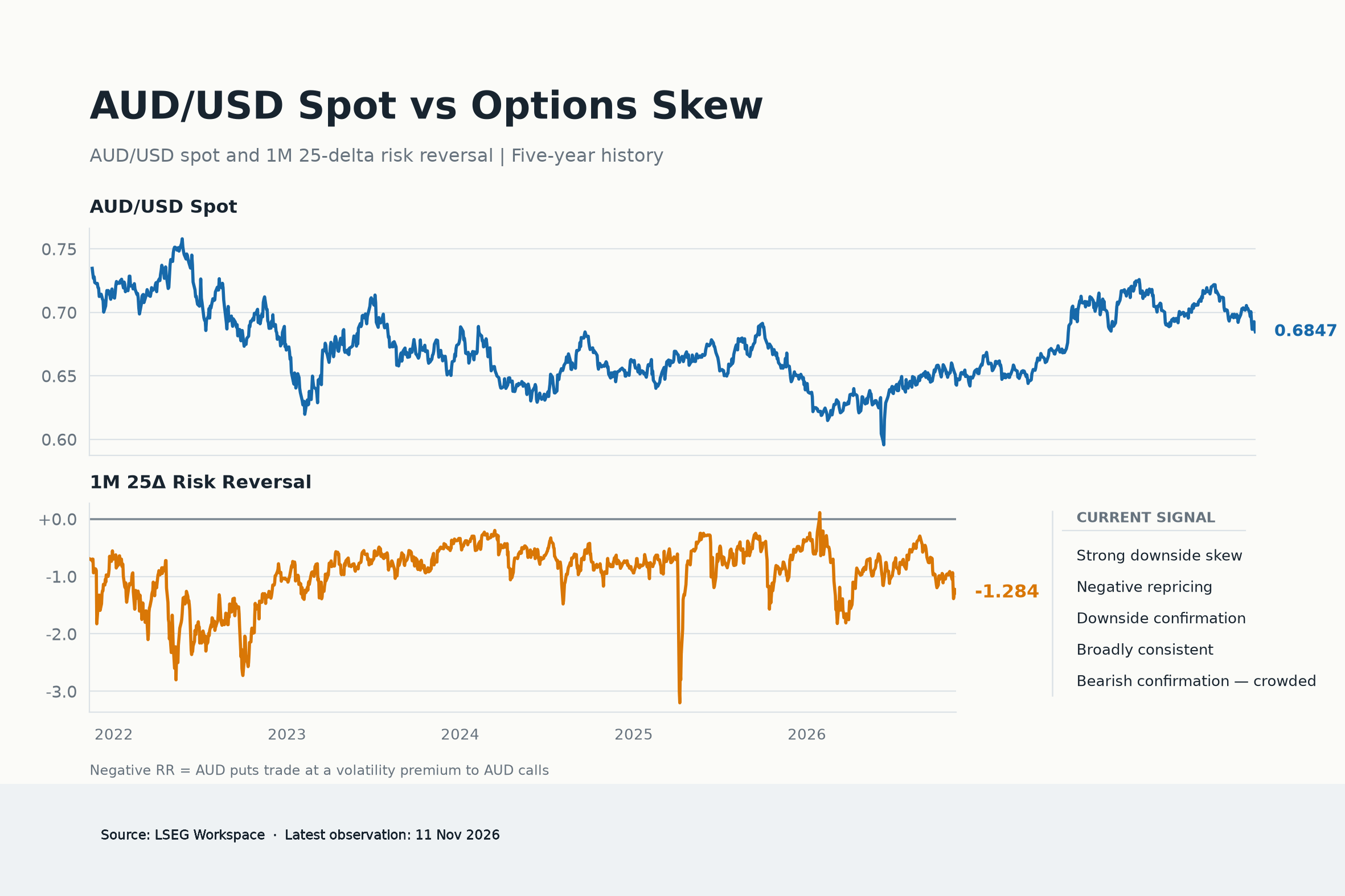
However, the recent improvement in Risk Reversals, alongside a slower pace of bearish futures positioning, suggests that selling conviction may be losing some momentum, leaving AUD vulnerable to a short-covering rebound if sentiment improves.
What’s next for the Aussie
US Dollar dynamics, global risk sentiment, and geopolitical developments remain the main near-term drivers of AUD/USD.
Next on tap on the domestic docket will be the release of the RBA Minutes on November 17. Outside Oz, the FOMC Minutes on November 18 should shed extra details to the Fed officials’ debate around the October hawkish hold.
Beyond that, the main risks are expected to emerge from China, a persistently cautious Fed, a deterioration in investor risk appetite or a change in the RBA’s current policy stance.
Any of these developments could quickly alter the outlook for the Australian currency.
Technical analysis
In the daily chart, AUD/USD trades at 0.6808, keeping a bearish near-term tone as it holds beneath the 55-day, 100-day and 200-day simple moving averages (SMAs) clustered between roughly 0.7026 and 0.7054. The latest Relative Strength Index (14) at 32.7 hovers just above oversold territory, hinting at stretched downside conditions, while the Average Directional Index (14) around 29.5 suggests a still-respectable trend that has yet to fully fade.
On the topside, immediate resistance is seen at the horizontal level of 0.6897, ahead of the group of medium- and long-term SMAs near 0.7026–0.7054, which reinforce a broader cap, with higher barriers at 0.7147, 0.7283 and 0.7661. On the downside, initial support appears at 0.6798, followed by deeper floors at 0.6660, 0.6593 and 0.6414, where sellers would likely reassess their pressure if the pair extends its slide.
(The technical analysis of this story was written with the help of an AI tool. Know more.)
Near-term outlook
In terms of the forecast, a bearish scenario for the pair appears the most favourable option, but the increasingly crowded bearish trade requires some caution.
The AUD has been supported by sticky inflation in Australia and the RBA’s desire to maintain tight monetary policy, but weakening domestic momentum, a patchy recovery in China, and ongoing demand for the US Dollar may limit any major revival.
Currently, the important dividing line is the 200-day SMA: a prolonged rebound above that level would enhance the technical picture and put the 0.7100 barrier back into focus, while further selling might expose recent lows near 0.6800.
For now, the risk balance remains skewed to the negative, with speculative shorts already at record extremes amid cooling downside risks from the options markets. However, an improvement in global mood or further weakening of the Greenback carries the potential to spark a dramatic, albeit transitory, short-covering rally.
RBA FAQs
The Reserve Bank of Australia (RBA) sets interest rates and manages monetary policy for Australia. Decisions are made by a board of governors at 11 meetings a year and ad hoc emergency meetings as required. The RBA’s primary mandate is to maintain price stability, which means an inflation rate of 2-3%, but also “..to contribute to the stability of the currency, full employment, and the economic prosperity and welfare of the Australian people.” Its main tool for achieving this is by raising or lowering interest rates. Relatively high interest rates will strengthen the Australian Dollar (AUD) and vice versa. Other RBA tools include quantitative easing and tightening.
While inflation had always traditionally been thought of as a negative factor for currencies since it lowers the value of money in general, the opposite has actually been the case in modern times with the relaxation of cross-border capital controls. Moderately higher inflation now tends to lead central banks to put up their interest rates, which in turn has the effect of attracting more capital inflows from global investors seeking a lucrative place to keep their money. This increases demand for the local currency, which in the case of Australia is the Aussie Dollar.
Macroeconomic data gauges the health of an economy and can have an impact on the value of its currency. Investors prefer to invest their capital in economies that are safe and growing rather than precarious and shrinking. Greater capital inflows increase the aggregate demand and value of the domestic currency. Classic indicators, such as GDP, Manufacturing and Services PMIs, employment, and consumer sentiment surveys can influence AUD. A strong economy may encourage the Reserve Bank of Australia to put up interest rates, also supporting AUD.
Quantitative Easing (QE) is a tool used in extreme situations when lowering interest rates is not enough to restore the flow of credit in the economy. QE is the process by which the Reserve Bank of Australia (RBA) prints Australian Dollars (AUD) for the purpose of buying assets – usually government or corporate bonds – from financial institutions, thereby providing them with much-needed liquidity. QE usually results in a weaker AUD.
Quantitative tightening (QT) is the reverse of QE. It is undertaken after QE when an economic recovery is underway and inflation starts rising. Whilst in QE the Reserve Bank of Australia (RBA) purchases government and corporate bonds from financial institutions to provide them with liquidity, in QT the RBA stops buying more assets, and stops reinvesting the principal maturing on the bonds it already holds. It would be positive (or bullish) for the Australian Dollar.
Author

Pablo Piovano
FXStreet
Born and bred in Argentina, Pablo has been carrying on with his passion for FX markets and trading since his first college years.