Copper outlook 2026/2027: Why supply growth may fail to prevent a market squeeze


The copper market is facing a somewhat contradictory development. While Chile, the world's largest copper producer, is struggling with declining production volumes, aging mines, and increasing operational difficulties, international commodity organizations expect global copper supply to improve in 2027. At the same time, mining companies are investing billions in additional production capacity, while a stronger US dollar and elevated Treasury yields have recently weighed on copper prices. But what is really behind this?
The International Copper Study Group (ICSG) forecasts a global surplus of 368,000 metric tons of refined copper for 2027. Chile's Copper Commission, Cochilco, also expects supply conditions to improve.
Both forecasts therefore point toward an improvement in the supply situation. However, the question is how reliable these expectations actually are.
A significant part of the projected production increase depends on the recovery of producing countries that already experienced considerable difficulties in 2026. In addition, the global availability of copper does not necessarily reflect supply conditions in individual regions.
For copper prices in 2027, the projected surplus itself may therefore be less important. What matters more is whether the additional supply actually materializes and whether it will be available to international consumers.
The global Copper balance points toward easing supply conditions
According to the ICSG's October forecast, global mine production is expected to increase by only 1.3% in 2026 before growth accelerates to 3.1% in 2027.
A similar development is expected for refined copper. Following production growth of only 0.4% this year, the organization expects an increase of 3.4% in 2027. Global consumption, meanwhile, is projected to grow by 2.5%.
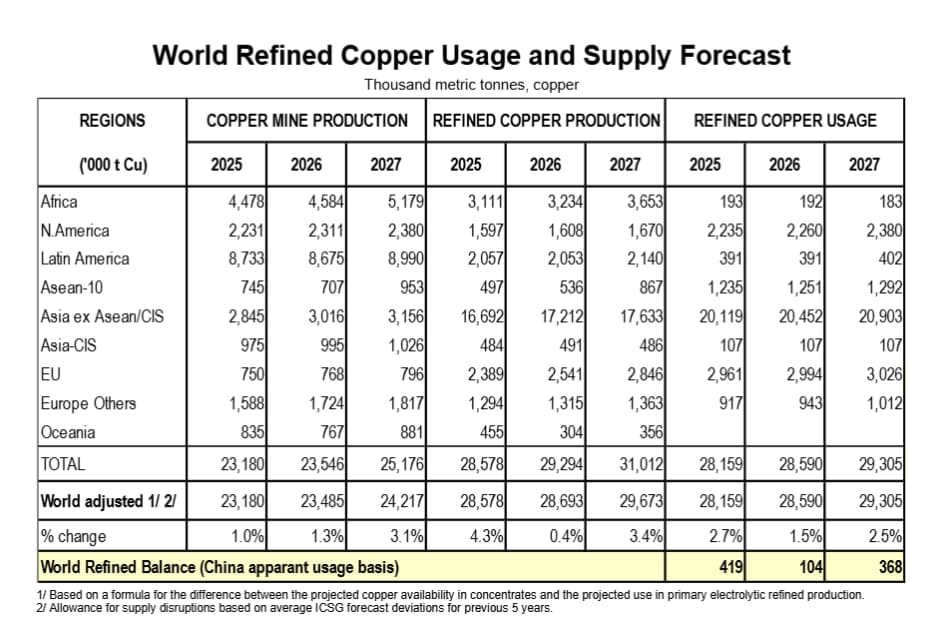
The forecast is based, among other factors, on higher production in Chile and Zambia, as well as improving operating conditions in Indonesia and the Democratic Republic of Congo. New and expanded mines, along with additional refining capacity, are also expected to contribute to improving supply.
Cochilco (Chilean Copper Commission) also expects a recovery, although its calculations are based on a different statistical framework. The organization forecasts refined copper production of 28.20 million metric tons and consumption of 27.98 million metric tons in 2027. This would result in a surplus of approximately 215,000 metric tons, equivalent to just 0.8% of expected global consumption.
Both forecasts therefore lead to a similar conclusion: The global copper market could become better supplied in 2027, although the expected surplus remains relatively small compared with total consumption.
Chile shows how difficult a recovery in mine production has become
The risks surrounding these expectations are particularly evident in Chile.
According to Cochilco, the country produced approximately 3.63 million metric tons of copper between January and September 2026. During the same period in the previous year, production was still close to 3.97 million metric tons. This represents a decline of approximately 8.5%.
More than three-quarters of the decline came from three major producers: Escondida, Codelco, and Spence.
However, the weakness in production cannot be explained solely by temporary operational disruptions.
In October, Bloomberg reported on growing structural difficulties within Chile's mining sector. Many of the country's major mines are aging, while ore grades continue to decline. As a result, larger quantities of rock must be extracted and processed to produce the same amount of copper.
Additional challenges include increasing requirements for water and energy supplies, maintenance work, and increasingly difficult geological conditions.
Extreme weather events and serious workplace accidents have further complicated the situation. At Codelco's El Teniente mine, operations were affected by accidents and weather-related disruptions. Labor disputes at other major producers also created uncertainty.
The combination of these factors is already reflected in production forecasts.
At the end of 2025, Cochilco still expected Chilean copper production to reach approximately 5.97 million metric tons in 2027. In its latest report, this forecast was reduced to around 5.08 million metric tons.
For 2026, Cochilco now expects production of approximately 4.94 million metric tons. Even the projected recovery of 3% next year would only offset roughly one-third of the production decline experienced in 2026.
Chile's copper production in 2027 would therefore remain approximately 5.7% below its 2025 level.
This is important for the global copper outlook because a recovery from a weak previous year does not necessarily mean that the structural production problems have been resolved.
The Congo adds further uncertainty to supply forecasts
Alongside Chile, the Democratic Republic of Congo plays an important role in the expected recovery of global copper production.
The Congo has become the world's second-largest copper producer. At the same time, it is one of the most important suppliers for international commodity and processing companies.
In early November, Bloomberg reported on extensive government measures against illegal copper and cobalt mining and smuggling.
Congolese authorities seized several thousand metric tons of raw materials, as well as more than 500 vehicles and machines, in the provinces of Lualaba and Haut-Katanga.
The measures also affected areas where international mining companies hold production concessions.
At first glance, this creates additional risks for commodity supply chains. Stricter controls, seized materials, and potential disruptions to illegal trading flows could put pressure on individual processing operations.
However, this does not automatically mean that total Congolese copper production will decline. Successful efforts to combat illegal mining activities could also improve the security of legitimate mines over the longer term and help stabilize legal production.
For the 2027 forecast, the real risk therefore lies less in the seizures themselves and more in the broader uncertainty surrounding the development of production capacity.
The ICSG expects operating conditions in the Congo to improve following earlier production problems. If this recovery is delayed, global mine supply could grow considerably more slowly than currently forecast.
High Copper prices encourage new investments, but with a delay
The difficulties in Chile and other producing countries stand in contrast to another development: High copper prices create economic incentives to expand production capacity.
One example is the American mining company Freeport-McMoRan.
In early November, the company announced investments of approximately $4.5 billion to expand and modernize its Bagdad mine in the US state of Arizona.
The existing mine is expected to more than double its mining and processing capacity. Over the longer term, Freeport expects annual copper production to exceed 400 million pounds.
The company's economic calculations are particularly interesting.
According to The Wall Street Journal, Freeport expects the expansion project to break even at a copper price of approximately $4 per pound. At the time of the report, copper was trading at around $6.40.
High market prices therefore improve the economic incentives for additional investments.
However, most of the $4.5 billion is not expected to be spent until between 2028 and 2030.
This highlights a fundamental characteristic of the copper market.
High copper prices can certainly increase future supply. However, the additional volumes do not necessarily become available when the market actually needs them.
China remains the most important factor for global Copper demand
As significant as production problems in individual countries may be, they do not necessarily lead to rising copper prices without sufficiently strong demand.
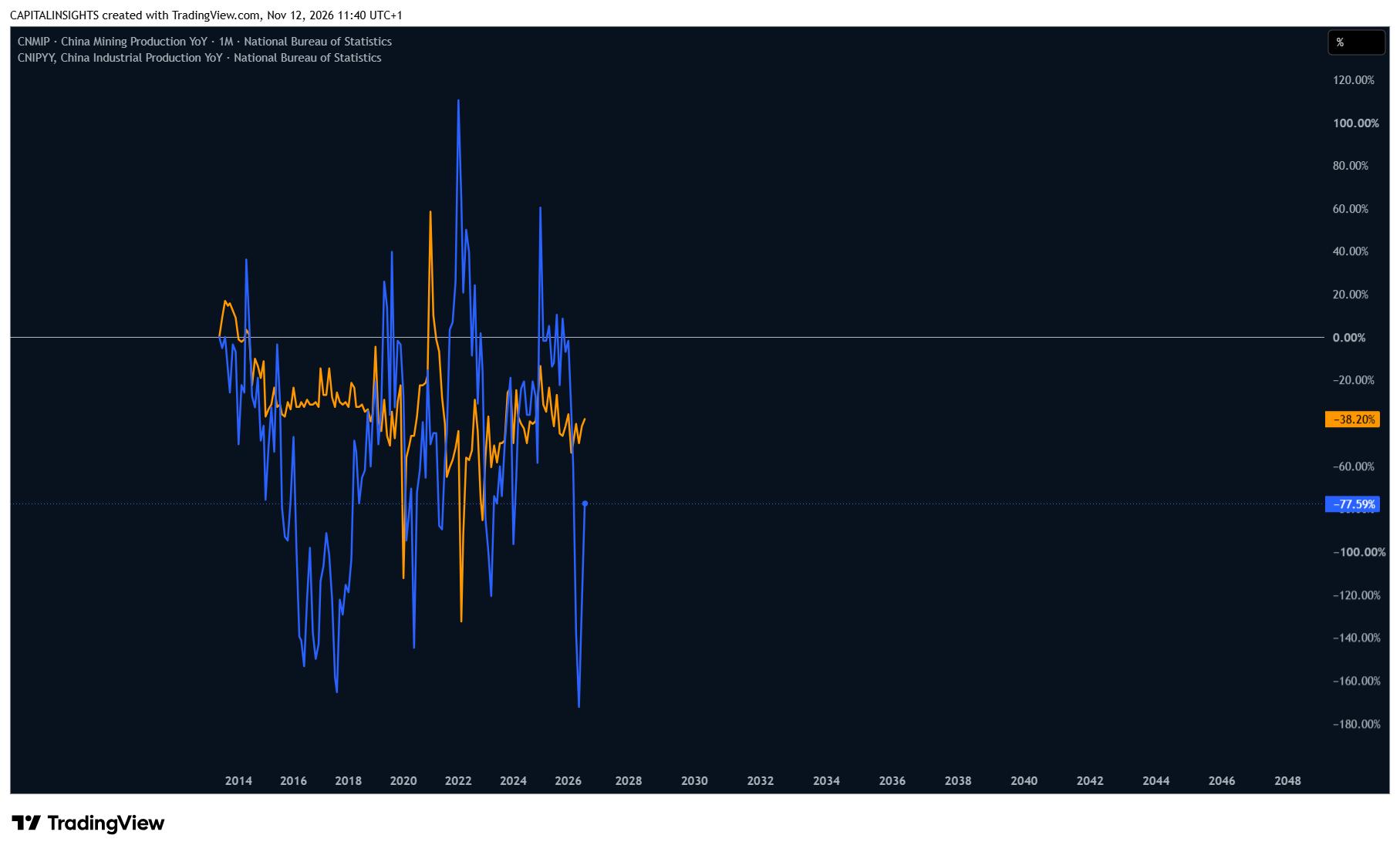
China is particularly important in this regard.
According to the ICSG, approximately 59% of global apparent refined copper consumption comes from the Chinese economy.
The organization expects Chinese consumption to grow by 2.5% in 2026.
However, the latest economic and trade data present a mixed picture.
In September, China's industrial production increased by 5.5% compared with the previous year, according to the National Bureau of Statistics.
Production of electrical machinery and equipment even recorded growth of 8.1%. In contrast, value added in the processing and smelting of non-ferrous metals declined by 5.1%.
Import statistics also show different developments.
Between January and October 2026, China imported approximately 24.14 million metric tons of copper ores and concentrates. This represents a decline of 3.8% compared with the same period in the previous year.
Imports of unwrought copper and related copper products fell by 5.5% over the same period to approximately 4.21 million metric tons.
These figures could indicate a slowdown in certain parts of the copper-processing industry.
However, the declines must be considered in the context of the supply problems already discussed.
If Chile produces fewer copper concentrates while Chinese smelters simultaneously face high costs or insufficient raw material availability, declining import volumes may also be driven by supply constraints.
Furthermore, a distinction must be made between import demand, refined copper consumption, and actual end-use demand from Chinese industry.
For the 2027 outlook, it therefore remains uncertain whether investments in power grids, electric mobility, and digital infrastructure can offset weakness in other industrial sectors.
Slower growth in Chinese demand could increase the expected global supply surplus. A stronger industrial recovery, on the other hand, would absorb additional volumes and tighten the market balance.
Why a global surplus does not guarantee equal supply availability
In October 2026, approximately 69% of global copper inventories, equivalent to around 726,000 metric tons, were stored in the United States, while significantly less copper was available in London and Shanghai.
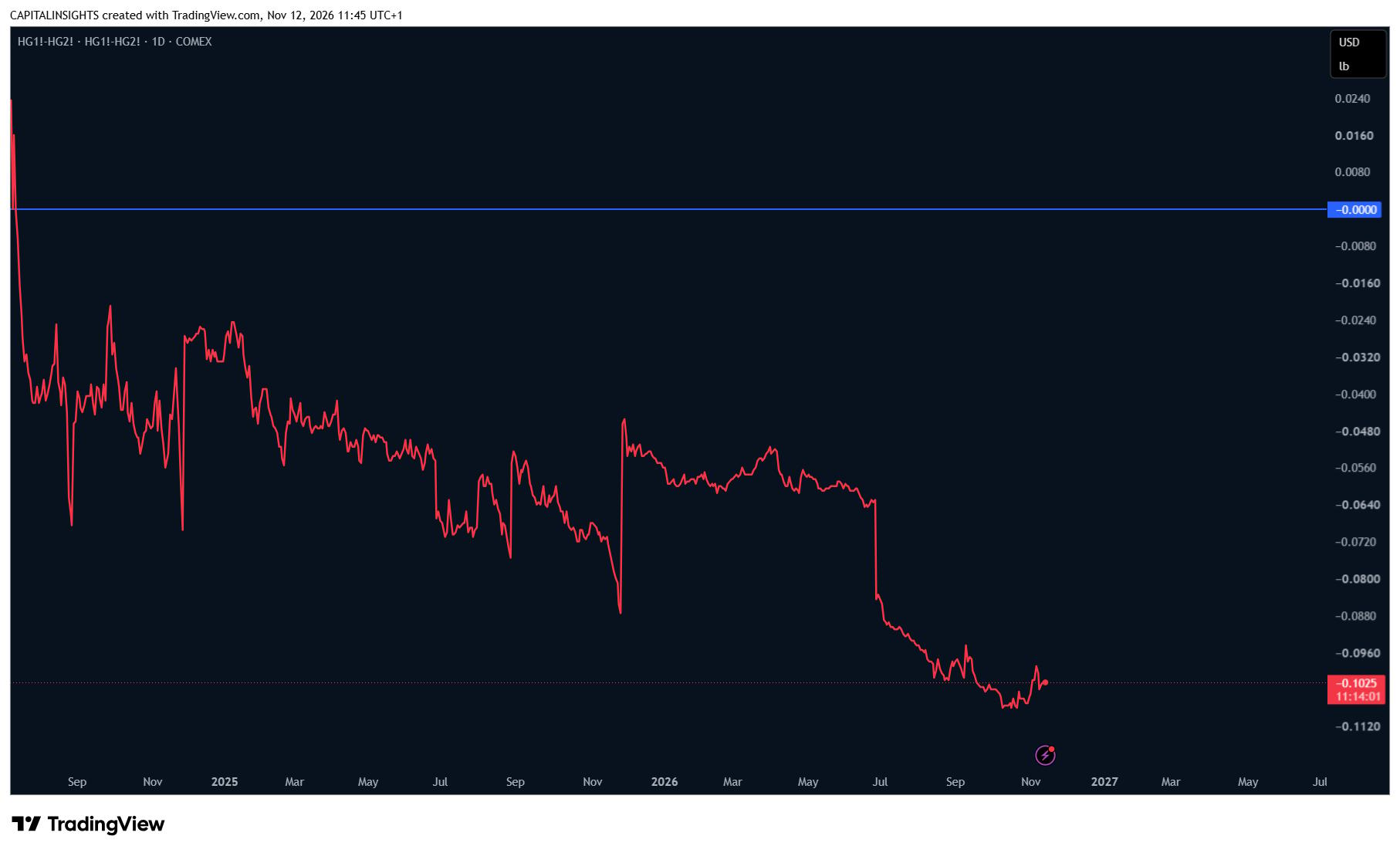
This uneven distribution created contrasting pricing conditions across the exchanges:
- In the United States, the market is in contango: Because inventories are high, copper available for immediate delivery is cheaper than copper delivered in the future.
- In London, the market is in backwardation: Because less copper is available locally, buyers must pay a premium for immediate delivery.
- Reasons for the bottleneck: High transportation costs and uncertainty surrounding US trade tariffs prevent surplus copper from being easily transferred from the United States to other regions.
Higher US Yields and a stronger Dollar are changing pricing conditions
While structural supply risks remain, the macroeconomic environment for copper has recently deteriorated.
A stronger US dollar and higher US interest rates have recently put significant pressure on copper prices. On November 12, the price fell to approximately $6.21 per pound as the dollar strengthened and US Treasury bonds once again offered yields of around 5%.
A stronger dollar makes copper more expensive for international buyers, while high interest rates increase the costs of inventory storage and new construction projects.
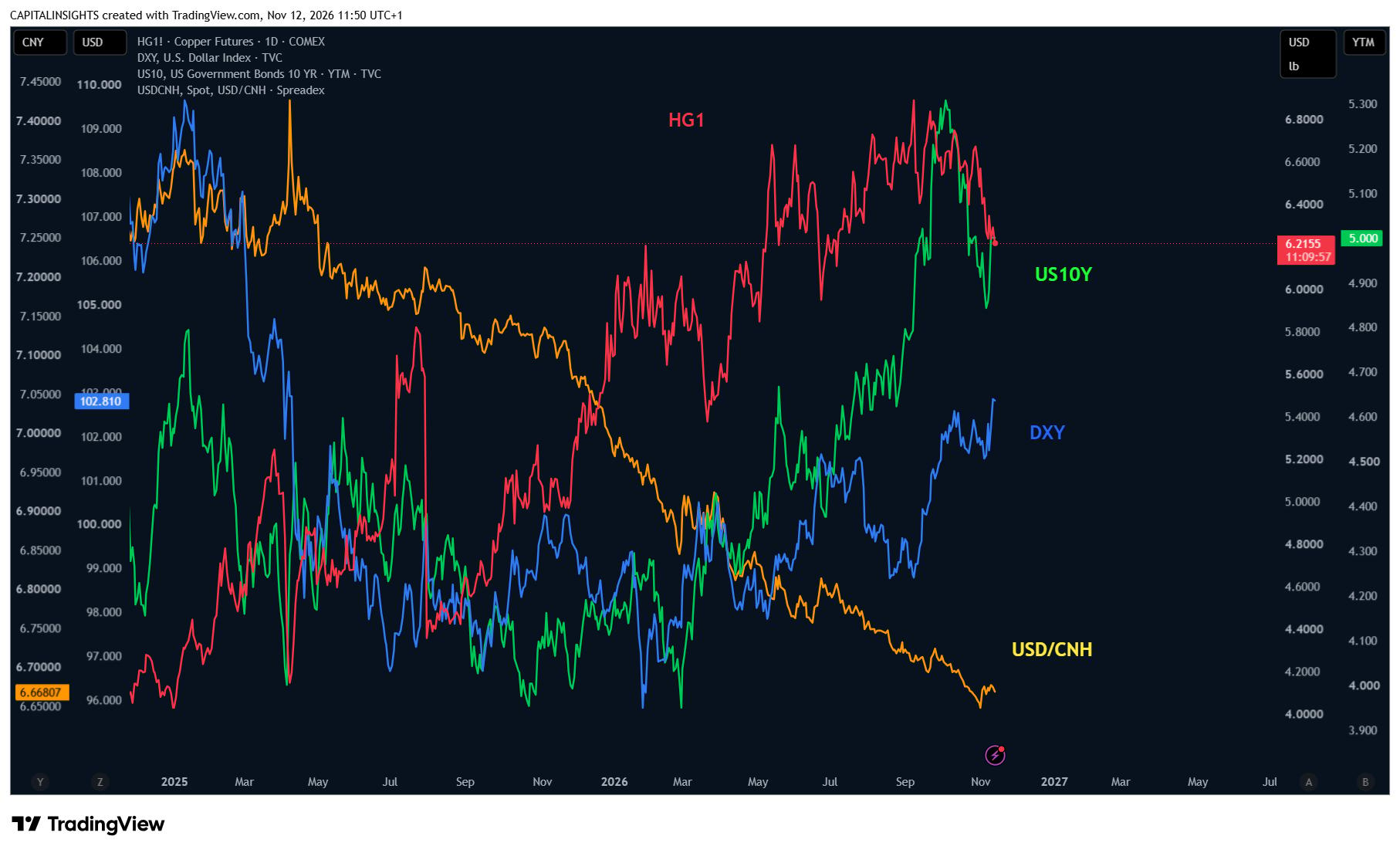
How long this pressure continues will now depend on the economy. If interest rates rise because of strong economic growth, higher industrial demand could offset some of the pressure. However, if the economy weakens despite elevated interest rates, copper prices could face even stronger headwinds.
Another important factor is the development of the Chinese yuan.
Since mid-2025, the yuan has appreciated significantly against the US dollar. The USD/CNH exchange rate declined from approximately 7.25 to around 6.67.
In principle, yuan appreciation improves the purchasing power of Chinese companies when dollar-denominated commodity prices remain unchanged. Recently, however, the appreciation has slowed, while the broader US Dollar Index has risen again.
Overall, financial conditions for copper appear less supportive in the short term than during earlier phases of the rally.
These developments do not fully explain the price movement, but they increase the risk that weaker demand or rising inventories could trigger stronger market reactions.
How sensitive is the expected Copper surplus for 2027?
The projected global copper surplus of approximately 368,000 metric tons for 2027 provides only a very limited buffer against fluctuations. According to the ICSG forecast, production of approximately 29.67 million metric tons is expected to be matched against consumption of 29.31 million metric tons.
Even small deviations in these enormous volumes could almost completely eliminate the expected surplus.
If production declines by just 1%, or if global demand increases by 1%, the surplus would shrink to approximately 71,000–75,000 metric tons.
Although recycling and existing inventories can partially offset smaller disruptions in mining production, this still leaves very little room for unexpected changes in supply or consumption.
The same calculation applies to the demand side. If global consumption in 2027 turns out to be 1% higher than the ICSG expects, the theoretical surplus would decline to approximately 75,000 metric tons, assuming production remains unchanged.
These calculations are not independent production or consumption forecasts. They merely illustrate how sensitive the market balance is to deviations from current expectations.
It is also important to recognize that disruptions in mine production do not automatically lead to an equivalent decline in refined copper production. Recycling, existing concentrate inventories, and changes in processing activity can offset part of these disruptions.
What does this mean for Copper mining stocks?
A potential trend reversal is also emerging in copper mining stocks.
The Global X Copper Miners ETF (COPX) is showing signs of stabilization around the $70 level. If the price manages to remain sustainably above $75, a further move toward $80 could become possible.
However, these developments in the options market are not a guarantee of a genuine recovery in copper prices.
For individual mining stocks, what ultimately matters is how much profit the companies actually generate. Even when copper can be sold at high prices, lower production volumes or rising energy and processing costs can reduce profitability.
This is why individual mining stocks often perform very differently and must be evaluated separately from the underlying copper price.
Another factor is the major options expiration on November 20, 2026. According to the reports, approximately 70,000 call options are expected to expire on that date.
Large expiration dates like this can often act as price magnets and may generate considerable short-term movement in COPX.
Fundamental copper analysis and the valuation of copper mining stocks should therefore be treated separately.
Copper outlook 2027: More supply, but a market that remains vulnerable
Based on the available data, I consider a gradual improvement in global copper supply in 2027 to be the most plausible base case.
Both the ICSG and Cochilco expect a supply surplus. The announced expansions of existing mines and the recovery of individual production sites provide reasonable arguments supporting this expectation.
At the same time, repeated downward revisions to Chilean production forecasts suggest that the speed of this recovery should not be overestimated.
This leads to a cautious assessment of future price developments.
An improvement in global supply could ease the exceptional price pressure experienced in recent years. The combination of a stronger dollar, elevated financing costs, and mixed signals from Chinese demand also argues against assuming an uninterrupted copper rally in the short term.
Cochilco also expects some price normalization, forecasting an average copper price of $5.95 per pound for 2027, compared with $6.18 in 2026.
However, the supply situation remains sensitive to further disruptions.
If production increases in Chile, Indonesia, or the Congo fall short of expectations while Chinese demand stabilizes, the global surplus could be significantly smaller than currently projected.
Under such a scenario, renewed price increases and persistently high regional delivery premiums would be plausible.
The opposing argument is equally important.
If production capacity returns as planned, Chinese industrial demand grows more slowly, and international copper inventories become more evenly distributed, the copper market could ease more significantly than currently expected.
For the coming quarters, three developments will therefore be particularly important: Actual production volumes from major producers, Chinese refined copper consumption, and changes in physical inventories, including regional delivery premiums.
Author