|

Australian Dollar falls after jobs report

The Australian dollar is lower for a fifth straight trading day. In the European session, AUD/USD is trading at 0.6467, down 0.27% on the day. The Australian dollar has been a dreadful slide and has plunged 6.4% since Oct. 1.

Australia’s employment decelerates

Australian’s employment report in October was lukewarm. Employment increased by 15.9 thousand, down from 61.3 thousand in September and shy of the market estimate of 25 thousand. The unemployment rate remained unchanged at 4.1%. The labor market remains in solid shape despite sticky inflation and high interest rates which have dampened economic activity.

Overshadowed by the employment report, inflation expectations dropped to 3.8% in November from 4% in October. This was the lowest level since October 2021. This drop is reflective of the downswing in inflation, which dropped to 2.8% in the third quarter, the lowest level in 14 quarters.

The Reserve Bank of Australia has held its cash rate for 4.35% for eight straight meetings. The RBA noted at its November meeting that headline inflation has declined considerably but that underlying inflation remains too high. The RBA holds its final meeting of the year on Dec. 10 and is widely expected to maintain rates, which means that a long-awaited initial rate cut will have to wait until 2025.

In the US, the October consumer inflation report showed a gain of 2.6% y/y, up from 2.4% in September. The Federal Reserve isn’t too worried that inflation has accelerated for the first time in seven months, as the inflation’s path isn’t expected to be always smooth. The Fed is widely expected to lower rates by a quarter-point at the December meeting and continue trimming in 2025.

AUD/USD technical

  • AUD/USD is testing support at 0.6462. Below, there is support at 0.6438.

  • 0.6504 and 0.6528 are the next resistance lines.
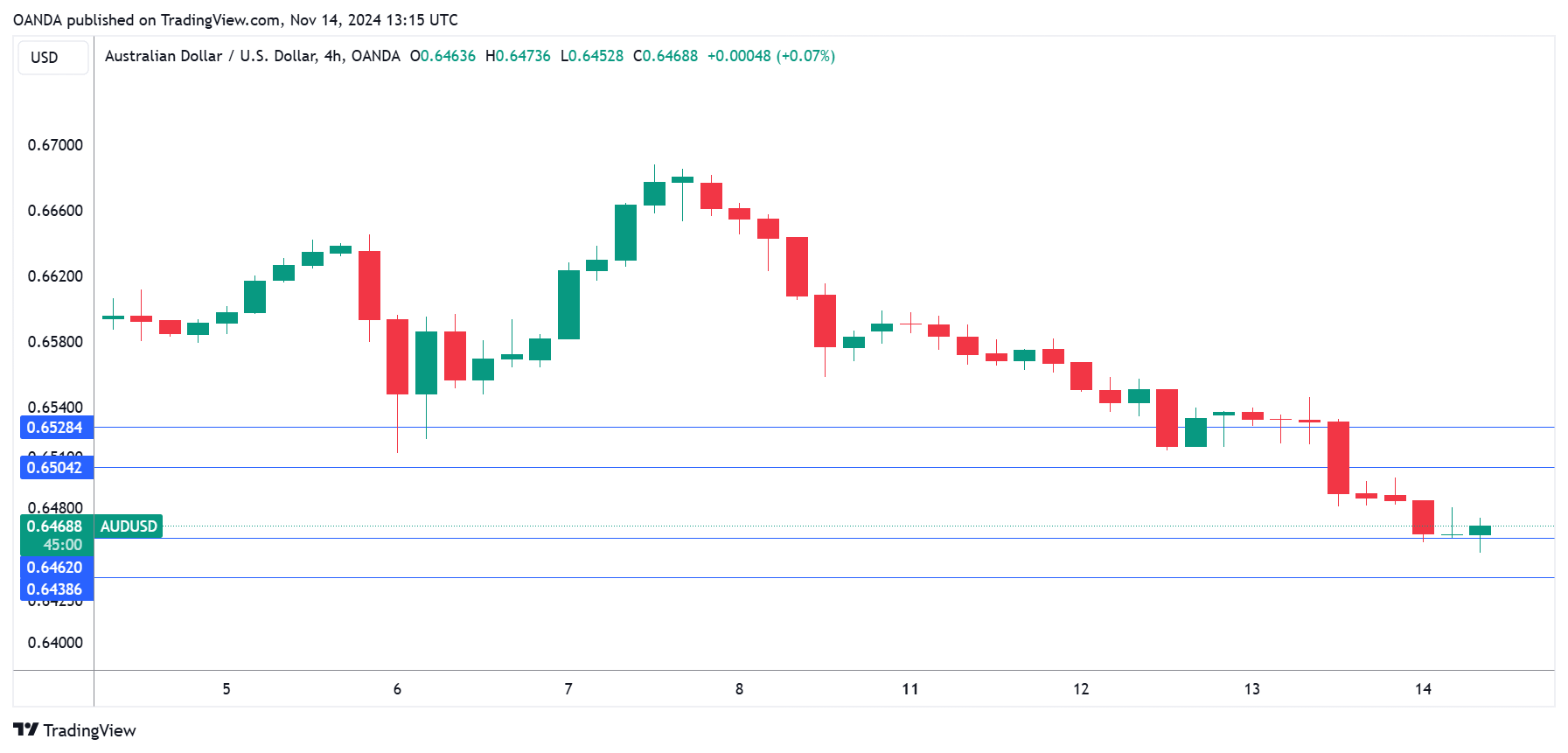
Chart

Author

Kenny Fisher

Kenny Fisher

MarketPulse

A highly experienced financial market analyst with a focus on fundamental analysis, Kenneth Fisher’s daily commentary covers a broad range of markets including forex, equities and commodities.


More from Kenny Fisher
Share:

Editor's Picks

GBP/USD bounces off four-day lows, still below 1.3500

GBP/USD sticks to the bearish tone on Thursday, coming down to the 1.3480 region in the latter part of the NA session. In the meantime, Cable’s weakness comes as investors continue to assess mixed UK data, poor US results, and the persistent uncertainty surrounding the US-Iran conflict.

EUR/USD looks apathetic around 1.1530

EUR/USD reverses Wednesday’s downtick and trades with modest gains in the 1.1530 region following the end of the NA session on Thursday. The pair’s tepid advance comes on the back of the absence of clear direction in the US Dollar despite tensions from the Middle East appear far from alleviated. Later on Friday, investors are expected to monitor the the releases of another revision of GDP figures in the Euroland, US Retail Sales and the preliminary U-Mich gauge.

Gold remains on the defensive below $4,350; downside seems cushioned

Gold trades below $4,350 during the Asian session on Friday and looks to extend the previous day's pullback from the highest level since June 5 as the US-Iran standoff continues to underpin the US Dollar's reserve-currency status. However, reduced bets for an immediate Fed rate hike, amid signs of cooling US inflation, should act as a tailwind for the non-yielding bullion and help limit deeper losses.

Dogecoin reclaims $0.07 support as whales step in
Dogecoin (DOGE) edges above the daily open, trading above $0.070 as of Thursday. While this uptick offers a positive signal, DOGE continues to trade within a broader bearish context, down approximately 12% from its July peak of $0.079. Still, should the $0.070 support level hold, the mild recovery could gather pace, targeting resistance at $0.080 and potentially the key $0.100 threshold.
Why credit markets aren’t pricing $570B of AI debt

Forecasts put global artificial intelligence related debt issuance near $570 billion this year, with roughly $236 billion of it priced by the end of May at four times the prior year's pace. Data centre securitisation alone has gone from about $4 billion a year through 2022 to roughly $10 billion in each of 2023 and 2024, and then $27 billion in 2025.

Why is Crude Oil priced for a reopening the ships haven't made?
Fourteen vessels crossed the Strait of Hormuz on Tuesday. Before the war, the count ran near 120 a day. In the sessions since the waterway was publicly declared open, Brent has drifted back to $87 and West Texas Intermediate (WTI) to $81, both a little lower again on Wednesday, with daily momentum on each unwound from the top of its range in late July to the low twenties now.