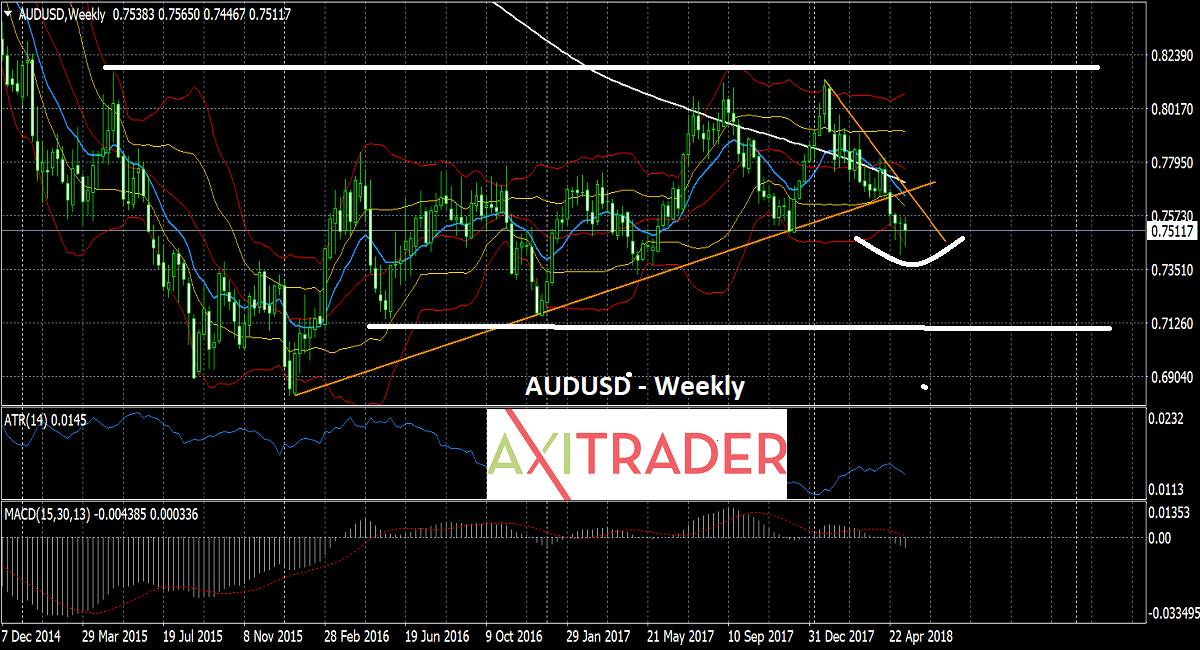
Aussie dollar holds on to .75 cents level despite USD strength


The Aussie dollar is lower this morning but holding 75 cents for the moment after base metals helped it outperform most of the other majors in the past 24 hours.
It does, however, remain under pressure
The source of that pressure was rising bond rates again as Europe entered the fray yesterday afternoon. But the pressure was reinforced by last night's data flow in the United States - Philly Fed and Jobless claims - which show the US Fed is on track to hike rates at least twice but more likely 3 times in June, September, and December this year.
While readers know I've been on the 4 hikes in 2018 train for some time, it seems last night's data saw a subtle but important change in market pricing with the chance of 3 more hikes in 2018 beating out 2 for the first time.
And as I've written many times and again today, this move in rates and the strength of the US economy which appears to be underlying it will continue to drive the US dollar's strength.
That's having most resonance against emerging market currencies at the moment particularly those with high US dollar denominated debt loads and current account issues.
But, as we've seen in the Euro, GBP, Aussie, NZD, and Yen recently the USD's march is sweeping most currencies aside at the moment.
The Aussie is not different.
Indeed, last night Morgan Stanley put out some research saying the Kiwi, Aussie and CAD are going to continue to be pressured. “There's a broad basket of highly levered household sectors, which include Australia, New Zealand, Canada and Sweden, which will all be negatively impacted by Fed tightening,” the bank said.
That’s essentially the theme I’ve been talking about for a while now - that is policy divergence is back, and it matters.
It's the counterbalance to the fact that mining and metals shares are outperforming the broader index at the moment.
So, while the outperformance of Mining and Metals shares relative to the total MSCI world index recently tells us a lot about where real money investors are putting their cash to work and as such gives an insight that while the Aussie is still suffering from concerns about the domestic economy and interest rate spreads moving in the USD’s favour, there are areas of demand which may still persist or emerge.
Indeed, as I wrote the fact that copper and base metals are a little higher suggests the Aussie might continue to outperform on the crosses.
On the day 0.7590, then 75, then 45 are important while resistance is 0.7520, 35 and then 60/66.
Author
Gregory McKenna
GO Markets
Greg McKenna has been working in and around financial markets since 1988.