AUD/USD Forecast: Weakness remains unabated so far
- AUD/USD dropped to six-week lows near 0.6530.
- Mixed Chinese data releases weighed on AUD.
- Markets’ attention now shifts to the Australian jobs report.

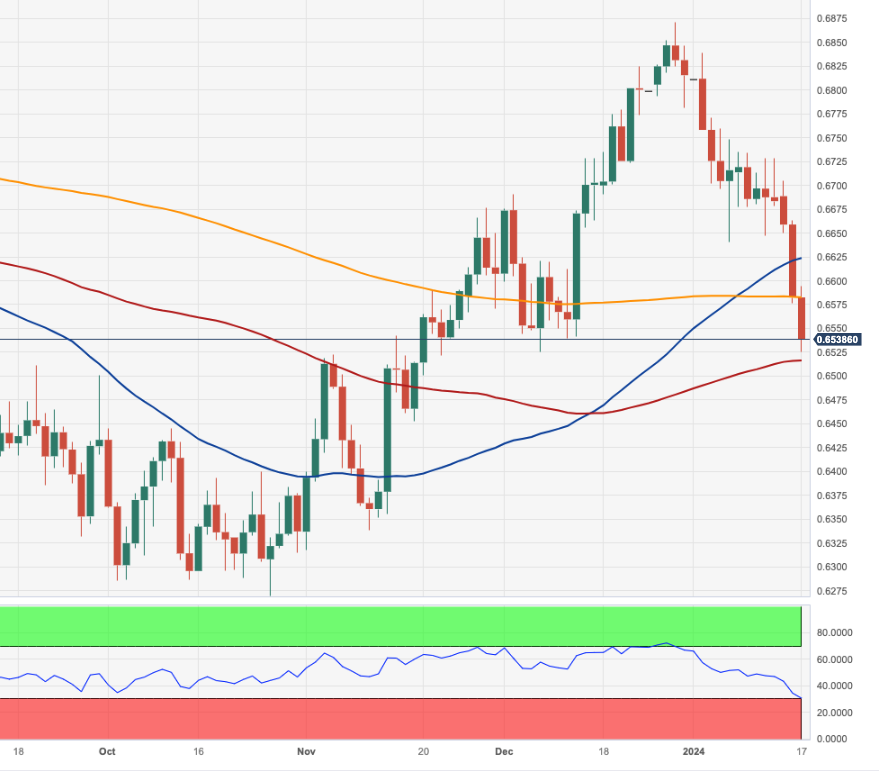
Sellers continued to exert control during Wednesday’s session, prompting a retreat of AUD/USD to the low-0.6500s, marking six-week lows. This further extends the recent breach of the critical 200-day SMA (0.6581).
In light of the ongoing price action, the pair fully faded the rally seen in the second half of December, while the recent break below the 200-day SMA leaves the door wide open to further retracements in the short-term horizon.
Wednesday’s bearish developments around the Aussie dollar followed disheartening prints from the Chinese economy for the month of December released during early trade, where the GDP Growth Rate expanded below consensus by 5.2% in the October-December period, the Unemployment Rate ticked higher to 5.1%, Retail Sales increased less than predicted by 7.4%, and the House Price Index contracted 0.4% vs. the same month of 2022. On a brighter note, Industrial Production expanded 6.8% YoY.
Adding to the persevering sour mood around the high-beta currency emerged another positive session in the greenback, which remained propped up by shrinking speculation of an interest rate cut in March.
In the meantime, market participants are anticipated to assess the forthcoming release of the labour market report in Australia on January 18 in relation to the ongoing speculation surrounding the RBA’s stance at its February event. On this, market chatter around the likelihood that the RBA could keep rates unchanged next month has been underpinned by the recent lower-than-expected inflation figures in the country, as indicated by the Monthly CPI Indicator for December.
AUD/USD daily chart
AUD/USD short-term technical outlook
The AUD/USD pair hit a new 2024 low of 0.6534 on January 17. A further decline might see the December 2023 level of 0.6525 (December 7) retested before the transitory 100-day SMA at 0.6512. Further deterioration of the outlook should cause the pair to attempt to move to the 2023 bottom of 0.6270 (October 26). If bulls take control, the focus will turn to the December 2023 high of 0.6871 (December 28), which comes before the July 2023 top of 0.6894 (July 14) and the June peak of 0.6899 (June 16), all of which are prior to the important 0.7000 mark.
The negative tone appears to be exacerbated on the 4-hour chart. In fact, the breach of the year-to-date lows opens up the possibility of a move to 0.6525 and 0.6452. The MACD deepens into the negative zone, while the RSI hovers around 23, opening the door to more losses in the near term. The bullish trend, on the other hand, may face first resistance around the 200-SMA at 0.6687, followed by the 100-SMA at 0.6732, which is regarded as the final line of defense before the previous high at 0.6870.
Author

Pablo Piovano
FXStreet
Born and bred in Argentina, Pablo has been carrying on with his passion for FX markets and trading since his first college years.