AUD/USD Forecast: Post-RBA breakdown favours bearish traders on the back of sustained USD buying
- AUD/USD drops to a fresh YTD low and is weighed down by a combination of factors.
- The RBA decided to leave interest rates unchanged for the fourth successive month.
- Hawkish Fed, elevated US bond yields and the risk-off mood underpin the Greenback.


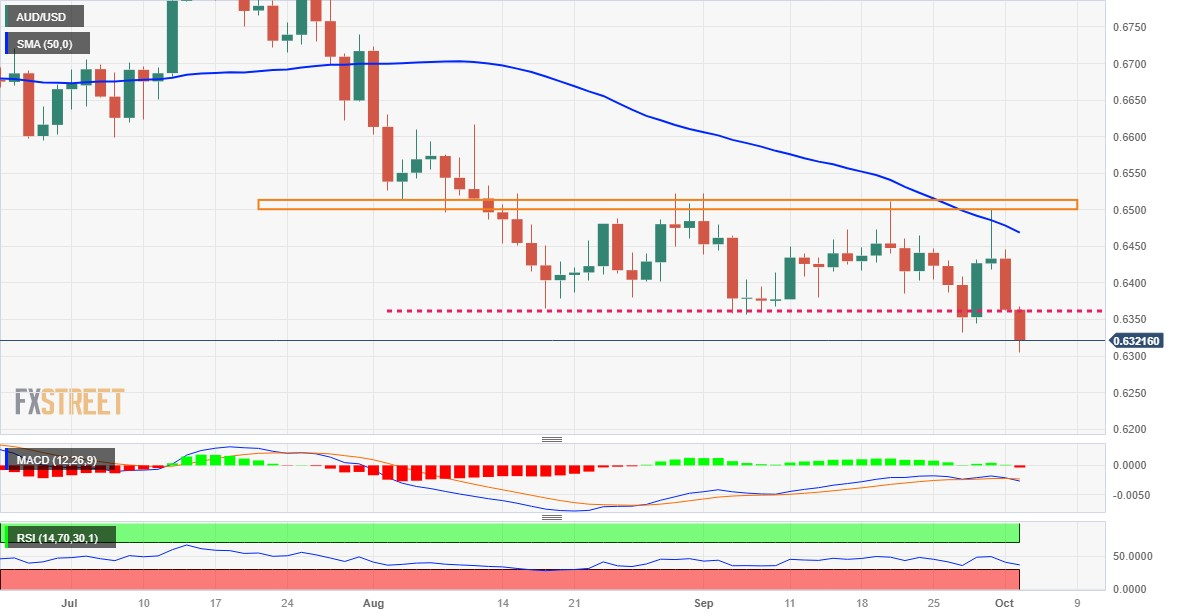
The AUD/USD pair remains under heavy selling pressure for the second successive day and dives to the 0.6300 neighbourhood, or its lowest level since early November after the Reserve Bank of Australia (RBA) announced its policy decision on Tuesday. As was widely anticipated, the Australian central bank decided to leave the benchmark interest rate unchanged, at 4.1% for the fourth month in a row and noted that there is still uncertainty surrounding the economic outlook. In the accompanying monetary policy statement, the RBA noted that the pause will provide more time to assess the impact of previous rate hikes and reiterated that some further tightening may be required as inflation remains too high. Meanwhile, the RBA Governor Michele Bullock said that Australian inflation had passed its peak, suggesting that the central bank might have already ended the rate-hiking cycle, which, in turn, is seen weighing on the Aussie.
This, along with sustained US Dollar (USD) buying, bolstered by hawkish Federal Reserve (Fed) expectations, contributes to the offered tone surrounding the AUD/USD pair lower through the early European session. Investors seem convinced that the Fed will continue to tighten its monetary policy and have been pricing in the possibility of at least one more lift-off by the end of this year. The bets were reaffirmed by comments by several Fed officials, backing the case to keep rates restrictive for longer to bring inflation back to the 2% target. Furthermore, the US ISM Manufacturing PMI released on Monday recorded improvement for the third straight month and rose to 49.0 in September – the highest reading since November 2022. This points to a still-resilient US economy and should allow the Fed to raise rates further, which remains supportive of elevated US Treasury bond yields and underpins the USD.
In fact, the yield on the benchmark 10-year US government bond advances to its highest level since 2007. Apart from this, a sea of red across the global equity markets is seen as another factor benefitting the Greenback's relative safe-haven status and driving flows away from the perceived riskier Australian Dollar (AUD). Investors remain worried about a real-estate crisis in China and economic headwinds stemming from rapidly rising borrowing costs. Traders now look to the release of the US JOLTS Job Openings data, which, along with the US bond yields, will influence the USD price dynamics and provide a fresh impetus to the AUD/USD pair. Apart from this, the broader risk sentiment should allow traders to grab short-term opportunities. The aforementioned fundamental backdrop, meanwhile, remains tilted firmly in favour of bearish traders and suggests that the path of least resistance for spot prices is to the downside.
Technical Outlook
From a technical perspective, a sustained breakdown through the 0.6360-0.6350 horizontal support and a subsequent slide below the previous YTD low, around the 0.6360 area, validates the negative bias. Moreover, oscillators on the daily chart are holding deep in the bearish territory and are still far from being in the oversold zone. This, in turn, supports prospects for a further near-term depreciating move for the AUD/USD pair. That said, it will be prudent to wait for some follow-through selling below the 0.6300 mark before placing fresh bearish bets. Spot prices might then accelerate the fall towards the 0.6270 intermediate support en route to the mid-0.6200s before eventually dropping to the 0.6210-0.6200 area.
On the flip side, any attempted recovery might now confront stiff resistance near the 0.6350-0.6360 support breakpoint. The latter should act as a key pivotal point, which if cleared might trigger a short-covering rally and allow the AUD/USD pair to reclaim the 0.6400 round figure. The momentum could get extended further towards the 0.6455-0.6460 supply zone, above which bulls could aim back towards conquering the 0.6500 psychological mark. A sustained strength beyond the latter will suggest that the pair has formed a near-term bottom and pave the way for a further near-term appreciating move.
Premium
You have reached your limit of 3 free articles for this month.
Start your subscription and get access to all our original articles.
Author
Haresh Menghani
FXStreet
Haresh Menghani is a detail-oriented professional with 10+ years of extensive experience in analysing the global financial markets.