Asia Open:The Schitt's Creek scenario

The Schitt's Creek scenario
"Schitt's Creek" is a Canadian TV comedy series about a wealthy video-store magnate Johnny Rose (Eugene Levy) and his family suddenly find themselves broke, and they are forced to leave their pampered lives to regroup in Schitt's Creek. If you haven't seen it give it a try
Stock Markets
The US market is closed for Presidents Day, so in the absence of an unexpected headline shock, price action could be a bit muted as it typically is during a US holiday weekend.
The growth over value theme continues to play out, and, as with the last few Fridays, there was little appetite to add to risk into the weekend. still, the US market managed to post gains
The bad news is that on Sunday; authorities reported 2,009 new cases and 142 more deaths nationwide; the good news is, however, it represents a drop in new cases from the coronavirus outbreak for a third consecutive day.
This will be good news for the market to run with this morning and we should see the usually predictable unwinding of weekend defensive hedges out of the gates and the SPX should continue to plow higher on the "cleanest dirty shirt" argument for owning US assets, which is particularly salient at the moment given the likely asymmetric growth impact of the coronavirus shock. At present, the growth impact of the virus remains expected to be more severe in China (and hence in Germany) than in the US.
Fund flows continue to be supportive of the general risk-on theme. EPFR data showed $23.6bn flowed into fixed-income funds in the week ending Wednesday, the most significant inflow since 2001. I am surprised that fund flows into equities were not higher given the ongoing move. For now, equity markets remain in look through mode
However, it's not hard to be skeptical about just how much looking through investors will be willing to bear the cost of for the next few weeks, especially if China's high-frequency data comes out worse than expected. Although, to be frank, I'm not really sure what to expect from the data, but if it comes out bad enough for confidence to plummet, investors could quickly find themselves up the creek ( Schitt's Creek) without a paddle. Let's face it, financial markets are not known for their rational thinking lately and given the 500 million or so mainlanders affected by the Covid19 quarantine, and it's also not hard to come up with more downside risks than upside ones right now.
This is a tricky market environment. There isn't intemperate fear, and there isn't unreasonable optimism. The easy trades of reverting overextended markets are gone, which has turned traders very wary of taking on big wagers. While the virus stories don't carry the same headline gravitas, it's still a focal point while the economic data fears continue to simmer on the back burner. It will soon be the fear of the data unknowns' that will keep investors awake at night. But that has not stopped the market frustrating the bears in the past and now feels no different. Depressing the returns available through the duration in risk-free government bonds creates incentives for investors to re-allocate capital to stocks even more so into the resilient US markets.
Oil markets
The oil price action continues to be swayed backward and forwards by news flow around the Covid-19 infection/death rates and the prospects of OPEC+ agreeing a quota cut to balance off the demand slowdown. However, with a reality check about to set in when the China high-frequency data start to roll in, and in the absence of the Russian compliance commitment, any excuse to sell still feels like the sentiment in the market right now. And while the worst is probably priced into the China equation, the convexity of global economic data to how much of the China economy comes back online should not be underestimated, especially with a reported 500 million Chinese lives touched by the quarantine. That over 1.5 times the US population!!
On Friday, oil market investors took solace after the US energy secretary noted only "slight reductions in production" from the coronavirus and that the agency is "not yet concerned about its ultimate impact. "After markets closed, the office of the US Trade Representative announced it would lift tariffs on aircraft imports from the EU, from 10 to 15% effective March 18, though it stopped short of raising higher tariffs on other goods.
Gold Markets
There's more to the recent gold move that meets the eye. While retail sentiment seems to be now moving purely on the end of coronavirus headlines, long term strategic buyers are starting to take notice of a soft underlying read for US retail sales. The headline for January was in line, but the bit that matters for GDP - retail control - was weaker, recording a flat outturn against expectations of a 0.3%mom rise and with a sizeable downward revision for December. The recent trend has been weak: 3m annualized is only up 0.22%, and the 6m annualized is down -0.12%, only the second negative reading since the GFC (the other was during the collapse in December 2018). While it is early in the quarter and retail sales are often revised, the next retail sales release on March 17 takes on added significance as it has the potential to impact the Fed's current policy narrative.
And while analyst has been focusing on ASEAN central bank policy measures. It's the Fed who is now wearing the yellow jersey in the rate cut peloton as there are far more cuts priced for the Fed than the other central banks. From the time coronavirus cases started to pick up in mid-January, the Fed went from being middle of the pack to now leading the pack at 36bp of cuts being priced. This is a bullish swing in the gold narrative.
Also, the convexity of global economic data to how much of the China economy comes back online should not be underestimated, especially with a reported 500 million Chinese impacted by the quarantine.
With the US stock markets trading at record highs, and downside risks outnumbering upside one's by a count of 2:1 according to my watch list. It's not hard to figure out why Gold markets are bid.
With bond yields falling on coronavirus concerns and as the effects of existing tariffs make there way through the US economy. But when factoring in geopolitical tensions such as the recent standoff between the United States and Iran, a potential technological divergence between Washington and Beijing, and the possibility of a U.S.-EU trade war, gold should be on everyone's radar
Stock market liquidity?
Liquidity on driving equity? That's not what the chart below shows. The Fed's balance sheet is pretty much unchanged so far this year and shrank over the latter stages of January. Same for reserves balances. Yes, both rose steeply in Q4 last year, but they haven't made further progress this year.
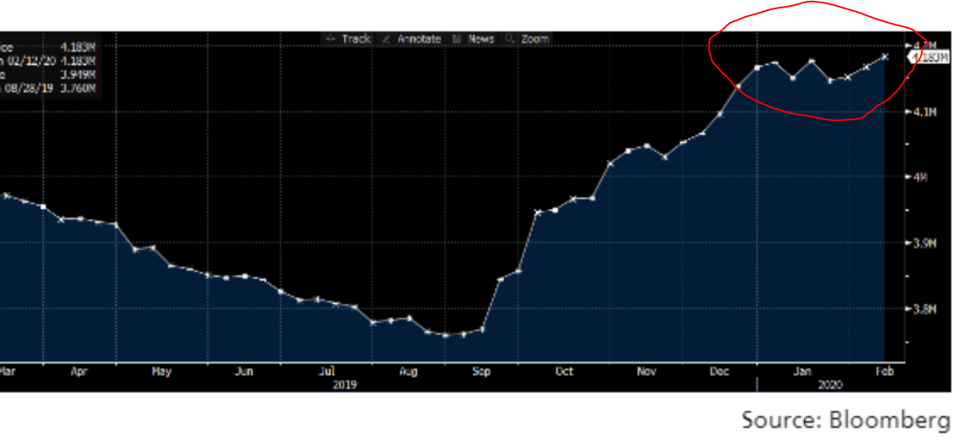
Well, the markets will soon get to test the liquidity theory as The New York Fed reported it would lower its 14-day repo offerings by $5 bn, down to $25 bn through March 3, and then down to $20 bn from March 3 onward. The overnights will drop $20 bn to $100 bn maximum. On Thursday, the Fed provided $30 bn in 14d and $48.85 bn in overnight.
Still, its bill purchases hold at $60 bn/month, so perhaps the idea is to get back to a more conventional balance sheet management sooner rather than later.
Currency Markets
Asia FX
Mainland authorities have leaned mostly on targeted measures like individual re-lending facilities, with the macro policy response more fiscal (additional pre-financing quota for local governments) than monetary (net OMO injection of the only 140bn in the last two weeks), and USDCNY fix mostly been in line with the model, after the initial lowballing adjustment post-LNY. With RMB1.2tn of OMOs maturing early next week, the focus will be on whether PBoC rolls them using MLF, and at a cheaper price point (ahead of LPR reset on the 20th). The emphasis in rest of the region is on Singapore Budget (18th), Bank Indonesia MPC (20th), and BOK (27th)
Even although coronavirus risk premia are reducing and vols are taming there a gigantic swath of economic carnage left in Covid-19 wake so even with Hubei province not reporting fewer infections from the day before, its full steam ahead for the region's economic stimulus plans
If the past week is any indication, investors are will be looking for a buying Asia FX opportunity but could remain cautious about adding more currency risk before assessing the depth of the economic fallout. But with regional policymakers taking protractive actionable measures to thwart of the legacy effects of Covid-19, this should be viewed as growth positive. But the market appears to lack a catalyst for a real trend, and I expect consolidation to continue until bluer skies look likely.
The Yuan
USDCNH slipped from the high of 6.9917 and traded at 6.9830-80 last Friday Asia morning but back up again in the NY time zone. There was no demand for long USD gamma, however. Instead with the curve pointing south implying that traders seemed to have priced in a potential RRR cut Friday, so when it didn't come, forward points reverse higher and dragged spot along for the ride. The drop in the daily virus headcount is a positive for regional risk as the curve now refocuses on PBoC policy measures, which should be bullish for the Yuan.
The Ringgit
For the Ringgit, which is a mid-level carry currency, it very much relies on a pickup in growth expectations to recover sustainably. And with another rate cut looks largely priced into swap markets and out to 10Y on the bond curve and with 10Y MGS trading this week with yields through 3.0% to all-time lows, it might be up to equity flows to do much of the heavy lifting this week as perhaps offshore blond flows could turn more neutral from here after significant inflows in the past three months. Look for the Ringgit to take it's lead from the Yuan today.
The Thai Baht
The USDTHB continues to hold well above the 31.00 level as currency trader to a tee the negative tail to the Covid-19 outbreak is best expressed at this stage via being long USD vs. THB.
Singapore Dollar
FX and rates curves in Singapore are mostly already pricing in a shift by MAS to neutral. While the reduction in new flu cases, ex-Hubei has already helped Asian FX consolidate. But if the response to SARS were any indication, it might take a 'positive announcement shock' like a lifting of the travel ban to get the Singapore dollar moving in the other direction.
G-10 Currency markets
The Yen
Why isn't the Yen working? Don't even get me going? Besides the fact, Covid -19 poses a significant near-term downside risk to Japan's economy, negative rates, and a magnetic attraction to the 110 level have made it an expensive proposition to purchase in a panic and then sit on.
The Euro
Any concerns about your short Euro position? You bet. Besides President Trump's twitter feed set to exposed if the EURUSD breaches 108, the ECB's strategic review has a hawkish bias, particularly given the current euro weakness. I think this supports the Euro if this is the case G10 traders will take their cue for the rates markets as this should create a measurable bounce in near term EU interest rate yields. Still given the dismal economic outlook in Germany, given my current view, look to sell on rallies to the 1.09 handle, not before. While downside optionality volumes are exploding, cash remains a bit neutral at this point, suggesting the market looks to well-positioned for a downside move, and in this low vol environment, short term positioning looks a bit extreme at the moment.
The Australian Dollar
The Aussie, which continues to trade super beta to China risk, is punching higher this morning on improving regional risk sentiment as China reported a drop in new cases from the coronavirus outbreak for a third consecutive day.
Author

Stephen Innes
SPI Asset Management
With more than 25 years of experience, Stephen has a deep-seated knowledge of G10 and Asian currency markets as well as precious metal and oil markets.

















