After a five-week strong uptrend, USD/CAD hits major resistance

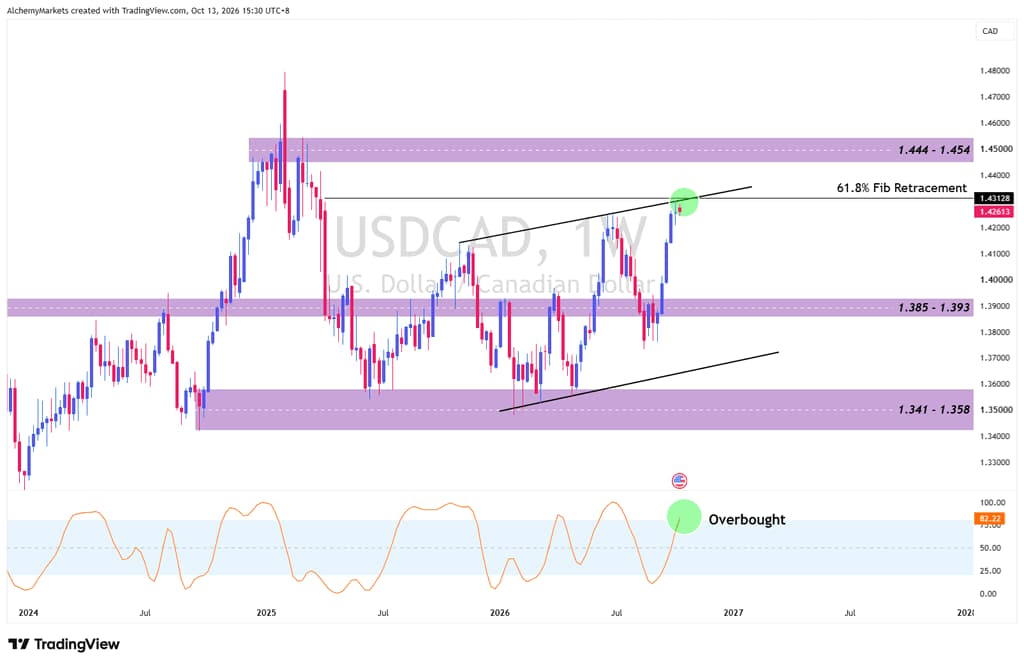
The Dollar-CAD has been in a five week strong uptrend.
Price has returned to a rising weekly trendline and near the 61.8% Fib retracement of the decline since 2025.
Weekly Stochastic RSI is also overbought, reading roughly 8 and favouring a reversal.
After such a sharp move, buyers now have to prove they can push through resistance rather than simply reach it.
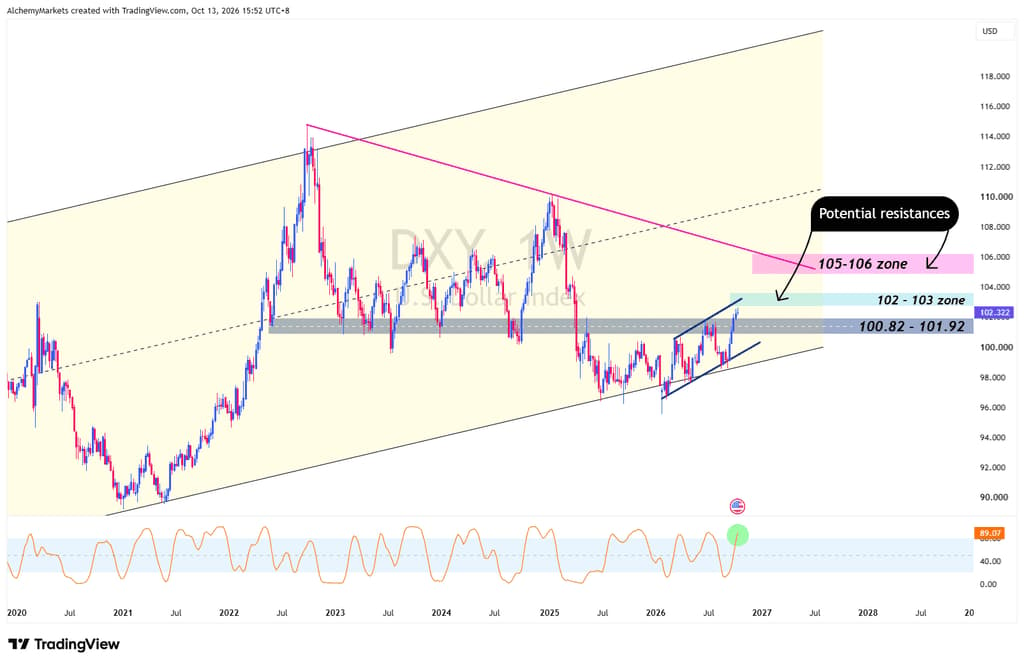
DXY is also near a potential resistance, and similarly with an overbought signal.
The dollar index is moving up from an ascending channel and towards overhead resistance around the 102 to 103 area.
If USD/CAD and DXY both print a rejection at their key levels, it would hint at a weakening dollar in the coming weeks.
Why the Canadian Loonie is weak
The latest Canadian labour numbers do not give the Bank of Canada much room to sound hawkish.
Statistics Canada said employment fell by 68,000 in September after a 42,000 decline in August. The unemployment rate rose to 6.5%, and the participation rate slipped to 64.8%, its lowest level since December 1997 outside the pandemic period.
That is not the profile of an economy inviting tighter policy. Even if inflation risks remain alive because of energy and trade frictions, a softer jobs market makes it harder for policymakers to lean against the economy with higher rates. At a minimum, it argues for caution.
The Bank of Canada already held its policy rate at 2.25% on 2 September. Its next decision is not due until 28 October. So unless Canadian data suddenly rebound, the market has little reason to price an aggressive move higher from Ottawa in the near term.
Why has USD/CAD climbed so quickly?
Another explanation comes from the bond market. The spread between US and Canadian 10-year yields has been rising sharply, reaching around 1.316 percentage points on the weekly chart.
A rising spread means the market is rewarding the US with a much higher long-term return than Canada.
That can happen because traders expect firmer US growth, stickier US inflation, bigger Treasury supply, or simply a Bank of Canada that cannot keep pace with the higher-for-longer mood in the US.
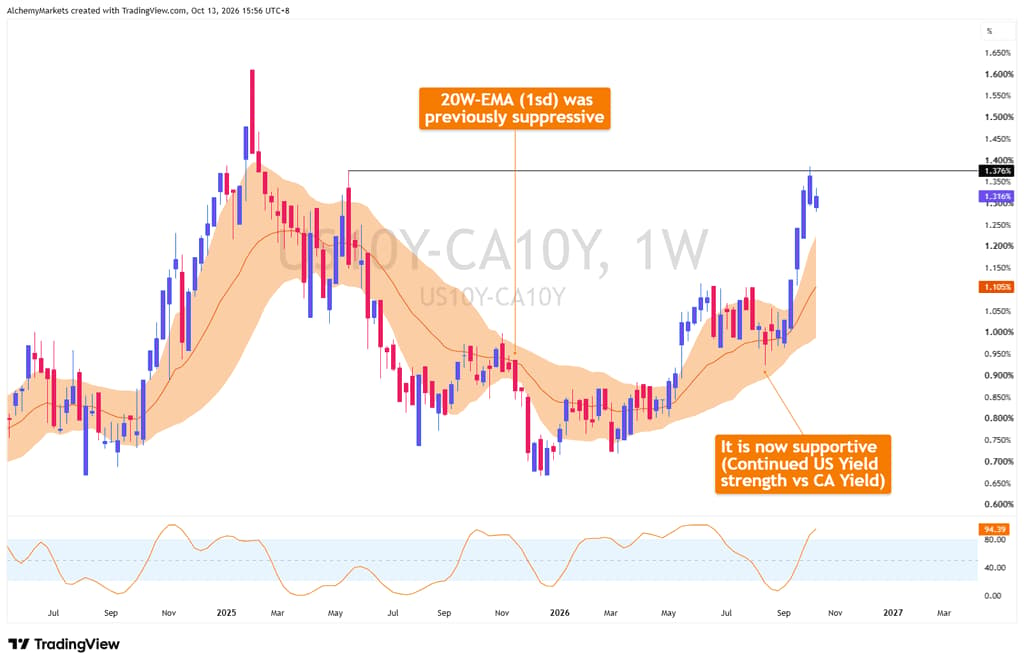
I do not think we need to overcomplicate it. The simplest read is this: US rates are rising because the market still sees a tougher inflation and growth mix there, while Canadian data are soft enough to limit how far Canadian yields can follow.
That is also why the recent USD/CAD rally deserves respect until the spread stops widening. If the yield gap keeps expanding, the pair can stay bid even when it looks technically stretched.
So even if we retrace here – which should weaken the dollar and strengthen CAD, therefore USDCAD moves lower – the overall trajectory for USDCAD is still posited to the upside.
Watch how the spreads react when they return into that orange band, which is the 20W-EMA with 1 standard deviation.
What would change the view?
The main near-term risk to the thesis is a softer-than-expected US CPI print this Wednesday.
If inflation cools and Treasury yields back off, part of the dollar’s current support could fade quickly.
On the Canadian side, a surprise rebound in domestic data or a much more hawkish tone from the Bank of Canada later this month would also weaken the argument.
For now though, the balance still favours the upside. USD/CAD is not only breaking higher because the dollar is strong. It is climbing because Canada looks less able to live with the kind of long-end repricing now visible in the United States.
Author

Zorrays Junaid
Alchemy Markets
Zorrays Junaid has extensive combined experience in the financial markets as a portfolio manager and trading coach. More recently, he is an Analyst with Alchemy Markets, and has contributed to DailyFX and Elliott Wave Forecast in the past.

















