ADP employment Preview: Private hiring in May set to double the historical average

- The US ADP is expected to deliver 190K new jobs in May exceeding the historical average of last 14 years by more than 100%.
- The US ADP private employment report is a forerunner of government Non-farm payroll report that due this Friday, June 1st.
- Strong US labor market is likely to confirm the US Federal Reserve's willingness to hike rates in June.
The Automated Data Processing (ADP) private employment is expected to rise 190K in May after adding 204K new jobs in April and 228K new jobs in March. The ADP is considered the forerunner of the most important US macro release, the US non-farm payroll report that usually set the trend for the US Dollar on the foreign exchange market.
The ADP private employment report confirms strong momentum in the US labor market with job creation exceeding the market estimates every month since July 2017. The long-term average of monthly private jobs increases reached 89K while looking at the time series starting in May 2002. Should May ADP private employment add 190K new jobs, the actual number would double the long-term average and come out 20% above the historical median of 158K.
The beginning of this year is showing very strong labor market in the US with the average number of private new jobs added during the first four months of this year reaching 229K compared to the average of 185K in 2017 and 172K in 2016.
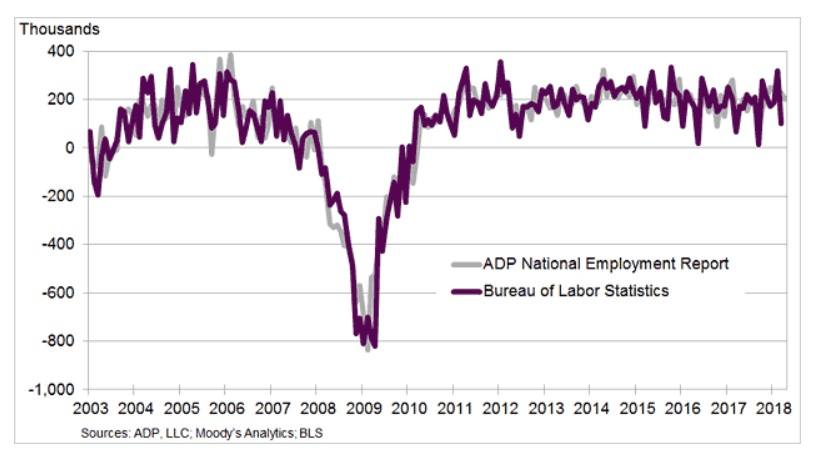
Although there is a historically high correlation between the ADP employment report headline number of the headline non-farm payroll new jobs added in the US economy published by the US government, the differences in the surveyed sample result in variations.
The sample of companies that the ADP is using to analyze the labor market in the US includes 411K private US companies employing some 24 million workers and still differentiated with the outcome of government’s report in both April and in March.
While the ADP report surprised on the upside in April rising 204K, the government’s non-farm report showed a reading of below expectation of 164K. The same below expectations reading repeated in the US non-farm payroll report also in March when the private ADP employment rose strong 241K while the government’s report two days later disappointed on the downside with new jobs rising 103K compared to 188K expected.
The historical correlation of ADP and Labor Department’s number of new jobs in the US
Author

Mario Blascak, PhD
Independent Analyst
Dr. Mário Blaščák worked in professional finance and banking for 15 years before moving to journalism. While working for Austrian and German banks, he specialized in covering markets and macroeconomics.

















