2026 market analysis: Technical strategies and Elliott Wave opportunities [Video]
![2026 market analysis: Technical strategies and Elliott Wave opportunities [Video]](https://editorial.fxsstatic.com/images/i/NZDUSD.png)
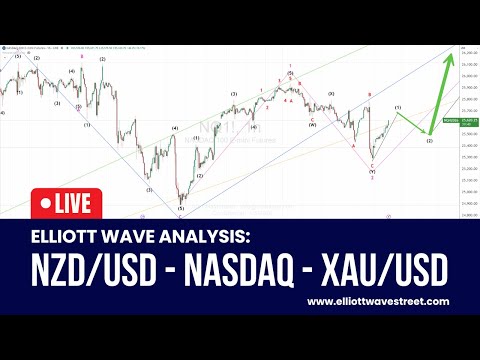
The beginning of 2026 presents an exceptional environment for financial markets. A combination of major macroeconomic events, shifting liquidity conditions, and rising volatility is reshaping the structure of key assets. This analysis provides a practical framework for trading instruments such as the U.S. dollar, gold, and the Nasdaq, integrating Elliott Wave–based technical analysis, risk management, and fundamental insight. The objective is to support informed decision-making and more efficient trade execution.
Fundamental context: The Federal Reserve and the new liquidity wave
One of the defining features of the current cycle is the Federal Reserve’s renewed use of the repo market, injecting historically significant levels of liquidity into the financial system. Similar interventions were observed ahead of the dot-com downturn, during the 2008 financial crisis, and throughout the 2020 pandemic.
In the 2025–2026 cycle, these measures are not a response to an immediate crisis but rather to late-cycle adjustments. This environment tends to favor opportunities in currencies and risk assets. Excess liquidity has historically exerted downward pressure on the U.S. dollar while supporting bullish conditions in broader markets.
US Dollar strategies: Why bearish scenarios matter
The U.S. dollar’s pullback at the end of 2025, followed by an early rebound in 2026, creates a strategic setup. Periods of elevated liquidity often weaken the dollar over time, making corrective rallies potential selling opportunities.
Effective approaches include:
- Identifying bearish setups after short-term retracements.
- Using Elliott Wave structures to anticipate new downside impulses.
- Confirming trades through a combination of fundamentals, volume, and price structure.
New Zealand Dollar and other pairs: Liquidity-driven signals
Among the most attractive currencies in this environment is the New Zealand dollar, which shows a constructive technical structure supported by liquidity indicators. Institutional activity suggests accumulation in key zones.
Key considerations when trading these pairs include:
- Identifying areas where large market participants are absorbing liquidity.
- Focusing on entries at pullbacks or structural lows.
- Combining momentum divergence with volume analysis and price action.
How to identify optimal entries
Two primary approaches stand out:
- Direct entries at structural lows.
- More conservative entries after pullbacks into key technical zones, improving risk-to-reward ratios.
Risk management in a high-volatility environment
The volatility expected in 2026 requires disciplined and consistent risk management. Capital preservation should take precedence over capturing every market move.
Essential principles include:
- Clearly defined stop-loss levels and partial profit-taking.
- Avoiding the need to capture entire trends.
- Applying strict risk management rules to every trade.
Nasdaq and Gold: Key vehicles for the current cycle
The Nasdaq continues to display technical strength, supported by long positioning from institutional participants. Buy-the-dip strategies, guided by Elliott Wave analysis and multi-timeframe alignment, remain relevant in this context.
Gold, meanwhile, appears to be in a potential reversal phase. Confirmation through volume and price action is critical before committing to directional trades.
Key guidelines for trading these assets
- Establish directional bias before each session.
- Align strategies with daily liquidity conditions and fundamental drivers.
- Use pullbacks to build or adjust positions progressively.
The role of liquidity and fundamentals
Robust trading decisions require a multidimensional view of the market. Price alone does not tell the whole story. Liquidity flows, macroeconomic fundamentals, volume behavior, and divergences provide essential context for understanding market intent. Continuous monitoring of these factors improves scenario validation and probability assessment.
Strategic outlook
The year 2026 is shaping up to be rich in opportunity for disciplined, well-prepared traders. Mastery of liquidity dynamics, structured technical analysis, and consistent risk management will be key differentiators in navigating this evolving market environment. Access to ongoing analysis, live sessions, and advanced tools can significantly enhance execution and strategic clarity throughout the cycle.
Author

Juan Maldonado
Elliott Wave Street
Juan Maldonado has a University degree in Finance, and Foreign trade started his trading career in 2008. Since 2010 has been analyzing the markets using Elliott Wave with different strategies to spot high probability trades.