Australian Dollar Price Forecast: Regains the smile, and 0.7000
- AUD/USD leaves behind part of the recent weakness and reclaims 0.7000.
- Persistent geopolitical concerns lend legs to the US Dollar.
- The PBoC kept its policy rate unchanged earlier on Monday, as expected.

The Aussie Dollar's recovery appears to have met some resistance just above the 0.7000 threshold against the US Dollar so far. Indeed, AUD/USD still struggles to surpass that mark in a convincing fashion, while the constructive outlook appears unchanged above its critical 200-day SMA near 0.6890. Looking at the broader picture, the RBA’s cautious stance and still sticky domestic inflation are also expected to underpin the Aussie in case of occasional bouts of weakness.
The Australian Dollar (AUD) regains composure in quite a promising start to the week, lifting AUD/USD back above the key 0.7000 threshold.
That said, the pair’s decent bounce comes despite a move higher in the US Dollar (USD), in a context where geopolitical jitters appear anything but abated and investors seem to have already digested last week’s lower-than-expected US inflation data and its impact on the repricing of Fed rate hikes.
Australia’s economy keeps its footing
The Australian economy does look healthy and stable altogether and, honestly, in much better shape than many of its G10 peers.
This performance appears underpinned by a solid domestic demand and pretty decent figures when it comes to economic growth. The spectre of sticky inflation seems to justify the cautious and data-dependent stance from the Reserve Bank of Australia (RBA), particularly following the latest meeting, where it raised rates to 4.35%, broadly in line with market expectations.
Supporting the above, the final data from the June Purchasing Managers’ Index (PMI) showed Manufacturing at 51.5 (from 50.7) and Services at 50.5 (from 48.7).
Removing some shine from the domestic fundamentals, the latest trade balance figures showed a A$3.018 billion deficit in May, reversing April’s A$1.383 billion surplus. In addition, Gross Domestic Product (GDP) data disappointed expectations after the economy expanded by 0.3% QoQ in Q1 2026 (from 0.9%) and 2.5% YoY (from 2.5%), with both prints coming in short of expectations.
Meanwhile, the labour market remains healthy. Indeed, the Unemployment Rate ticked lower to 4.4% in May (from 4.5%), and the Employment Change increased by 40.6K individuals (from the revised 40.7K drop seen in the previous month).
Regarding inflation, May data was far from telling after the Consumer Price Index (CPI) ticked lower to 4.0% from a year earlier (from 4.2%), while the Trimmed Mean and the Weighted Median rose to 3.6% over the last twelve months (from 3.4%). The pace of disinflation remains weak, although the direction is still broadly correct. Somehow reinforcing that view, the latest Melbourne Institute’s Consumer Inflation Expectations eased to 4.7% in July (from 5.5%).
For the RBA, that means the job is still incomplete, as policymakers continue to signal that inflation may only return to target around mid-2028, keeping the focus firmly on patience rather than any imminent pivot.
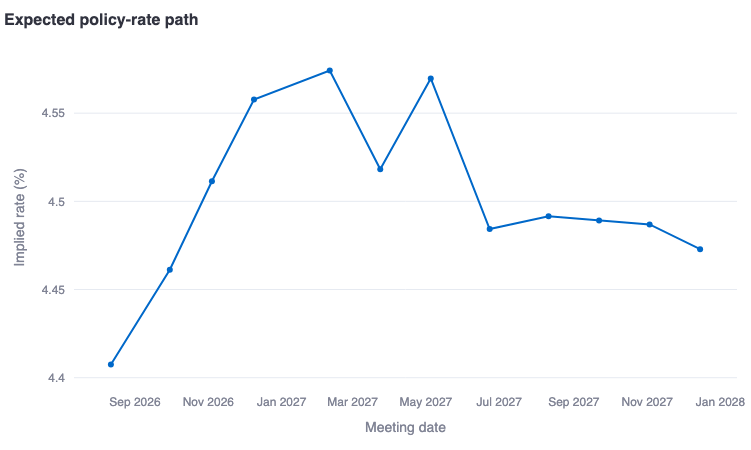
Looking ahead, investors expect the central bank to maintain its current stance at its August meeting, while they now anticipate just over 19 basis points of tightening by year-end.
China steadies without accelerating
China now looks more like a stabilising force than the tailwind it usually provides for the Australian economy.
Let’s see some numbers: the economy expanded by 4.3% YoY in the April-June period, while Retail Sales gained 1% in the year to June. In addition, Industrial Production kept its strong pace and expanded by 5.3% over the last twelve months.
Of note is the strong recovery of the trade balance, with June’s surplus widening to $125.62 billion from $105.4 billion in the previous month, and both imports and exports expanding markedly.
In the same line, business activity seems to be regaining traction after the National Bureau of Statistics (NBS) reported the Manufacturing PMI at 50.3 in May (from 50) and Services at 50.2 (from 50.1). In addition, private gauges like RatingDog remained in expansionary territory in June, as Manufacturing came in at 51.7 and Services at 54.1.
The disinflationary trend in China seems to have re-emerged after the CPI disappointed expectations and rose by 1.0% in the year to June (from 1.1%). On a monthly basis, prices dropped by 0.1%, while Producer Prices gained 4.1% over the last twelve months, exceeding the 3.9% annual gain recorded in the previous month.
Regarding monetary policy, the People’s Bank of China (PBoC) matched consensus early on Monday, leaving its Loan Prime Rates (LPR) unchanged at 3.00% for the one-year tenor and 3.50% for the five-year tenor.
In summary, China is no longer pushing growth higher, but it is not dragging it down aggressively either. It is simply keeping things steady.
Sticky inflation keeps the RBA cautious
As widely expected, the Reserve Bank of Australia (RBA) left its Official Cash Rate unchanged at 4.35% at its June 16 gathering.
While the accompanying statement retained a hawkish tone, policymakers appeared a little more comfortable with the progress made on inflation. The Board repeated that price pressures remain too high and that further tightening could still be required if inflation proves more persistent, while higher energy costs and geopolitical tensions are pointed to as key upside risks.
Governor Michele Bullock struck a more balanced tone in her press conference. Although she refused to rule out another rate increase, she noted that incoming data had broadly evolved as expected, the economy is not heading into recession, and the labour market remains relatively resilient. In other words, there was no urgency to tighten policy again.
The Minutes echoed that message. Policymakers agreed that leaving rates unchanged while maintaining a restrictive policy stance offered the best balance between bringing inflation back to target and preserving the gains in the labour market. The door to another hike remains open, but for now the RBA appears willing to give previous rate increases more time to work through the economy.
What lies ahead for AUD/USD?
Bears tighten their grip
Speculative sentiment towards the Australian currency has further deteriorated during the week ending July 14, with Commodity Futures Trading Commission (CFTC) data showing net short positions increasing to 30.7K contracts from 24.7K previously. The weekly increase in bearish exposure (-6.1K contracts) was not as sharp as last week’s decline but was another week of steady selling pressure and further pushing the negative bias to the Aussie.
Unlike previous weeks, this week’s increase in bearish positioning also saw a small increase in market participation. Open interest rose to 208.5K contracts from 204.8K, which implies that traders opened new positions rather than just closing out existing longs. At the same time Speculative Exposure rose to -14.7% of open interest from -12.0%, and its percentile increased to 80.8, the strongest reading in recent months. This implies growing confidence in the bearish view.
That said, there are early signs that the broader positioning trend is becoming less aggressive. The 4-week change improved to -26.6K contracts from -42.8K a week earlier, indicating that although investors continue to add shorts, the cumulative pace of bearish repositioning has moderated considerably compared with the heavy liquidation seen earlier this summer. The Net Position Percentile also edged up to 75.8, keeping positioning firmly within historically bearish territory but still well short of extreme levels.
In summary, the latest CFTC report strengthens the view that noon-commercial investors are still decidedly bearish on the AUD. But the pace of the 4-week deterioration is slowing, and positioning is becoming increasingly stretched, suggesting the market is moving into a more mature phase of the bearish cycle.
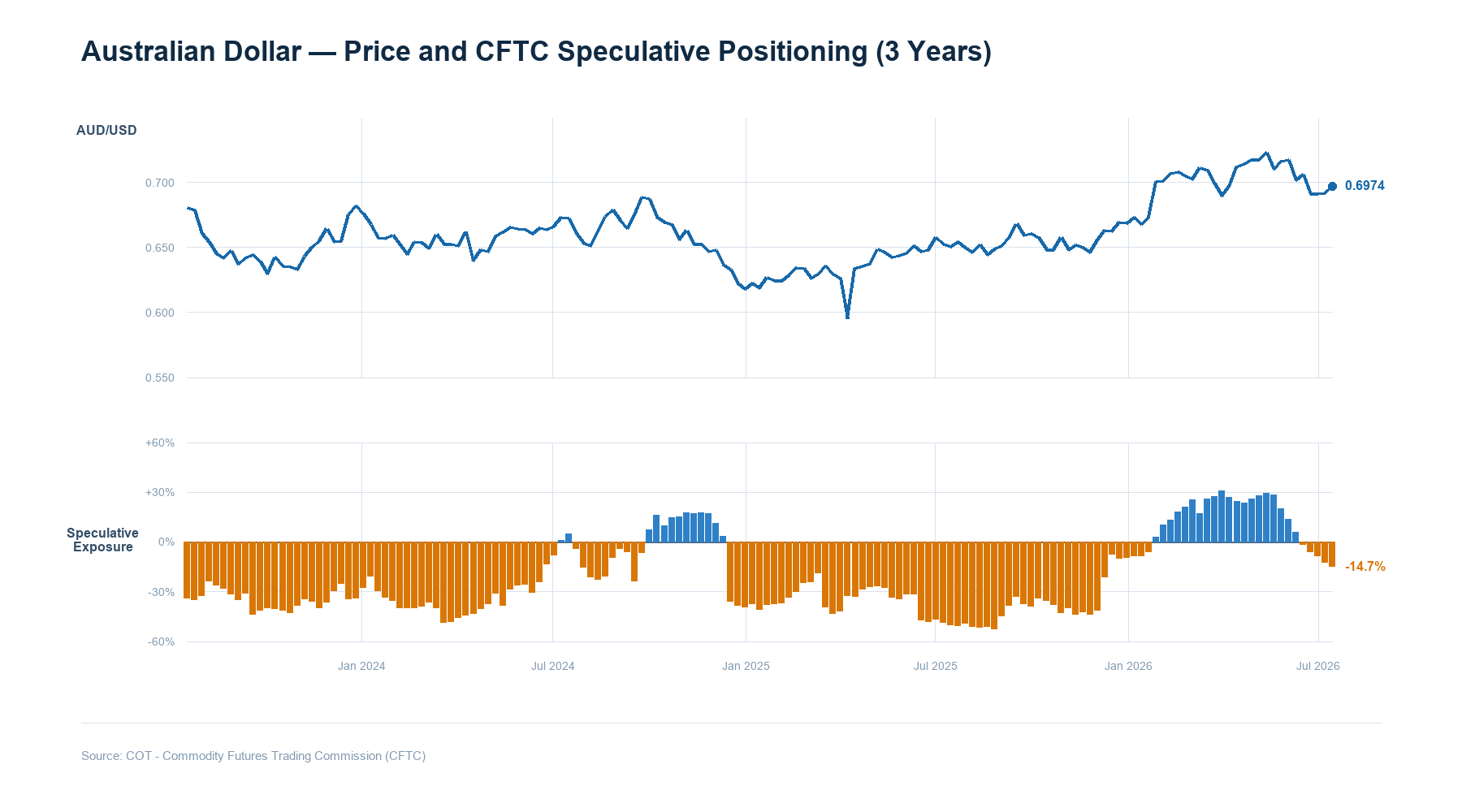
In the absence of further deterioration in macroeconomic fundamentals, the ability for new aggressive selling to take place may become more and more limited, and the likelihood that future moves will be driven more by incoming data on the economy and changes in global risk sentiment than positioning alone will increase.
What comes next?
In the near term, the US Dollar, global risk sentiment, and geopolitics remain the main focus. Those remain the key drivers of price action. In the meantime, the next relevant event in Oz will be the release of the monthly labour market report on July 23.
Key risks include a sharper slowdown in China, a persistently cautious Fed, a change in investors' risk sentiment, or any shift in the RBA’s stance. Any of these could quickly destabilise the Australian currency in the near term.
Technical landscape
In the daily chart, AUD/USD trades at 0.7003, holding just above the 200-day simple moving average (SMA) at 0.6889 but still capped beneath a tight confluence of the 55- and 100-day SMAs, both near 0.7060. This keeps the near-term bias neutral to slightly capped despite improving momentum, as the Relative Strength Index (14) at 53.8 tilts modestly bullish while the Average Directional Index around 25 suggests only a modest trend, hinting at consolidation rather than a sustained breakout for now.
On the topside, initial resistance is seen at the horizontal barrier around 0.7079, ahead of the clustered 55- and 100-day SMAs near 0.7060, with higher hurdles emerging at 0.7278 and 0.7283 and, further out, 0.7661. On the downside, the first layer of support is anchored by the 200-day SMA at 0.6889, followed by horizontal floors at 0.6833 and then 0.6660, with deeper cushions at 0.6593, 0.6414 and 0.6373 if selling pressure were to intensify.
(The technical analysis of this story was written with the help of an AI tool. Know more.)
The broader picture remains constructive
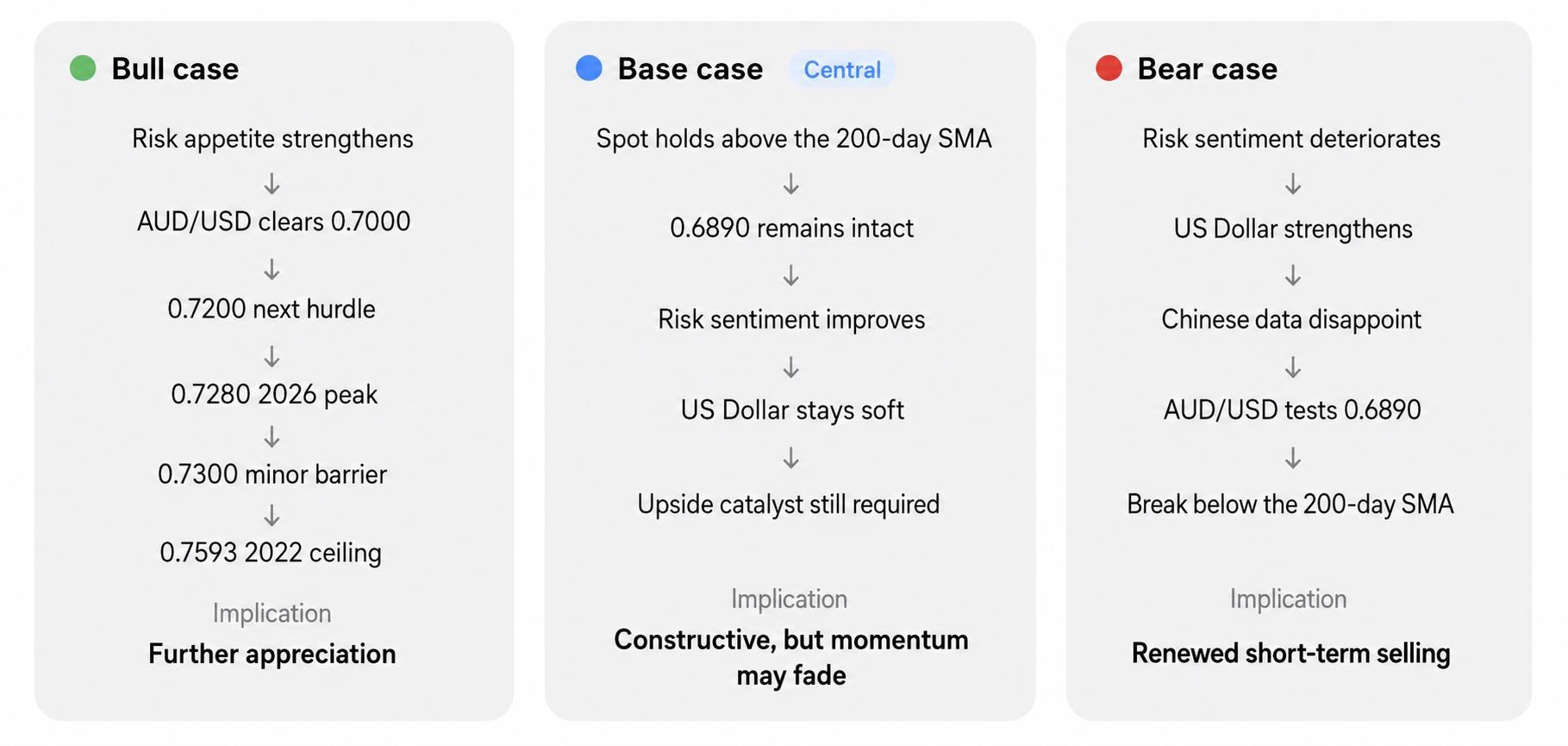
The Aussie remains constructive on the bigger picture, but the path higher is getting tougher. Australia's domestic background continues to compare favourably with that of many advanced economies, and the RBA is in no rush to abandon its mildly hawkish bias. However, that support is being offset by a resilient US Dollar, lingering geopolitical tensions and a Chinese economy that is stabilising rather than accelerating.
For now, the 200-day SMA around 0.6890 remains the key zone. Holding above that level keeps the broader bullish structure intact, but a convincing break above 0.7000 will likely require a sustainable road downwards of US inflation, a more dovish turn from the Fed, or a meaningful improvement in global risk appetite.
Until then, expect the AUD to be more driven by outside forces than domestic fundamentals.
Australian Dollar FAQs
One of the most significant factors for the Australian Dollar (AUD) is the level of interest rates set by the Reserve Bank of Australia (RBA). Because Australia is a resource-rich country another key driver is the price of its biggest export, Iron Ore. The health of the Chinese economy, its largest trading partner, is a factor, as well as inflation in Australia, its growth rate and Trade Balance. Market sentiment – whether investors are taking on more risky assets (risk-on) or seeking safe-havens (risk-off) – is also a factor, with risk-on positive for AUD.
The Reserve Bank of Australia (RBA) influences the Australian Dollar (AUD) by setting the level of interest rates that Australian banks can lend to each other. This influences the level of interest rates in the economy as a whole. The main goal of the RBA is to maintain a stable inflation rate of 2-3% by adjusting interest rates up or down. Relatively high interest rates compared to other major central banks support the AUD, and the opposite for relatively low. The RBA can also use quantitative easing and tightening to influence credit conditions, with the former AUD-negative and the latter AUD-positive.
China is Australia’s largest trading partner so the health of the Chinese economy is a major influence on the value of the Australian Dollar (AUD). When the Chinese economy is doing well it purchases more raw materials, goods and services from Australia, lifting demand for the AUD, and pushing up its value. The opposite is the case when the Chinese economy is not growing as fast as expected. Positive or negative surprises in Chinese growth data, therefore, often have a direct impact on the Australian Dollar and its pairs.
Iron Ore is Australia’s largest export, accounting for $118 billion a year according to data from 2021, with China as its primary destination. The price of Iron Ore, therefore, can be a driver of the Australian Dollar. Generally, if the price of Iron Ore rises, AUD also goes up, as aggregate demand for the currency increases. The opposite is the case if the price of Iron Ore falls. Higher Iron Ore prices also tend to result in a greater likelihood of a positive Trade Balance for Australia, which is also positive of the AUD.
The Trade Balance, which is the difference between what a country earns from its exports versus what it pays for its imports, is another factor that can influence the value of the Australian Dollar. If Australia produces highly sought after exports, then its currency will gain in value purely from the surplus demand created from foreign buyers seeking to purchase its exports versus what it spends to purchase imports. Therefore, a positive net Trade Balance strengthens the AUD, with the opposite effect if the Trade Balance is negative.
Author

Pablo Piovano
FXStreet
Born and bred in Argentina, Pablo has been carrying on with his passion for FX markets and trading since his first college years.

















