WTI Price Forecast: More pain likely if fails to hold $77
- The oil price faces intense selling pressure as Iran agrees to reopen the Strait of Hormuz.
- Oil prices rally over 22% in July due to aggressive exchange of attacks between the US and Iran.
- Investors worry about the longevity of the US-Iran peace.

West Texas Intermediate (WTI), futures on NYMEX, holds onto early losses, trading 7.6% lower at around $78.60 during the Asian trading session on Monday. The oil price faces selling pressure as United States (US) President Donald Trump announced, through a post on Truth Social, that planned attacks on Iran have been suspended as the nation has agreed to surrender its nuclear ambitions and the total reopening of the Strait of Hormuz, a critical chokepoint to almost 20% of global energy supply.
“We have just been asked by Iran, and other Middle Eastern Countries, to hold off any attack in that the perimeters of a deal has been agreed to. This would include the Immediate, Complete, and Total OPENING OF THE HORMUZ STRAIT, and an end to Iran’s nuclear threat,” Trump wrote.
The announcement from US President Trump has boosted the odds of a resumption of peace talks with Iran, a scenario that diminishes fears of a prolonged energy supply disruption.
In July, the WTI Oil price gained over 22.5% due to excessive military aggression between the US and Iran after President Donald Trump called off the ceasefire.
Meanwhile, financial markets still worry about whether the ceasefire between the US and Iran would sustain for longer.
Analysts at IG Markets said, "The bigger focus is whether this week turns into a rinse and repeat of last week — with hopes of a deal collapsing as Iran digs in its heels and continues to leverage its control over the Strait, potentially through an attack on a U.S. base or a tanker transiting the waterway," Reuters reports.
WTI technical analysis
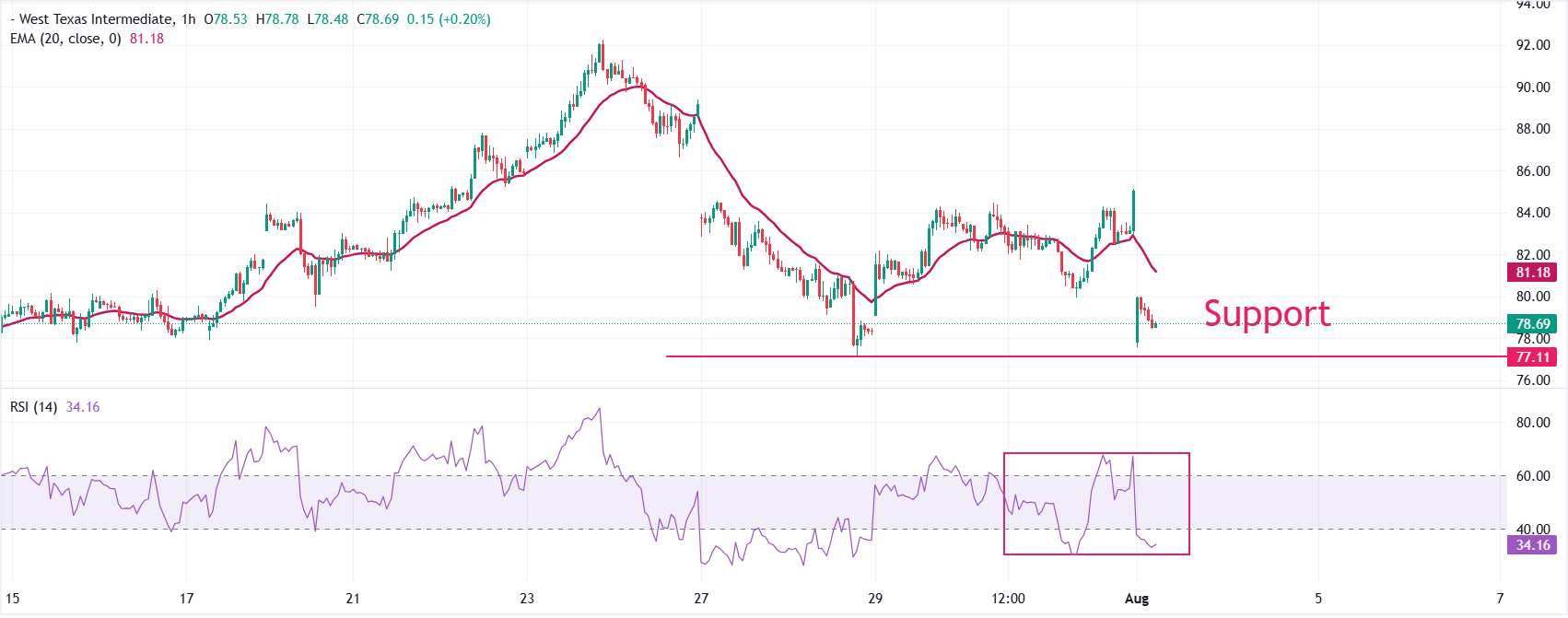
The WTI US Oil trades lower at $78.70, extending a bearish near-term bias as price remains clearly below the 20-hour exponential moving average (EMA) at $81.18. The positioning under this short-term EMA suggests sellers retain control after the recent retreat from the mid-$80s, while the Relative Strength Index (RSI) at 34.20 hovers just above oversold territory, hinting at persistent but not yet exhausted downside momentum.
On the topside, initial resistance is located at the 20-period EMA around $81.18, which now acts as the first barrier to any recovery attempts and a key level that bulls would need to reclaim to ease immediate downside pressure. Looking down, the July 28 low at $77.16 is the key support level; a break below that would expose the oil price to the July 13 low at $72.53.
(The technical analysis of this story was written with the help of an AI tool. Know more.)
WTI Oil FAQs
WTI Oil is a type of Crude Oil sold on international markets. The WTI stands for West Texas Intermediate, one of three major types including Brent and Dubai Crude. WTI is also referred to as “light” and “sweet” because of its relatively low gravity and sulfur content respectively. It is considered a high quality Oil that is easily refined. It is sourced in the United States and distributed via the Cushing hub, which is considered “The Pipeline Crossroads of the World”. It is a benchmark for the Oil market and WTI price is frequently quoted in the media.
Like all assets, supply and demand are the key drivers of WTI Oil price. As such, global growth can be a driver of increased demand and vice versa for weak global growth. Political instability, wars, and sanctions can disrupt supply and impact prices. The decisions of OPEC, a group of major Oil-producing countries, is another key driver of price. The value of the US Dollar influences the price of WTI Crude Oil, since Oil is predominantly traded in US Dollars, thus a weaker US Dollar can make Oil more affordable and vice versa.
The weekly Oil inventory reports published by the American Petroleum Institute (API) and the Energy Information Agency (EIA) impact the price of WTI Oil. Changes in inventories reflect fluctuating supply and demand. If the data shows a drop in inventories it can indicate increased demand, pushing up Oil price. Higher inventories can reflect increased supply, pushing down prices. API’s report is published every Tuesday and EIA’s the day after. Their results are usually similar, falling within 1% of each other 75% of the time. The EIA data is considered more reliable, since it is a government agency.
OPEC (Organization of the Petroleum Exporting Countries) is a group of 12 Oil-producing nations who collectively decide production quotas for member countries at twice-yearly meetings. Their decisions often impact WTI Oil prices. When OPEC decides to lower quotas, it can tighten supply, pushing up Oil prices. When OPEC increases production, it has the opposite effect. OPEC+ refers to an expanded group that includes ten extra non-OPEC members, the most notable of which is Russia.
Author

Sagar Dua
FXStreet
Sagar Dua is associated with the financial markets from his college days. Along with pursuing post-graduation in Commerce in 2014, he started his markets training with chart analysis.