WTI Price Analysis: Middle East war de-escalation restricts oil rally around $103.40
- The oil price corrects further to near $96.60 as Middle East ceasefire hopes intensify.
- Iran is ready to end the war if the US guarantees no repetitive aggression.
- The UAE calls for forced Hormuz reopening, ready to join the US and allies.

West Texas Intermediate (WTI), futures on NYMEX, is down 0.8% to near $96.60 in the early European trade on Wednesday. The oil price extends its correction from the three-week high of 103.33 posted on Tuesday on hopes of a ceasefire in the Middle East war.
The expectation of peace in the Middle East has intensified, following comments from both the United States (US) and Iran that they are ready to end the war.
According to the Iranian state news agency, Iran’s President Masoud Pezeshkian told European Union (EU) Council President António Costa on Tuesday that his country is ready to end the war with the US, but it needs certain guarantees of no repetitive aggression. This is the first time that Iran has discussed peace in the Middle East and not extending attacks on Gulf nations.
Meanwhile, the oil price retracement could prove to be short-lived as the Strait of Hormuz, a passage to almost 20% of global energy supply, is expected to remain covered under Iran’s military influence.
Earlier in the day, the United Arab Emirates (UAE) expressed willingness to join the US and other allies in the forceful reopening of the Hormuz, the Wall Street Journal (WSJ) reported.
WTI technical analysis
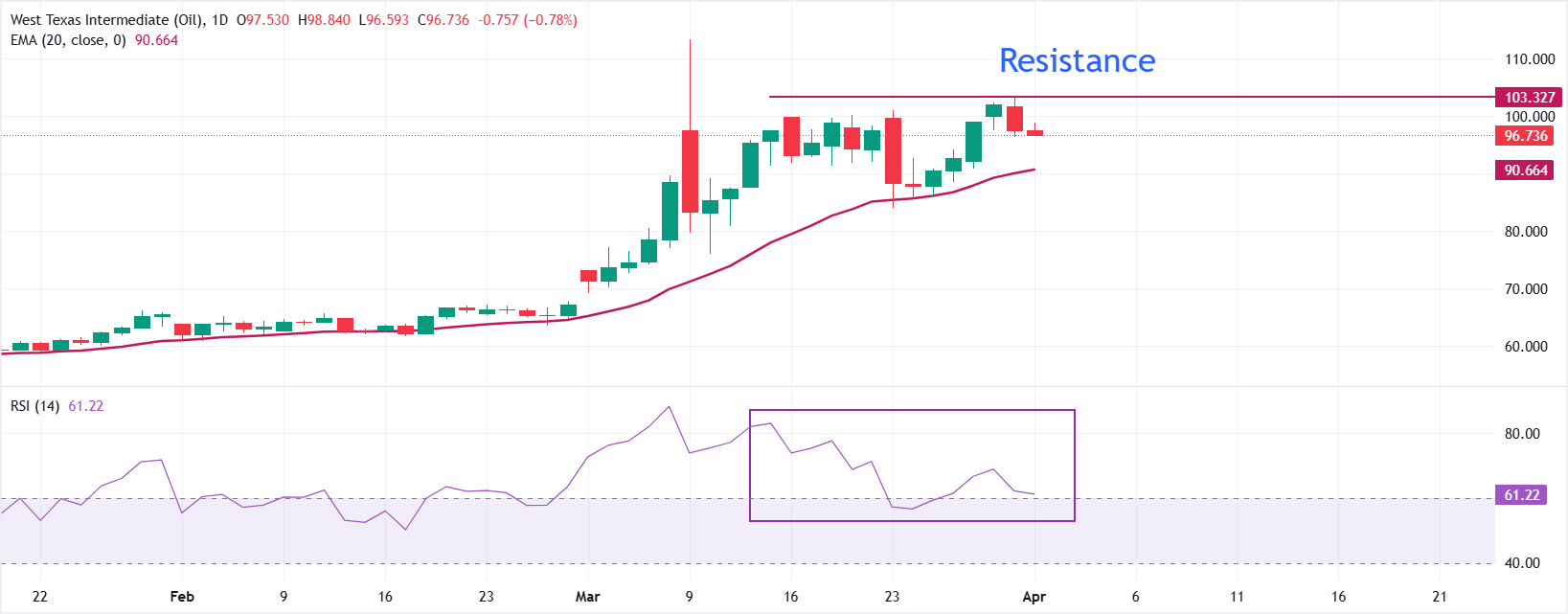
WTI US Oil trades lower at around $96.60 as of writing. However, the near-term bias remains bullish, with price holding well above the rising 20-day Exponential Moving Average (EMA) near $90.70, which underpins the broader uptrend from the mid-$60s. Recent dips toward the low $90s attracted buyers, preserving a pattern of higher lows and keeping the advance from $84 intact.
The RSI at 61 signals firm positive momentum rather than exhaustion, indicating that buyers retain control despite the recent pullback from the $103.41 peak.
Initial resistance emerges at $100.00, followed by the recent top at $103.41. A sustained break above the latter would open the way toward the mid-$100s and extend the current bullish phase. On the downside, immediate support is seen at $93.00–$94.00, where recent lows cluster above the 20-day EMA and prior consolidation. A deeper setback would expose the dynamic support of the 20-day EMA around $90.70, and a daily close below this area would weaken the bullish bias and point to a broader corrective phase toward the high-$80s.
(The technical analysis of this story was written with the help of an AI tool.)
(This story was corrected at 08:10 GMT to say in the second paragraph of the Technical Analysis part that the recent pullback is $103.41 peak, and not $101.97.)
WTI Oil FAQs
WTI Oil is a type of Crude Oil sold on international markets. The WTI stands for West Texas Intermediate, one of three major types including Brent and Dubai Crude. WTI is also referred to as “light” and “sweet” because of its relatively low gravity and sulfur content respectively. It is considered a high quality Oil that is easily refined. It is sourced in the United States and distributed via the Cushing hub, which is considered “The Pipeline Crossroads of the World”. It is a benchmark for the Oil market and WTI price is frequently quoted in the media.
Like all assets, supply and demand are the key drivers of WTI Oil price. As such, global growth can be a driver of increased demand and vice versa for weak global growth. Political instability, wars, and sanctions can disrupt supply and impact prices. The decisions of OPEC, a group of major Oil-producing countries, is another key driver of price. The value of the US Dollar influences the price of WTI Crude Oil, since Oil is predominantly traded in US Dollars, thus a weaker US Dollar can make Oil more affordable and vice versa.
The weekly Oil inventory reports published by the American Petroleum Institute (API) and the Energy Information Agency (EIA) impact the price of WTI Oil. Changes in inventories reflect fluctuating supply and demand. If the data shows a drop in inventories it can indicate increased demand, pushing up Oil price. Higher inventories can reflect increased supply, pushing down prices. API’s report is published every Tuesday and EIA’s the day after. Their results are usually similar, falling within 1% of each other 75% of the time. The EIA data is considered more reliable, since it is a government agency.
OPEC (Organization of the Petroleum Exporting Countries) is a group of 12 Oil-producing nations who collectively decide production quotas for member countries at twice-yearly meetings. Their decisions often impact WTI Oil prices. When OPEC decides to lower quotas, it can tighten supply, pushing up Oil prices. When OPEC increases production, it has the opposite effect. OPEC+ refers to an expanded group that includes ten extra non-OPEC members, the most notable of which is Russia.
Author

Sagar Dua
FXStreet
Sagar Dua is associated with the financial markets from his college days. Along with pursuing post-graduation in Commerce in 2014, he started his markets training with chart analysis.














