|

WTI flirts with the 200-day SMA below $40.00/bbl ahead of EIA

  • Prices of the WTI remains side-lined below the $40.00 mark.
  • Markit’s PMI, Powell’s testimony leaves the attention on the dollar.
  • The weekly EIA’s report on inventories is coming up next.

Prices of the WTI are alternating gains with losses below the key $40.00 mark per barrel on Wednesday.

WTI looks to Powell, EIA

The barrel of the West Texas Intermediate is hovering around the key 200-day SMA just below the key $40.00 mark following two consecutive daily pullbacks and amidst the moderate recovery in the greenback.

Traders continue to look to the impact of the coronavirus pandemic on the global economy and in particular on the demand for the commodity. While demand outlook for crude oil remains fragile, the likeliness of selective lockdowns appears to have mitigated concerns in the industry somewhat.

Also putting extra pressure on prices, Libya’s National Oil Corporation (NOC) is expected to resume the activity as well as exports of crude oil in oilfields and ports free of military presence (paramilitary and mercenary). The NOC expects production to increase to 260K bpd from the next week.

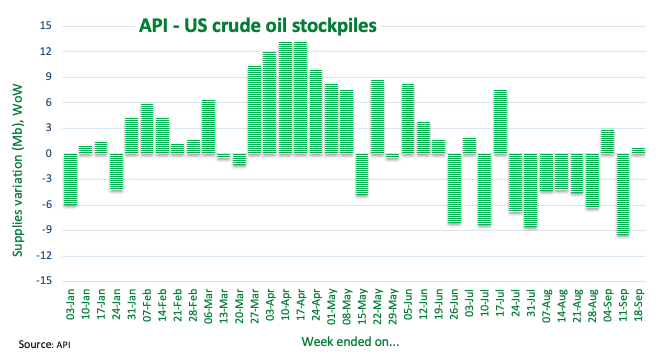
Late on Tuesday, the API reported an unexpected 691K build in crude oil supplies during last week, which is also limiting the upside on Wednesday ahead of the EIA’s weekly report.
Traders will also pay attention to the second testimony by Fed’s Powell before the House of Representatives and the release of Markit’s preliminary manufacturing and services PMIs, as a gauge of the sentiment surrounding the US economic recovery.

WTI significant levels

At the moment the barrel of WTI is gaining 0.47% at $39.92 and faces the next hurdle at $41.46 (weekly high Sep.18) seconded by $43.75 (monthly high Aug.26) and finally $48.64 (monthly high Mar.3). On the downside, a breach of $38.67 (weekly low Sep.21) would aim for $38.56 (100-day SMA) and then $36.15 (monthly low Sep.8).

Author

Pablo Piovano

Born and bred in Argentina, Pablo has been carrying on with his passion for FX markets and trading since his first college years.


More from Pablo Piovano
Share:

Editor's Picks

AUD/USD turns south toward 0.6900 as USD firms up

AUD/USD sees fresh selling and drops toward 0.6900 in late Asian trading on Monday, as renewed US Dollar strength weighs on the pair amid lingering Middle East and Russia-Ukraine geopolitical tensions. Focus remains on Oil prices, Treasury bond yields, and RBA expectations for fresh trading impetus in the major.

USD/JPY retakes 158.00 amid hawkish BoJ bets, firmer USD

USD/JPY erases losses and retakes 158.00 in the Asian session on Monday, trading within a one-week-old range. Geopolitical uncertainty continues to underpin the US Dollar, despite fading Fed rate hike hopes, supporting the pair's rebound. However, further upside could be capped by hawkish BoJ expectations and looming intervention risks that could support the Japanese Yen.

Gold languishes below $4,200 amid high US yields

Gold trims some losses on Monday, but remains trapped within previous ranges, with upside attempts limited below $4,200 and with two-month lows of $4,110 at a short distance. The recent pullback on the US Dollar Index has provided some support for precious metals although the high US Treasury yields are keeping a floor on US Dollar dips so far.

Pi Network risks a steeper decline as bearish momentum builds

Pi Network extends losses below $0.090 maintaining a steady decline for the fifth consecutive day. The retail demand remains firm, with the notional value of active perpeutals holding above $10 million. The technical outlook for PI remains bearish as bearish momentum mounts.

ISM Services PMI expected to show robust US economy in September

The US ISM Services PMI is expected to improve marginally in September. The US services sector is expected to remain well into expansionary territory. Bets of further Fed tightening appear to have lost traction in the last few days.

The Euro is near a one-year low: Inflation could trigger its rebound, not its fall

EUR/USD has fallen to its lowest level since May 2025. The pair hit 1.1312 on Wednesday and trades well below the January peak of 1.2082. The decline reflects a powerful combination of US Dollar strength, geopolitical uncertainty and renewed concerns about Europe's exposure to higher energy prices.