British Pound rebounds as soft JOLTS and Oil decline pressure USD
- GBP/USD rebounds from a daily low of 1.3419 as softer-than-expected jobs data weighs.
- Oil slide boosts risk appetite as Hormuz deal hopes rise.
- Fed-tightening bets ease, keeping US Dollar recovery attempts limited.

The Pound Sterling (GBP) recovers some ground against the US Dollar (USD) on Tuesday, up 0.14%, as US jobs data was softer than expected but confirmed the strength of the labor market, with layoffs being little changed. The GBP/USD pair trades at 1.3451 after rebounding from 1.3419.
GBP/USD aims higher due to reduced Fed hawkish bets weighing on the Greenback
The US Job Openings and Labor Turnover Survey (JOLTS) in June dipped from 7.537 million to 7.359 million, beneath forecasts of 7.4 million.
Vacancies fell due to a slowdown in healthcare, wholesale trade, business services and leisure and hospitality. The limited layoffs suggest low firing and low hiring, and show about one vacancy for each unemployed worker, indicating a balanced labor market.
The US Commerce Department reported that the trade deficit narrowed in June, down from $-77.6 billion to $-73.3 billion, slightly above the estimates of $-73 billion.
An improvement in risk appetite is underpinning the GBP/USD pair. Hopes that the US and Iran might reach a deal on Wednesday to reopen the Strait of Hormuz pushed Oil prices lower, with West Texas Intermediate (WTI), the US crude benchmark, falling 4% to $76.73 per barrel.
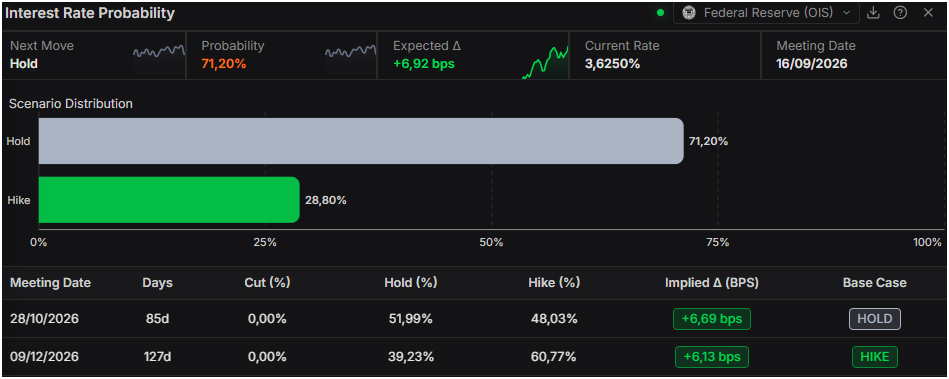
The US Dollar Index (DXY), which tracks the buck’s value against six currencies, is down 0.04% to 99.94, dragged lower by crude Oil amid its recent positive correlation. Another factor behind the Greenback’s fall is traders trimming Fed-hawkish bets, as they see just about 20 basis points of tightening towards the end of the year, four fewer than a day ago, according to Prime Terminal data.
In the UK, an absent economic docket keeps investors focused on the fiscal policy enacted by the new Prime Minister Andy Burnham. Last week the Chancellor of the Exchequer John Healey told cabinet members to reduce their budgets, aimed to create space for commitments by the new PM.
The US economic docket will feature further jobs data, led by jobless claims on Thursday, followed by Nonfarm Payrolls on Friday. Across the pond, the UK economic schedule will remain absent.
GBP/USD Price Forecast: Technical outlook
In the daily chart, GBP/USD trades at 1.3451, maintaining a mildly bullish near-term bias as spot holds above the clustered support zone defined by the simple moving average triple around 1.3364 and the reclaimed downward trend-line break near 1.3445. The pair also trades above the shorter-term upward trend-line break at 1.3308, while the Relative Strength Index (14) at 56.5 points to constructive but not overstretched momentum, suggesting scope for further gains as long as the pair stays supported on dips.
On the downside, immediate support is seen around 1.3445, followed by the simple moving average cluster near 1.3364 and then the former upward trend-line break at 1.3308. On the topside, initial resistance emerges at the more recent downward resistance trend-line break around 1.3526, with the higher upward trend-line break at 1.3548 acting as the next cap; a sustained move above this band would open the way for a deeper recovery toward previous highs, while failure to clear it would keep the pair consolidating within the current range.
(The technical analysis of this story was written with the help of an AI tool. Know more.)
Pound Sterling FAQs
The Pound Sterling (GBP) is the oldest currency in the world (886 AD) and the official currency of the United Kingdom. It is the fourth most traded unit for foreign exchange (FX) in the world, accounting for 12% of all transactions, averaging $630 billion a day, according to 2022 data. Its key trading pairs are GBP/USD, also known as ‘Cable’, which accounts for 11% of FX, GBP/JPY, or the ‘Dragon’ as it is known by traders (3%), and EUR/GBP (2%). The Pound Sterling is issued by the Bank of England (BoE).
The single most important factor influencing the value of the Pound Sterling is monetary policy decided by the Bank of England. The BoE bases its decisions on whether it has achieved its primary goal of “price stability” – a steady inflation rate of around 2%. Its primary tool for achieving this is the adjustment of interest rates. When inflation is too high, the BoE will try to rein it in by raising interest rates, making it more expensive for people and businesses to access credit. This is generally positive for GBP, as higher interest rates make the UK a more attractive place for global investors to park their money. When inflation falls too low it is a sign economic growth is slowing. In this scenario, the BoE will consider lowering interest rates to cheapen credit so businesses will borrow more to invest in growth-generating projects.
Data releases gauge the health of the economy and can impact the value of the Pound Sterling. Indicators such as GDP, Manufacturing and Services PMIs, and employment can all influence the direction of the GBP. A strong economy is good for Sterling. Not only does it attract more foreign investment but it may encourage the BoE to put up interest rates, which will directly strengthen GBP. Otherwise, if economic data is weak, the Pound Sterling is likely to fall.
Another significant data release for the Pound Sterling is the Trade Balance. This indicator measures the difference between what a country earns from its exports and what it spends on imports over a given period. If a country produces highly sought-after exports, its currency will benefit purely from the extra demand created from foreign buyers seeking to purchase these goods. Therefore, a positive net Trade Balance strengthens a currency and vice versa for a negative balance.
Author

Christian Borjon Valencia
FXStreet
Markets analyst, news editor, and trading instructor with over 14 years of experience across FX, commodities, US equity indices, and global macro markets.














