Why the Swiss Franc isn’t likely to move far from 0.9200 against the Euro

The Swiss Franc (CHF) trades in a tight range against the Euro (EUR) as the Swiss National Bank (SNB) actively works to neutralize safe-haven capital inflows stemming from increased geopolitical woes.
While the European Central Bank's (ECB) restrictive monetary policy and recent rate hikes have provided a steady tailwind for the Euro, the SNB has leaned heavily into direct foreign exchange interventions to prevent an excessive appreciation of the Franc. Consequently, macro analysts project a period of near-term consolidation for the cross.
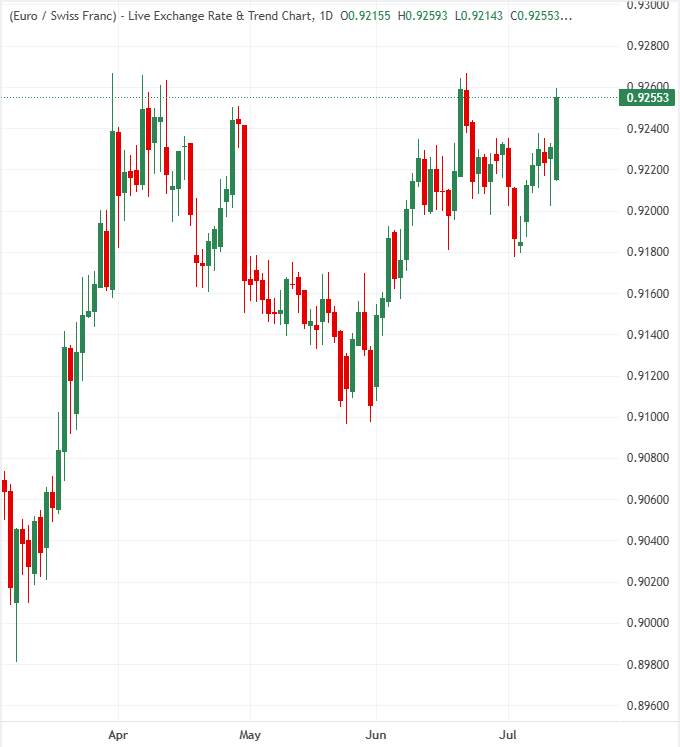
ECB hawkishness shields Euro from safe-haven Swiss Franc strength
Senior FX strategy experts at Rabobank note that the persistent hawkishness of the ECB has effectively relieved the intense downward pressure that previously plagued the EUR/CHF exchange rate. Although a modest rebound in the pair from its recent lows has raised some concerns about imported inflation creeping into Switzerland during the third quarter, the Euro remains structurally supported by the contrast in central bank postures. If Eurozone policymakers extend their tightening cycle, it could eventually force the SNB to contemplate its own move toward the turn of the year.
That said, the hawkishness of the ECB will have relieved some pressure on the EUR/CHF exchange rate and thus on the SNB. We expect further consolidation around the EUR/CHF 0.92 area on a 3-month view with potential for a slight upside bias reflecting ECB hawkishness.
SNB relies on active currency intervention to curb Franc appreciation
Rabobank highlights that the SNB has been pushing back against speculative Franc buying. Official data confirms that the central bank purchased billions in foreign currency during the first quarter to actively depress the local currency's value. With domestic inflation remaining low and growth risks appearing modest, SNB President Martin Schlegel has reaffirmed that direct market intervention remains the bank’s preferred first line of defense.
For now, we expect that the SNB’s focus will remain on emphasising that FX intervention is a policy tool with the aim of dissuading speculative buying and preventing the CHF from appreciating.
Analysts anticipate a range-bound trajectory for the Euro-Swiss cross
Banks anticipate a range-bound near-term trend for the EUR/CHF pair. Rabobank projects that the currency cross will closely orbit the 0.9200 threshold over a three-month horizon, supported by a mild upside bias from the ECB's relative hawkishness. However, because any aggressive appreciation of the Swiss Franc will be met with swift, unannounced currency sales by the SNB, the pair is expected to remain firmly trapped in a well-defined lateral band for the foreseeable future.
(This article was created with the help of an Artificial Intelligence tool and reviewed by an editor. Know more.)
Author

FXStreet Insights Team
FXStreet
The FXStreet Insights Team is a group of journalists that handpicks selected market observations published by renowned experts. The content includes notes by commercial as well as additional insights by internal and external analysts.