|

Why Goldman Sachs and JPMorgan think this payrolls report could rattle markets
Thank you for reading my posts. You may have noticed that some articles are now appearing behind a paywall.
Chart

Going forward, my trader interpretations of leading Wall Street banks’ actual research and institutional strategy notes ( and eventually those notes themselves) will become a much bigger part of The Dark Side of the Boom. These are often the ideas that move markets before the headlines catch up, and I believe they offer some of the most valuable insights for traders and investors trying to stay ahead of the curve.

Non-premium content remains free, in line with my commitment to keeping my blog accessible to everyone..

If you’d like to bypass the paywall entirely, you can either open an Axi trading account or subscribe directly through Substack.

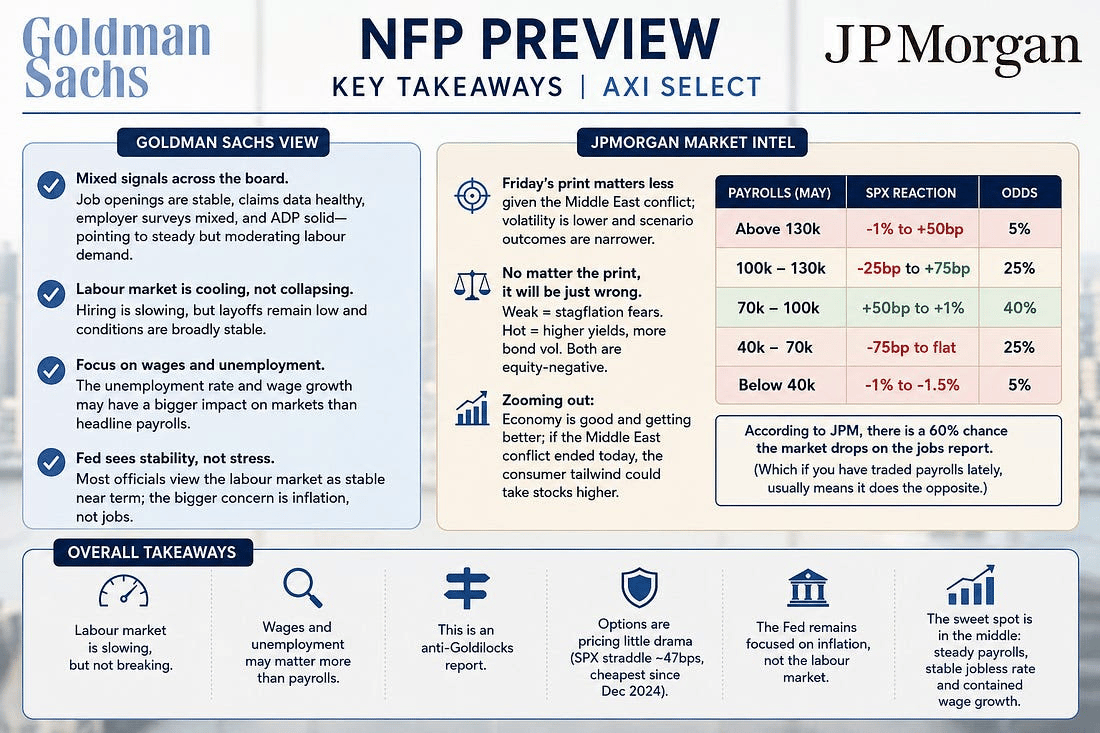
  • The labour market is slowing, but not breaking. Most indicators point to a gradual cooling in hiring rather than a sharp deterioration in employment conditions.
  • Wages and unemployment may matter more than payrolls. A stable jobless rate and moderating earnings could be more important for markets than the headline jobs number itself.
  • This is shaping up as an anti-Goldilocks report. A weak print risks reviving stagflation concerns, while a strong print could push yields higher and pressure equities.
  • Options markets are pricing very little drama. With the S&P straddle near its cheapest level for an NFP release since late 2024, the risk may be that investors are underestimating the potential for a larger move.
  • The Fed remains focused on inflation. Policymakers broadly view the labour market as stable, leaving energy prices, tariffs and inflation expectations as the primary drivers of the policy outlook.
  • The sweet spot remains somewhere in the middle. Payroll growth that is neither too hot nor too cold, combined with stable unemployment and contained wage growth, remains the outcome most likely to support risk assets...

Author

Stephen Innes

Stephen Innes

SPI Asset Management

With more than 25 years of experience, Stephen has a deep-seated knowledge of G10 and Asian currency markets as well as precious metal and oil markets.


More from Stephen Innes
Share:

Editor's Picks

AUD/USD falls to near 0.7100 after slipping below 50-day EMA

AUD/USD depreciates after registering minor gains in the previous day, trading around 0.7120 during the Asian hours. The technical analysis of the daily chart shows the pair consolidating sideways within a rectangle pattern, as neither bulls nor bears gain control. The AUD/USD pair is holding a slight bearish tone however as it sits beneath both the nine-day and 50-day EMAs.

USD/JPY consolidates near 160.00 as US NFP takes centre stage

The USD/JPY pair trades in a tight range around 160.00 during the European trading session. The pair wobbles as investors await the United States Nonfarm Payrolls data for May, which will be published at 12:30 GMT. Investors will closely monitor the employment data to get fresh cues regarding the Federal Reserve’s monetary policy outlook.

Gold remains offered below $4,500 following US Payrolls

Gold prices trade with a bearish bias and still remain below the key $4,500 mark per troy ounce at the end of the week. The slighlty softer tone in the US Dollar alongside mixed US Treasury yields across the curve also keep the yellow metal’s downside somewhat contained.


Cardano hits five-year low even as Hoskinson clarifies "break" isn't an exit

Cardano (ADA) price is down 10% at press time on Friday, extending losses over 30% so far this week amid Charles Hoskinson's clarification that "break" isn't an exit.

Week ahead – Fed countdown begins amid US inflation data and geopolitical risks

Fed Chair Warsh’s first meeting approaches as key US inflation data could reshape expectations. Oil prices remain elevated as US-Iran talks continue; tariffs also return to the spotlight. ECB is expected to hike; will it be a one-off move or is July live?

The US economy defies the rules: 100 days into the Oil shock and the recession signal is still missing

More than three months after the start of the Iran war and the resulting disruption to global energy markets, the US economy continues to display remarkable resilience. The conflict has triggered a sharp rise in Oil prices, reignited inflationary pressures and fueled widespread concerns about a potential economic slowdown.














