|

Whirlpool (WHR) sends economic shockwaves with huge warning

Shares of Whirlpool Corporation (WHR) collapsed 20% in early trading on Thursday, May 7, 2026, after the appliance maker reported earnings and revenue that missed analyst forecasts. Wall Street had expected a profit of $0.38 per share, but the company instead reported a staggering loss of $0.56 per share. Revenue also disappointed, coming in at $3.27 billion against a projected $3.44 billion.

To make matters worse, Whirlpool significantly slashed its forward guidance, citing three major headwinds:

  • Geopolitical Tension: The Iran-U.S. conflict is crushing consumer confidence.
  • Housing Market Weakness: A stagnant real estate sector is stifling appliance demand.
  • Rising Costs: Inflationary pressures have forced the company to raise prices dramatically.

In the near term, these three factors represent a potential deathblow for the company. Adding to the pain for shareholders, Whirlpool has officially suspended its dividend.

Technical analysis and trade levels

From a technical perspective, there is intraday support around the $40 level for day traders. However, for a high-probability swing trade, the level I am watching is much lower—specifically the $20–$21 range. This area represents the major double-bottom low from the 2009 financial crisis.

The bottom line

In my opinion, this report highlights the widening gap between the "real economy" and the "AI economy." While AI-related capital expenditures are keeping certain sectors roaring, the rest of the economy appears to be in a recession.
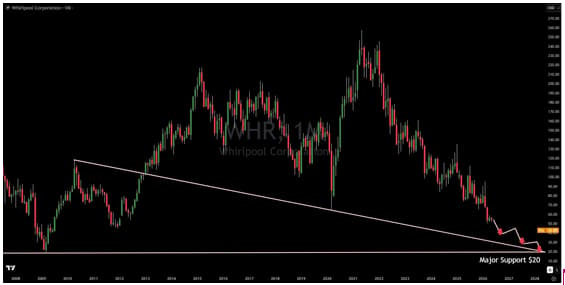
Chart

Author

Gareth Soloway

Gareth Soloway

Verified Investing

A renowned trader and financial expert specializing in chart analysis and market insights.

More from Gareth Soloway
Share:

Editor's Picks

AUD/USD bulls regain control above 0.6950 amid USD retreat

AUD/USD regains traction and extends the previous day's bounce from the weekly low, aiming for 0.7000 in Asia on Friday. The overnight pullback in US bond yields keeps the US Dollar below an 18-month high, which in turn offers some support to the pair. Meanwhile, hawkish RBA expectations also keep the major underpinned.

USD/JPY holds gains near 158.00 after Japan's weak Household Spending data

USD/JPY clings to gains around 158.00 after data showed on Friday that Japan's Household Spending fell for the ninth straight month, undermining the Japanese Yen. Meanwhile, the US Dollar remains depressed as the overnight fall in US bond yields counters a hawkish Fed and geopolitical uncertainties, could cap any downside in the pair.

Gold remains range-bound below $4,200

Gold has given up some ground after an initial bullish attempt to reach weekly highs, returning to below the $4,200 mark per troy ounce on Friday. The US Dollar’s strong upside momentum, combined with rising US Treasury yields across the curve, seems to keep further gains in the yellow metal under scrutiny.

Has Bitcoin really escaped the macro forces it was built to fight?
Over 17 years ago, Satoshi Nakamoto designed Bitcoin (BTC) on the back of a global financial crisis as an alternative to the global monetary system outside the control of central banks, governments and traditional intermediaries. This raises a key question: has Bitcoin really become independent of the macroeconomic forces it was built to challenge?
The Euro is not the sick man of Europe. France's bond market is
EUR/USD remains under pressure, near the 17-month low of 1.1161 reached on Monday. The pair has lost more than 7% since its yearly peak, as concerns over France's public finances increasingly weigh on the single currency. But behind the weakness of the Euro (EUR), the problem does not necessarily lie with the European economy as a whole.
Has Bitcoin really escaped the macro forces it was built to fight?
Over 17 years ago, Satoshi Nakamoto designed Bitcoin (BTC) on the back of a global financial crisis as an alternative to the global monetary system outside the control of central banks, governments and traditional intermediaries. This raises a key question: has Bitcoin really become independent of the macroeconomic forces it was built to challenge?















