|

When is the RBA and how might AUD react?

The statement on the outcome of the RBA Board meeting is released at 04.30 GMT today, Tuesday, May 5. It is universally expected that the cash rate will be held at a record low of 0.1%.

Analysts at Westpac explained that the focus will be on any shift in language in the decision statement, especially the final sentence of the March statement declaring that "Board is prepared to be patient."

''Inflation is now back in the target band and the unemployment rate, at 4.0%, will soon move below 4% for the first time since 1974,'' the analysts explained.

''However, the RBA has stated that it will not lift rates until inflation is “sustainably” within the target band – which requires a lift in wages growth from current relatively modest levels. We anticipate that by August, with the benefit of additional information on inflation, wages and unemployment, the case will be made for the tightening cycle to commence.''

How will AUD react?

Positive global risk sentiment underpinned AUD which made a new yearly high overnight, running deeper into weekly resistance. The question is, will it continue beyond here?

''The most crucial aspect of the post-meeting statement is whether it repeats the longstanding reference to the Board being 'patient as it monitors how the various factors affecting inflation in Australia evolve,''' analysts at ANZ Bank said. 

''We would interpret the removal of any reference to patience as a hawkish development that points to the May Board meeting as being live,'' they argued. This would then be expected to drive the Aussie forward.

AUD/USD H1 chart
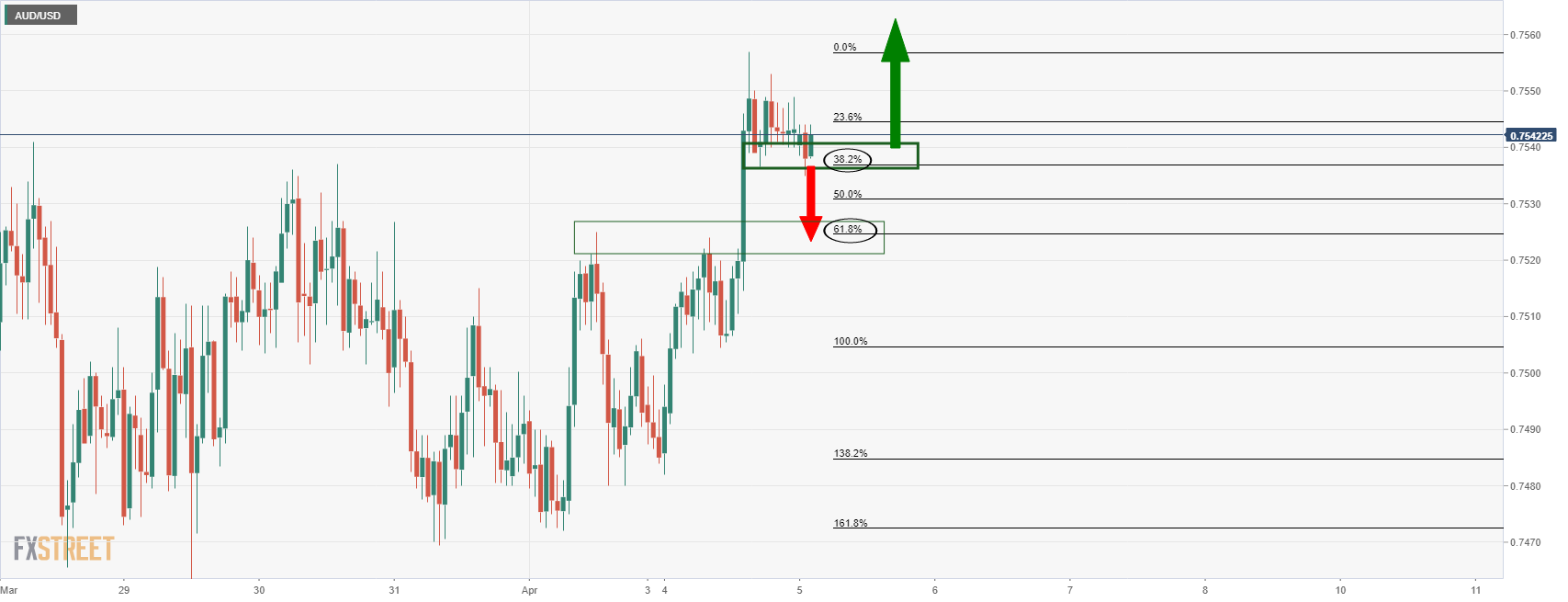
Support is found at the 38.2% Fibonacci level near 0.7535. A break here will open the risk of a quick move into the prior resistance near 0.7525 that meets the 61.8% Fibonacci retracement area. Conversely, a hawkish outcome will send the pair up to test weekly resistance around 0.7560 and far beyond with 0.7650 eyed. 

Author

Ross J Burland

Ross J Burland, born in England, UK, is a sportsman at heart. He played Rugby and Judo for his county, Kent and the South East of England Rugby team.


More from Ross J Burland
Share:

Editor's Picks

AUD/USD bounces off multi-month low, nears 0.6900

AUD/USD edges higher toward 0.6900 in the Asian session on Wednesday, recovering some of the previous day’s losses to its lowest level since March as the US Dollar stalls the hot US CPI-inspired rally amid hopes of a US-Iran peace deal. Meanwhile, hawkish comments from FOMC members have almost confirmed another December rate hike, which favors USD bulls and should cap the Aussie.

USD/JPY remains capped below 159.00 amid looming intervention risks

USD/JPY struggles to build on the previous day’s strong gains to a near one-month top as intervention risk supports the Japanese Yen while hopes of a US-Iran peace deal cap the safe-haven US Dollar. That keeps the pair's upside limited below 159.00, for now.

Gold puts the $4,000 mark to the test

Gold now accelerates its daily correction, challenging the key $4,000 mark per troy ounce on Wednesday. The precious metal’s continuation of the downward trend comes against the backdrop of a robust performance of the US Dollar, rising US Treasury yields across the board and rising bets of extra rate hikes by the Fed.

Pump.fun Price Forecast: PUMP rises despite subdued retail demand
Pump.fun (PUMP) gains momentum on Wednesday, trading at $0.0036. The meme coin launchpad native token is up over 2% on the day, after testing lows around $0.0035. More broadly, the technical picture remains bearish, with key indicators such as the Moving Average Convergence Divergence (MACD) stuck in negative territory.
Ten questions for China in 2027

2026 has been a year of slowing growth and increasing divergence within China's economy. We saw the gap between external and domestic demand, as well as between the new economy and the old economy, widen significantly. Here, we look ahead to the key questions facing China in 2027.

What the US CPI headline doesn’t tell you about inflation

Brent crude has fallen about a third since mid-October on hopes the Iran war is ending, but diesel, freight and fertiliser costs haven't followed. Those costs reach US consumer prices in stages through 2027 and could keep inflation high after gasoline gets cheaper.