What drove the Japanese Yen recovery from 162.60 to 160.60 in a single session?

The Japanese Yen (JPY) has staged a sharp recovery against the US Dollar, recovering from its weakest level in 40 years at around 162.50 to the 160.00-161.00 handle.
This reversal is fueled by a double-whammy of macro catalysts: a significantly weaker-than-expected US Nonfarm Payrolls report and intense market speculation of unconfirmed, "stealth" foreign exchange intervention by the Japanese Ministry of Finance (MoF).
As global markets recalibrate their expectations for US monetary policy heading into the second half of 2026, the near-term path for the USD/JPY currency cross is becoming increasingly defined by low summer liquidity and aggressive positioning shakeouts.
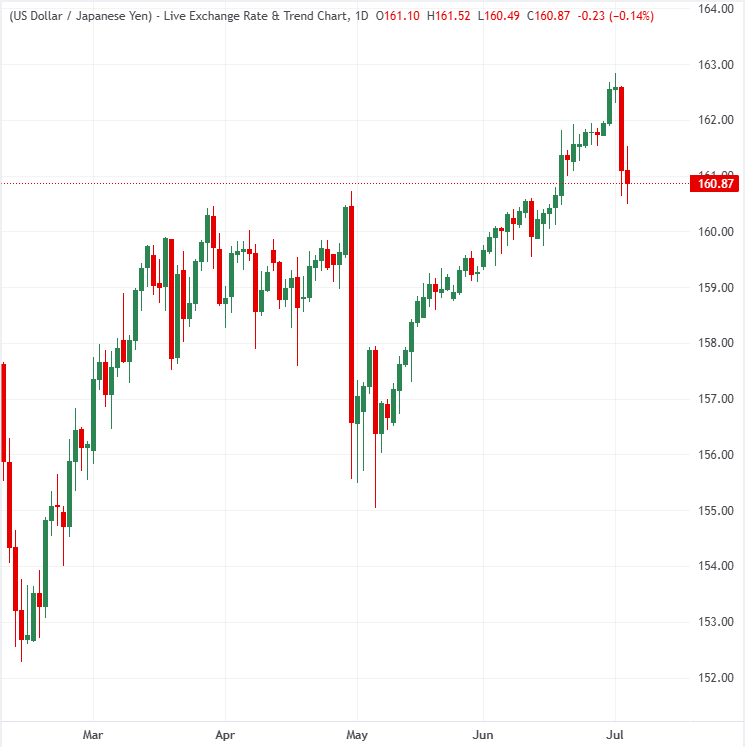
Soft US labor data and unconfirmed intervention ambush Yen shorts
According to currency analysts at MUFG, the unexpected cooling of the US labor market (where payrolls grew by a meager 57,000 against a consensus expectation of 110,000) has effectively taken the immediate pressure off the Federal Reserve to consider near-term interest rate hikes.
This macroeconomic soft patch could have created an ideal window for Japanese authorities to quietly step into the market to punish overextended speculative short positions without providing prior warnings.
While it was not officially confirmed whether Japanese authorities intervened yesterday to bring USD/JPY lower, our bias is as such that intervention if it has indeed started may continue for a while more in order to help flush out speculative positions.
Repriced Fed expectations put a firm ceiling on USD/JPY upside
The research team at Commerzbank underscores that the combination of downward job revisions and a soft June US payrolls print has forced fixed-income markets to trim cumulative Fed tightening bets for the remainder of the year. With the Fed funds futures lowering priced-in hikes from 36 basis points to 30 basis points, the macro incentive to buy the US Dollar against the Japanese Yen is fracturing.
Pressure for an interest rate hike at the Fed meeting in late July continues to ease. We continue to expect US key interest rates to remain unchanged this year.
Has the USD/JPY pair reached a peak?
The banks project that the Yen is likely to maintain its newly recovered footing. MUFG advises market participants to remain highly cautious, noting that an upcoming period of low holiday liquidity in the US provides the perfect tactical backdrop for Japanese authorities to extend its intervention campaign and clean out remaining speculative bears. Commerzbank points out that because US benchmark interest rates are projected to sit completely unchanged for the rest of 2026, the structural upside for USD/JPY is effectively capped, leaving the pair highly vulnerable to further downward adjustments on any upcoming US inflation misses.
(This article was created with the help of an Artificial Intelligence tool and reviewed by an editor. Know more.)
(This story was corrected on July 3 at 11:15 GMT to say, in the first paragraph, that the Japanese Yen rose up to the 161.00-160.00 area, not down.)
Author

FXStreet Insights Team
FXStreet
The FXStreet Insights Team is a group of journalists that handpicks selected market observations published by renowned experts. The content includes notes by commercial as well as additional insights by internal and external analysts.

















