What can we expect from the RBNZ monetary policy decision?
- RBNZ expected to raise OCR to 3%, with markets fully pricing hike.
- New Zealand inflation remains elevated at 3.7%, supporting further tightening.
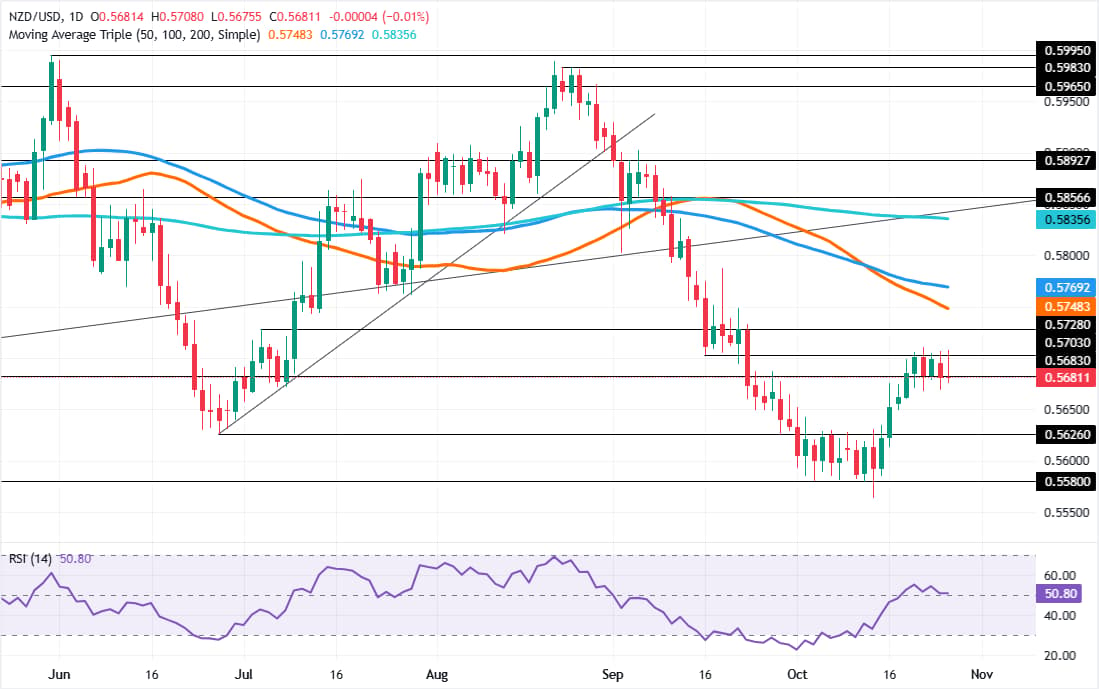
- NZD/USD faces resistance at 0.5748–0.5769, with 0.5600 as key support.

On Wednesday, October 28 at 01:00 GMT, the Reserve Bank of New Zealand (RBNZ), led by Governor Anna Breman, is expected to raise the Overnight Cash Rate (OCR) by 25 basis points, from 2.75% to 3%, as money markets price in a 100% chance.
RBNZ guidance in focus after a 100% chance of a rate hike
This would be the third-rate hike by the RBNZ, while the odds for another hike in December are nearly 50%.
In the September meeting, the Committee reached a consensus to increase the OCR, agreeing unanimously to remove monetary stimulus to drive inflation toward the 2% goal while supporting growth and the labour market. This decision was made to reduce the risk of more aggressive rate adjustments while maintaining an open mind regarding future OCR adjustments.
Of note, a rate hike would bring the OCR closer to the RBNZ's neutral range, with Governor Breman saying at a press conference following the decision that the committee is moving rates towards neutral while remaining accommodative.
Furthermore, Breman added that there will likely be a further increase in OCR, and they will assess the impact of the hikes already implemented.
Overall, this suggests the central bank is leaning towards further rate increases, though the timing remains uncertain.
Recent data suggest there is scope for further rate increases, as New Zealand GDP in Q2 exceeded forecasts at 2.6% YoY against estimates of 2.3%. Meanwhile, CPI for Q3 slowed and printed softer than expected at 3.7% YoY, beneath forecasts of 3.8%, but still was above the RBNZ’s 2% inflation objective.
What are the implications for the NZD/USD?
Currently, the NZD/USD sits comfortably at the bottom of the day’s trading range of 0.5675-0.5708, with traders waiting for a one-two punch reaction, as they are also eyeing the Federal Reserve’s decision.
If the RBNZ leans hawkish, a move to the confluence of the 50-day and 100-day Simple Moving Averages (SMAs), each at 0.5748 and 0.5769, respectively, is on the cards. If the Kiwi clears that area, a potential move towards 0.5800 is likely.
On the other hand, a dovish signal from the RBNZ could pave the way to test 0.5650 and the psychologically important 0.5600 level, guarded by traders, after trading above and below it for at least 14 days. On further weakness, the year-to-date (YTD) low of 0.5564 will be in play.
RBNZ FAQs
The Reserve Bank of New Zealand (RBNZ) is the country’s central bank. Its economic objectives are achieving and maintaining price stability – achieved when inflation, measured by the Consumer Price Index (CPI), falls within the band of between 1% and 3% – and supporting maximum sustainable employment.
The Reserve Bank of New Zealand’s (RBNZ) Monetary Policy Committee (MPC) decides the appropriate level of the Official Cash Rate (OCR) according to its objectives. When inflation is above target, the bank will attempt to tame it by raising its key OCR, making it more expensive for households and businesses to borrow money and thus cooling the economy. Higher interest rates are generally positive for the New Zealand Dollar (NZD) as they lead to higher yields, making the country a more attractive place for investors. On the contrary, lower interest rates tend to weaken NZD.
Employment is important for the Reserve Bank of New Zealand (RBNZ) because a tight labor market can fuel inflation. The RBNZ’s goal of “maximum sustainable employment” is defined as the highest use of labor resources that can be sustained over time without creating an acceleration in inflation. “When employment is at its maximum sustainable level, there will be low and stable inflation. However, if employment is above the maximum sustainable level for too long, it will eventually cause prices to rise more and more quickly, requiring the MPC to raise interest rates to keep inflation under control,” the bank says.
In extreme situations, the Reserve Bank of New Zealand (RBNZ) can enact a monetary policy tool called Quantitative Easing. QE is the process by which the RBNZ prints local currency and uses it to buy assets – usually government or corporate bonds – from banks and other financial institutions with the aim to increase the domestic money supply and spur economic activity. QE usually results in a weaker New Zealand Dollar (NZD). QE is a last resort when simply lowering interest rates is unlikely to achieve the objectives of the central bank. The RBNZ used it during the Covid-19 pandemic.
Author

Christian Borjon Valencia
FXStreet
Markets analyst, news editor, and trading instructor with over 14 years of experience across FX, commodities, US equity indices, and global macro markets.