USDCAD trims its losses and climbs toward 1.3280 on hawkish Fed commentary
- The USDCAD marches firmly toward 1.3300 following Fed official hawkish remarks.
- Federal Reserve Waller said the Fed could hike 50 bps in December or after that meeting.
- The US Dollar got bolstered by Waller’s remarks, while US Treasury yields rose.
- The Loonie is at the expense of Canadian CPI and GDP data throughout the week.

The USDCAD slightly recovers after losing for two consecutive days. The pair bounced around the 100-day Exponential Moving Average (EMA) at 1.3229, following hawkish remarks by Fed officials on Sunday. Even though factors like China’s easing Covid-19 conditions added to investors’ optimism, Fed’s Waller remarks, suggesting further tightening, spurred risk aversion. At the time of writing, the USDCAD is trading at 1.3280, up by 0.20%.
US Dollar bolstered by Fed policymaker remarks
Risk aversion is the name of the game on Monday. Sunday remarks by Federal Reserve (Fed) Governor Christopher Waller triggered a risk-off impulse. Waller said that the Fed “still has ways to go” hiking rates and commented that the US central bank could moderate the size of interest-rate increases to 50 bps at their December meeting or the one after that, reiterating that the US central bank is not close to pausing.
The US Dollar (USD), underpinned by Waller’s remarks, edged higher, as shown by the USDCAD, bottoming at around 1.3250 and climbing toward its daily high at 1.3306.
Canadian CPI and GDP data will influence Loonie’s direction
Meanwhile, on the Canadian front, the Bank of Canada (BoC) Governor Tiff Macklem said that inflation is too high and that lower-income Canadians will be “disproportionally” affected by the economic slowdown. Aside from this, the Loonie would be at the expense of the Canadian Consumer Price Index (CPI) on Wednesday, with investors expecting CPI to edge higher to 7.0% YoY in October.
Ahead in the week, the US economic docket will feature the Fed Vice-Chair Lael Brainard, October’s Producer Price Index (PPI), and the NY Empire State Manufacturing Index. On the Canadian front, New Motor Vehicle Sales, and Manufacturing/Wholesale Sales MoM for September, will shed some light ahead of Q3 GDP.
USDCAD Price Analysis: Technical outlook
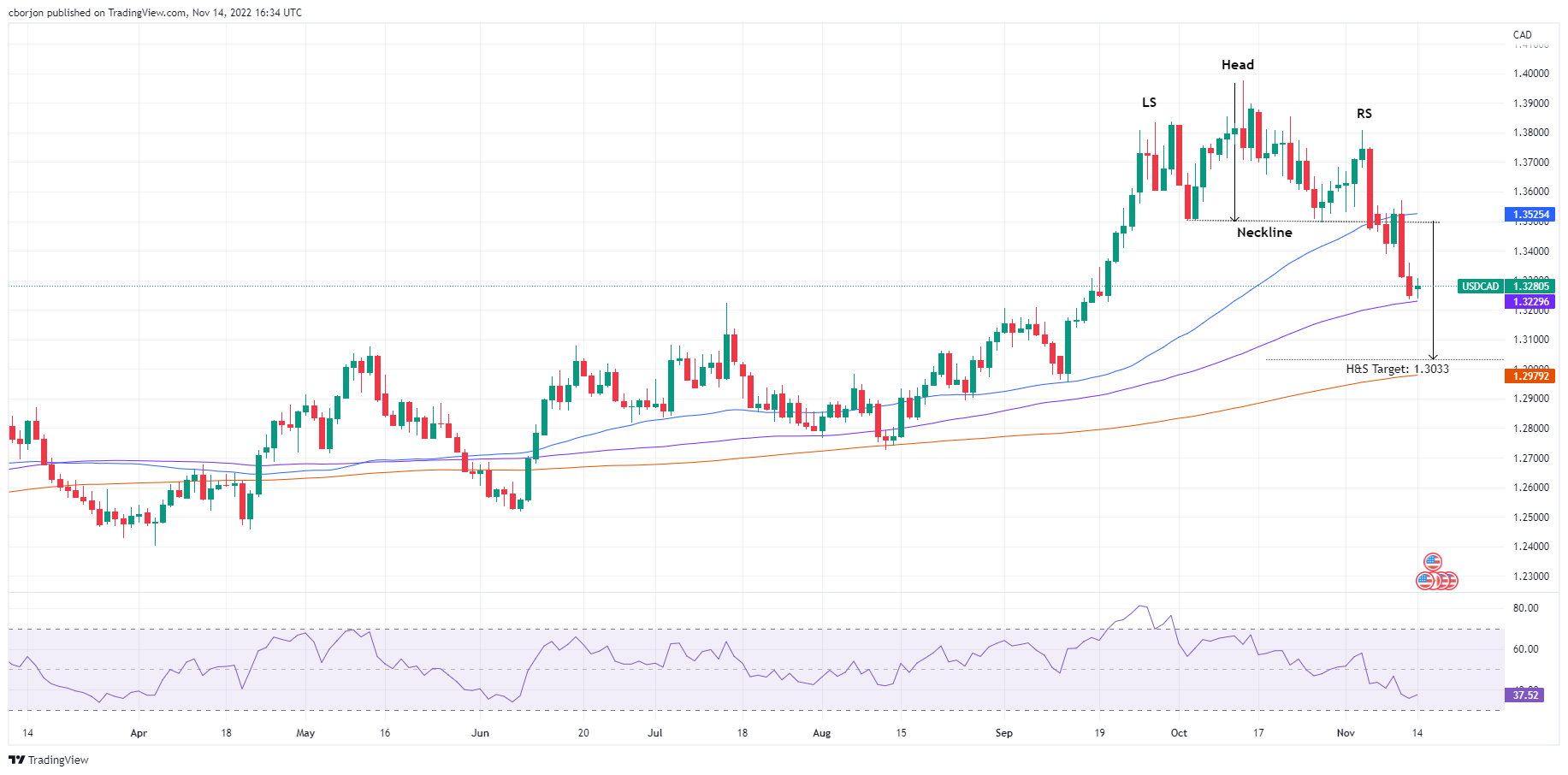
From a technical perspective, the USDCAD is neutral-to-downward biased, though it would be “firmly” cemented if CAD buyers clear the 100-day EMA, as the head-and-shoulders chart pattern remains in play. The head-and-shoulders target is 1.3033, ahead of the 200-day EMA at 1.2979.
If the USDCAD clears the 1.3300 figure, a test of the November 11 daily high at 1.3360 is on the cards. Otherwise, the major could fall towards the 100-day EMA, ahead of the 1.3200 figure. A breach of the latter will expose the 1.3100 figure ahead of the head-and-shoulders chart pattern target.
Author

Christian Borjon Valencia
FXStreet
Markets analyst, news editor, and trading instructor with over 14 years of experience across FX, commodities, US equity indices, and global macro markets.
















