USD/MXN tumbles below 17.0000 post US CPI data, eyes set on Banxico’s decision
- Soft US CPI readings suggesting no more Fed hikes needed sent the USD/MXN plunging.
- After the data, bets for additional Fed tightening dived below 30% for November and less than 10% in September.
- USD/MXN traders’ attention turns to Banxico’s decision at around 19:00 GMT.

USD/MXN plummets below 17.0000 after the Department of Labor in the United States (US) revealed that inflation rose above the prior month’s data but below estimates, seen as a sign that the US Federal Reserve (Fed) tightening cycle has ended. Hence, the USD/MXN exchanges hands at 16.9280, losses 0.74%, ahead of the Bank of Mexico (Banxico) monetary policy decision.
US inflation data underwhelms expectations, weighing on the USD, while traders await Banxico's monetary policy direction
The US Dollar (USD) cemented its faith in expectations for an inflation report that can spur speculations for further tightening by the Fed but failed to crystalize. The Consumer Price Index (CPI) rose 3.2% YoY, above June’s 3% but beneath forecasts, while core CPI, which strips volatile items, advanced 4.7% YoY, lower than the previous reading of 4.8% in June.
After the data, traders slashed bets the Fed would raise rates again, as shown by money market futures. The CME FedWatch Tools shows the chances for a rate hike in September below 10%, while for the November meeting, it dropped to 23.6% from 33.8% a month ago.
At the same time, another report from the Labor Department showed that Initial Jobless Claims for the week ending July 29 rose by 248K exceeding estimates of 230K.
Of late, the San Francisco Fed President Mary Daly stated that CPI data was good news. Still, the July report did not imply Fed’s victory n inflation, while stressing she’s data dependent and supported the last month’s Fed rate hike. She pushed back against easing monetary conditions, saying there’s a “long way from a conversation about rate cuts.”
Later in the day, Banxico is expected to hold rates unchanged at 11.25%, with traders eyeing signals about the forward path of the Mexican central bank. Dovish signs could weaken the Mexican Peso, and the USD/MXN could erase its earlier losses following US economic data releases.
USD/MXN Price Analysis: Technical outlook
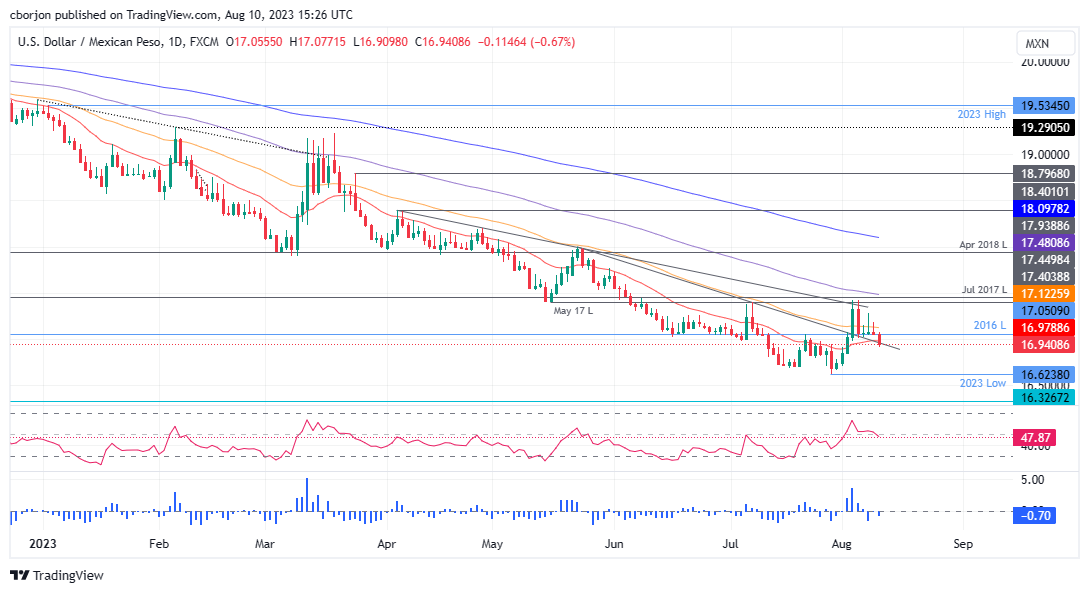
With the USD/MXN breaking support at 17.0000, the pair is testing a previously broken resistance trendline that turned support, which is cushioning USD/MXN’s fall. The USD/MXN break below the 20-day Exponential Moving Average (EMA) at 16.9771 gave another leg-down to the pair. Nevertheless, traders should be aware that Banxico’s decision late in the day could trigger a fade move in the pair’s recent fall. Key support levels lie at a year-to-date (YTD) low of 16.6238, followed by the October 2015 swing low at 16.3267. Contrarily, USD/MXN’s resistance areas emerge at the 20-day EMA at 16.9771, followed by the 17.0000 psychological level and the 50-day EMA at 17.1222.
Author

Christian Borjon Valencia
FXStreet
Markets analyst, news editor, and trading instructor with over 14 years of experience across FX, commodities, US equity indices, and global macro markets.