USD/MXN downward pressured as Fed’s Harker stirs the pot, eyes on Fed Powell’s speech
- USD/MXN down 0.12%, trading at 16.7685, as traders await Fed Chair Powell’s speech amid mixed US economic data.
- Philadelphia Fed President Harker suggests holding rates steady, causing US Treasury bond yields to climb and supporting the USD.
- Mexican inflation data above estimates; Banxico minutes reveal focus on high inflation, setting the stage for further USD/MXN downside.

USD/MXN trims some of its earlier losses as a Federal Reserve official rocks the boat. At the same time, mixed economic data from the United States (US) leaves traders focused on the Fed’s Chair Powell speech on Friday. The pair is trading at 16.7685, down 0.12%.
Philadelphia Fed President Haker advocates for restrictive stance; mixed US data and Mexican inflation in focus
Philadelphia Fed President Patrick Harker began the Fed parade ahead of the weekend. Harker said the Fed must keep its restrictive stance and added the they have probably done enough but must hold rates at the current level. He noted that inflation must fall to pave the way for rate cuts while acknowledging an eventual economic slowdown.
Earlier, US Durable Good Orders plunged -5.2, exceeding estimates of -4, weighed by falling Boeing orders. Excluding Transports, orders were steady at 0.5%, as in June, above 0.1% MoM forecasts by analysts. At the same time, the US Department of Labor revealed the labor market remains tight, as shown by unemployment claims for the week ending August 19, which rose by 230K, below estimates of 240K and 9K below the previous week.
The US Dollar Index (DXY), a gauge of the buck’s value against a basket of currencies, advances 0.44%, up at 103.818, underpinned by US Treasury bond yields climbing on Fed’s Harker words.
Across the border, inflation for the first half of August was above estimates monthly, at 0.32% vs. 0.28% foreseen, while annually based, edged to 4.67%, aligned with the consensus. Core inflation edged a tick lower after the Bank of Mexico (Banxico) increased rates toward 11.25%.
Recently, Banxico revealed its latest meeting minutes, which showed that inflation remains high, mentioned by all the members, while emphasizing the need to keep rates at their current level for an extended period. They said that services CPI begins to show a clear turn to the downside.
Given the backdrop, all eyes would turn to Fed Chair Powell’s speech at Jackson Hole. Hence, further USD/MXN downside is expected, as Banxico’s minutes show that its members remain focused on tackling inflation and have not given any dovish signal.
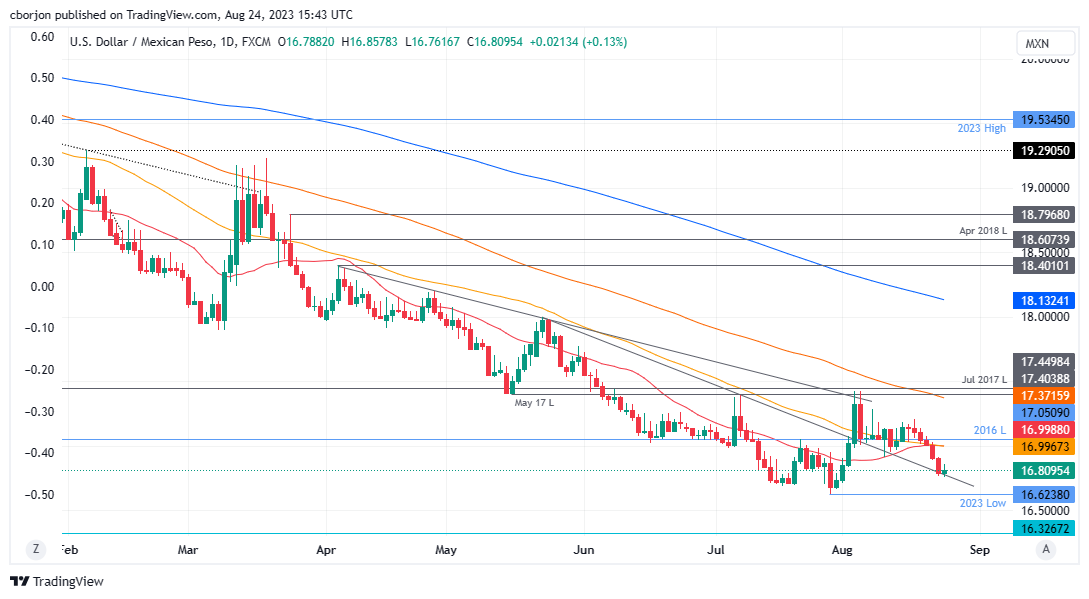
USD/MXN Price Analysis: Technical outlook
The pair remains in a downtrend after standing above the 17.0000 figure, with the USD/MXN set to retest the year-to-date (YTD) low of 16.6238. As of writing, the pair is testing a previous resistance trendline, turned support, stalling the downtrend. A break below the YTD low would expose the 16.5000 mark, followed by the October 2015 low of 16.3267.
Author

Christian Borjon Valencia
FXStreet
Markets analyst, news editor, and trading instructor with over 14 years of experience across FX, commodities, US equity indices, and global macro markets.

















