USD/JPY soars above the 143.00 figure on US bond yields advance
- USD/JPY climbs to 143.66, buoyed by US 10-year bond yield surpassing 4% and positive ISM Manufacturing PMI data.
- JOLTS report shows slight job opening increase; market anticipates December FOMC minutes for Fed's rate cut insights.
- Japan's financial markets to reopen post-holiday, facing challenges from a recent earthquake and awaited Manufacturing PMI data.

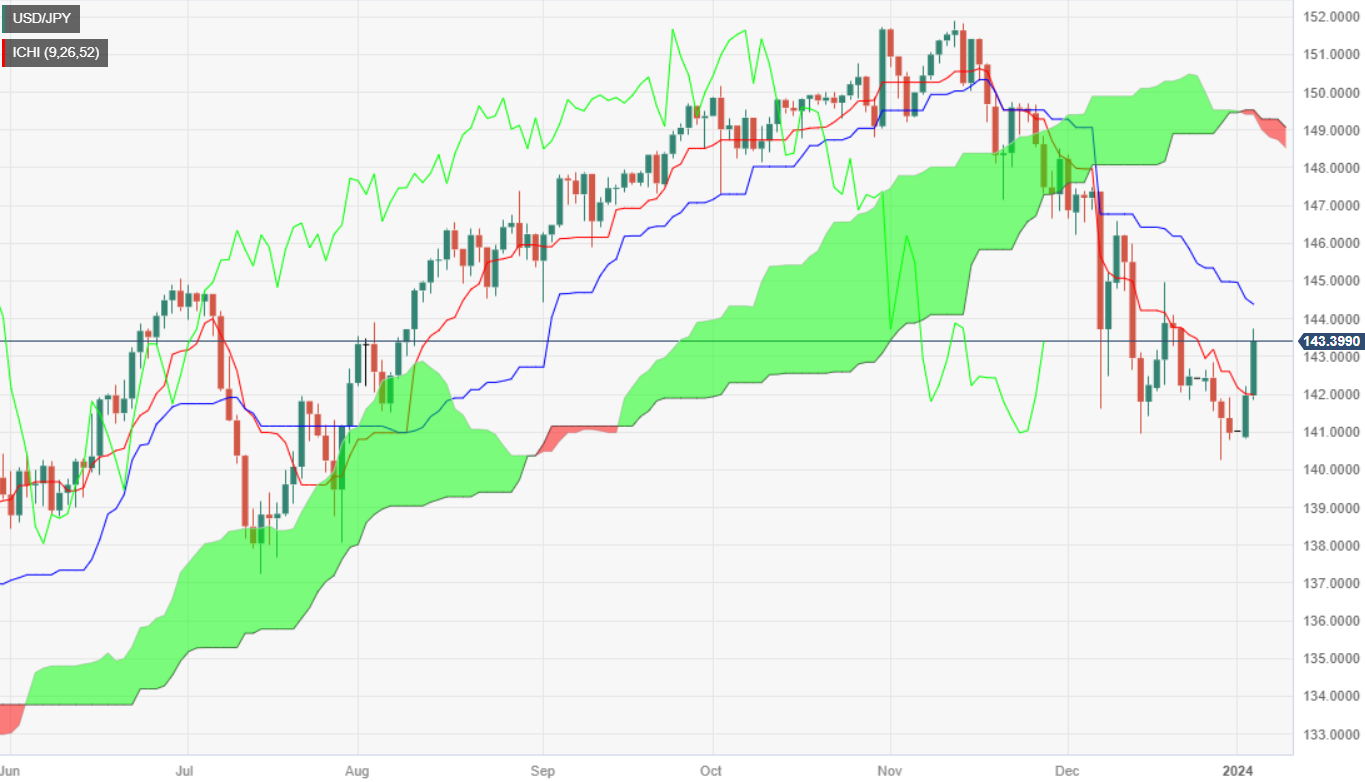
The USD/JPY rises sharply during the North American session after economic data from the United States (US) prompted investors to extend the US bond sell-off, as the US 10-year bond yield is back above the 4% threshold. Therefore, the major is prolonging its gains of more than 1.20%, trading at 143.66.
USD/JPY gains more than 1.20% as the US 10-year bond yield surpasses 4%, market await Fed minutes
The US economic calendar revealed that business activity is recovering slightly, as the ISM Manufacturing PMI was 47.4, exceeding forecasts of 47.1 November’s 46.7 reading. According to the ISM, a PMI reading below 48.7 over some time generally indicates a contraction of the economy as a whole.
The November Job Openings and Labor Turnover Survey (JOLTS) report indicated a slight increase to 8.79 million, below the anticipated 8.85 million. Additionally, the data for October was revised upwards to 8.852 million.
Meanwhile, Federal Reserve’s (Fed) speakers had begun to cross newswires, led by the Richmond Fed President Thomas Barkin. He said that although the US central bank is making real progress on curbing stickier inflation, and the economy remains robust, the risks of missing a soft landing remain.
Even though the USD/JPY is skyrocketing during Wednesday’s session, upside risks remain, with additional US economic data pending to be released. The Federal Reserve is expected to reveal December’s Federal Open Market Committee (FOMC) minutes, which would be digested by investors looking for rate cut discussions or any pushback by the “hawks” left at the US central bank.
In the meantime, traders remain aggressively pricing in more than 150 basis points of rate cuts by the Fed, according to futures data provided by the Chicago Board of Trade (CBOT). The odds for a rate cut in March stand at around 80%, but for May, it is fully priced in.
In Japan, the financial markets would re-open following a holiday and a bumpy start to 2024, as the country was hit by a 7.6 magnitude earthquake on January 1. Its economic docket will feature the release of the Jibun Bank Manufacturing PMI for December.
USD/JPY Price Analysis: Technical outlook
The USD/JPY daily chart depicts the pair as downward biased despite posting a leg-up of more than 140 pips, above the 143.00 figure. On the upside, buyers need to reclaim the 144.00 figure to remain hopeful of higher prices but would face strong resistance at the Kijun-Sen price level at 144.54. On the flip side, if sellers step in and drag prices below 143.00, that would pave the way for a resumption of the ongoing downtrend, with the next support seen at December 28 low of 140.24.
Author

Christian Borjon Valencia
FXStreet
Markets analyst, news editor, and trading instructor with over 14 years of experience across FX, commodities, US equity indices, and global macro markets.