USD/JPY Price Forecast: Yen plummets after BoJ’s policy outcome
- USD/JPY surges sharply to near 158.00 amid a significant weakness in the Japanese Yen.
- The BoJ hikes interest rates by 25 bps to 1.25% and reaffirms monetary tightening path.
- Traders are confident that the Fed will hike interest rates again this year.

The Japanese Yen (JPY) underperforms its major currency peers on Friday after the Bank of Japan’s (BoJ) monetary policy announcement. In the European trade, the USD/JPY pair trades 1.3% higher to near 158.00.
Japanese Yen Price Today
The table below shows the percentage change of Japanese Yen (JPY) against listed major currencies today. Japanese Yen was the weakest against the Australian Dollar.
| USD | EUR | GBP | JPY | CAD | AUD | NZD | CHF | |
|---|---|---|---|---|---|---|---|---|
| USD | 0.03% | 0.03% | 1.22% | 0.10% | -0.20% | 0.28% | 0.08% | |
| EUR | -0.03% | 0.00% | 1.20% | 0.08% | -0.25% | 0.27% | 0.05% | |
| GBP | -0.03% | -0.00% | 1.18% | 0.07% | -0.24% | 0.30% | 0.05% | |
| JPY | -1.22% | -1.20% | -1.18% | -1.07% | -1.41% | -0.90% | -1.12% | |
| CAD | -0.10% | -0.08% | -0.07% | 1.07% | -0.33% | 0.18% | -0.04% | |
| AUD | 0.20% | 0.25% | 0.24% | 1.41% | 0.33% | 0.52% | 0.29% | |
| NZD | -0.28% | -0.27% | -0.30% | 0.90% | -0.18% | -0.52% | -0.22% | |
| CHF | -0.08% | -0.05% | -0.05% | 1.12% | 0.04% | -0.29% | 0.22% |
The heat map shows percentage changes of major currencies against each other. The base currency is picked from the left column, while the quote currency is picked from the top row. For example, if you pick the Japanese Yen from the left column and move along the horizontal line to the US Dollar, the percentage change displayed in the box will represent JPY (base)/USD (quote).
In the policy meeting, the Bank of Japan (BoJ) raised interest rates by 25 basis points (bps) to 1.25%, the highest level seen in 31 years. Two BoJ board members: Toichiro Asada and Ayano Sato opposed the hike decision.
BoJ Governor Kazuo Ueda reiterates that the central bank will remain on the monetary tightening path, allowing market experts to price in more interest rate hikes in the near term.
According to TD Securities, the latest BoJ communication “provides strong justification for additional hikes,” reinforcing the policy trajectory outlined in its earlier guidance. The firm notes that the statement “reaffirmed the case for 25bps increases in the cash rate roughly every quarter,” effectively “validating the hawkish July framework” and underscoring the BoJ’s commitment to a gradual but persistent normalisation of policy.
Meanwhile, the US Dollar (USD) trades firmly amid firm expectations that the Federal Reserve (Fed) will hike interest rates again this year. At press time, the US Dollar Index (DXY), which gauges the Greenback’s value against six major currencies, revisits the seven-week high at 100.46.
USD/JPY Technical Analysis
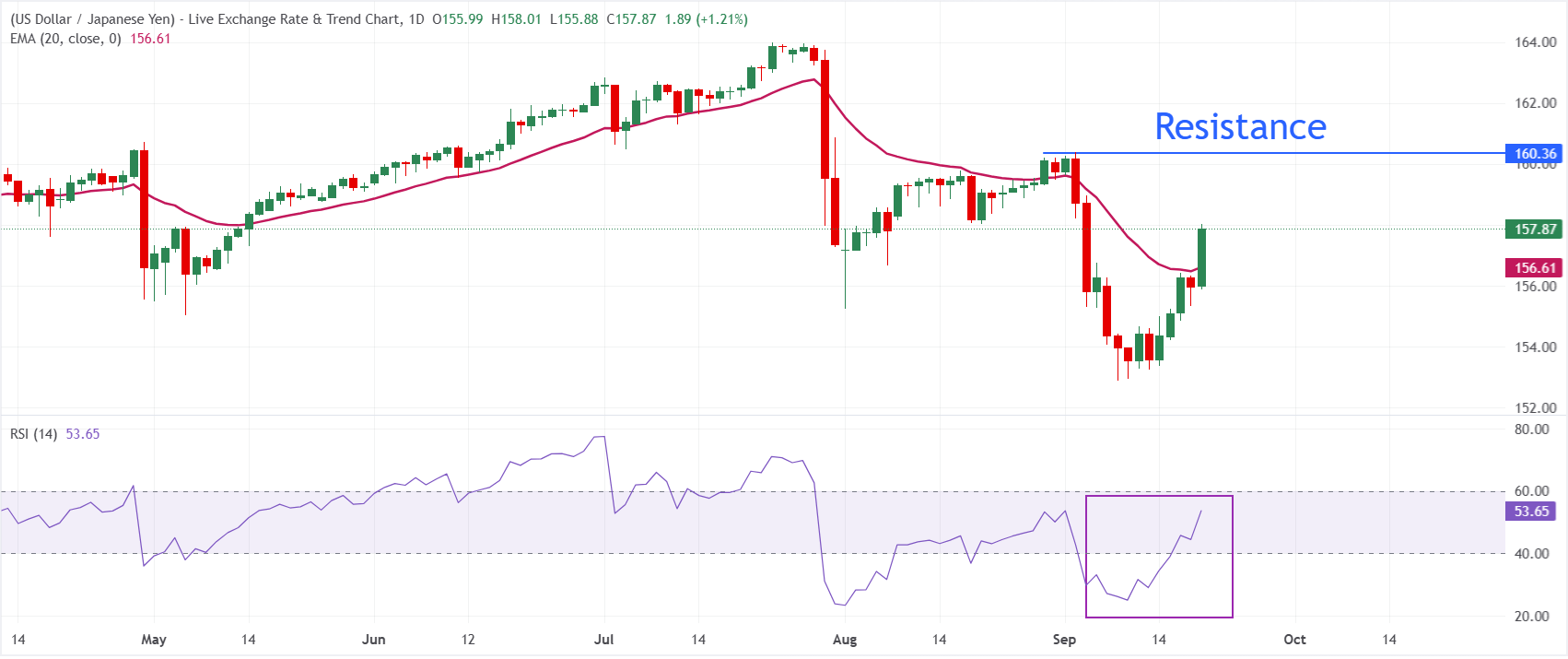
In the daily chart, USD/JPY trades at 158.00 The pair holds a constructive near-term bias as spot remains above the 20-period exponential moving average (EMA) at 156.61, suggesting underlying demand after the recent pullback from the 160.00 area. The Relative Strength Index (RSI) at 53.66 sits just above the neutral line, hinting at moderate bullish momentum rather than overbought conditions.
On the downside, initial support is seen at the 20-period EMA near 156.61, which reinforces the broader floor created by the recent higher lows above the mid-150s. On the upside, the rally could extend to near the September 2 high at around 160.40.
(The technical analysis of this story was written with the help of an AI tool. Know more.)
Economic Indicator
BoJ Interest Rate Decision
The Bank of Japan (BoJ) announces its interest rate decision after each of the Bank’s eight scheduled annual meetings. Generally, if the BoJ is hawkish about the inflationary outlook of the economy and raises interest rates it is bullish for the Japanese Yen (JPY). Likewise, if the BoJ has a dovish view on the Japanese economy and keeps interest rates unchanged, or cuts them, it is usually bearish for JPY.
Read more.Last release: Fri Sep 18, 2026 02:54
Frequency: Irregular
Actual: 1.25%
Consensus: 1.25%
Previous: 1%
Source: Bank of Japan
Author

Sagar Dua
FXStreet
Sagar Dua is associated with the financial markets from his college days. Along with pursuing post-graduation in Commerce in 2014, he started his markets training with chart analysis.

















