USD/JPY Price Forecast: Retreats from 155.50 with Fed’s policy in focus
- USD/JPY recovers its early losses and flattens around 155.00 ahead of the Fed’s policy.
- The Fed is almost certain to hike interest rates by 25 bps to the 3.75%-4.00% range.
- Investors also expect the BoJ to raise interest rates this week.

The Japanese Yen (JPY) turns flat against the US Dollar (USD) at around 155.00 in the European trading session on Wednesday after recovering its early losses. The USD/JPY pair is expected to trade cautiously, with market participants awaiting the Federal Reserve’s (Fed) monetary policy decision at 18:00 GMT.
The market reaction will likely hinge more on signals regarding how much the Federal Reserve (Fed) will tighten its monetary conditions in the near and medium than the interest rate decision.
The impact of Fed’s decision is expected to be limited as traders see an over 90% chance hiking interest rates by 25 basis points (bps) to 3.75%-4.00%.
Regarding the monetary policy outlook, analysts at BNY said that “while we expect a hike on Wednesday, and probably one more this year, we think the path to even higher policy rates is strewn with potential impediments to significantly tighter policy.” In their view, “the nearly 100bp of hikes (equivalent to four hikes of the standard 25bp increment) currently priced in will be realized,” but they caution that, although they are “not ready to see shorter-maturity yields fall any time soon,” these yields “may ultimately prove to be ahead of themselves.”
On the Tokyo front, investors keenly await the Bank of Japan’s policy decision on Friday. The BoJ is highly anticipated to hike interest rates by 25 bps to 1.25%.
USD/JPY Technical Analysis
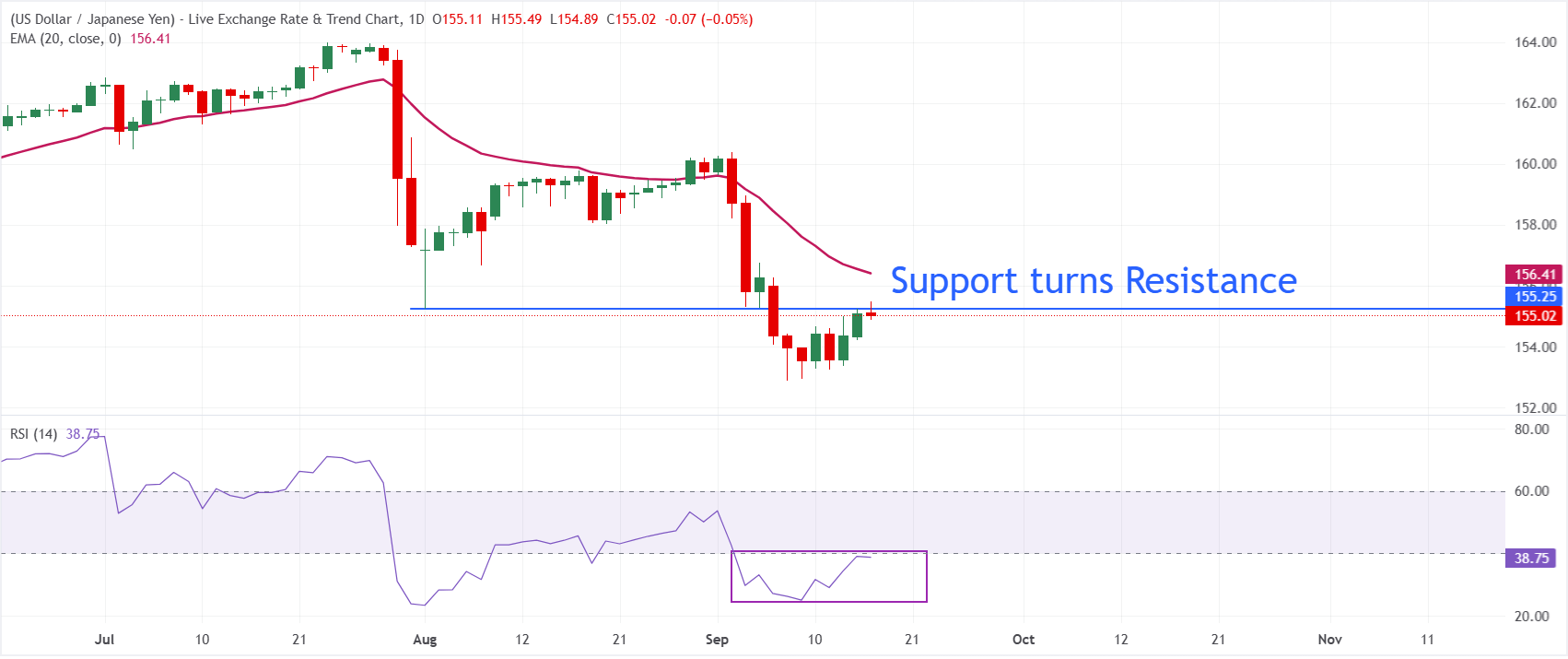
In the daily chart, USD/JPY trades at 155.02, keeping a bearish near-term tone as it holds beneath the 20-day Exponential Moving Average (EMA) at 156.41.
The pair’s failure to reclaim this moving average suggests rallies are still being capped by overhead supply, while the Relative Strength Index (RSI) around 39 hints at weak but stabilizing downside momentum rather than outright oversold conditions.
On the topside, the immediate hurdle is the 20-day EMA at 156.41. On the downside, the pair could resume the decline and revisit the monthly low at 152.89.
(The technical analysis of this story was written with the help of an AI tool. Know more.)
Economic Indicator
Fed Interest Rate Decision
The Federal Reserve (Fed) deliberates on monetary policy and makes a decision on interest rates at eight pre-scheduled meetings per year. It has two mandates: to keep inflation at 2%, and to maintain full employment. Its main tool for achieving this is by setting interest rates – both at which it lends to banks and banks lend to each other. If it decides to hike rates, the US Dollar (USD) tends to strengthen as it attracts more foreign capital inflows. If it cuts rates, it tends to weaken the USD as capital drains out to countries offering higher returns. If rates are left unchanged, attention turns to the tone of the Federal Open Market Committee (FOMC) statement, and whether it is hawkish (expectant of higher future interest rates), or dovish (expectant of lower future rates).
Read more.Next release: Wed Sep 16, 2026 18:00
Frequency: Irregular
Consensus: 4%
Previous: 3.75%
Source: Federal Reserve
Author

Sagar Dua
FXStreet
Sagar Dua is associated with the financial markets from his college days. Along with pursuing post-graduation in Commerce in 2014, he started his markets training with chart analysis.