USD/JPY Price Forecast: Range tightens further at around 161.60
- USD/JPY consolidates around 161.60 as hawkish BoJ supporting Japanese Yen counters outperforming the US Dollar.
- One BoJ member expects interest rates to rise to 2% as soon as possible.
- BoJ’s Asada, PM Takaichi appointee, voted against the interest rate hike in the policy meeting this month.

The USD/JPY pair trades in a limited range around 161.60 during the European trading session on Wednesday. The pair consolidates as hawkish Bank of Japan (BoJ) bets are supporting the Japanese Yen (JPY) against the US Dollar’s (USD) continued outperformance.
Earlier in the day, the BoJ Summary of Opinions (SoP) of the June meeting showed that a majority of officials favor more interest rate hikes to counter mounting inflation risks. Also, one board member said Japan's policy rate must be brought closer to the estimated neutral rate of around 2% as soon as possible.
The BoJ SoP also showed that new board member, Toichiro Asada, the appointee of Prime Minister (PM) Sanae Takaichi, voted against the hike, citing downside inflation and employment risks due to the Middle East crisis. In the policy meeting, the BoJ lifted interest rates by 25 basis points (bps) to 1%.
Meanwhile, a Reuters report shows that the BoJ is almost certain to deliver another interest rate hike this year in December.
At press time, the US Dollar Index (DXY), which tracks the Greenback’s value against six major currencies, trades 0.1% higher to near 101.50, the highest level seen in over a year.
USD/JPY technical analysis
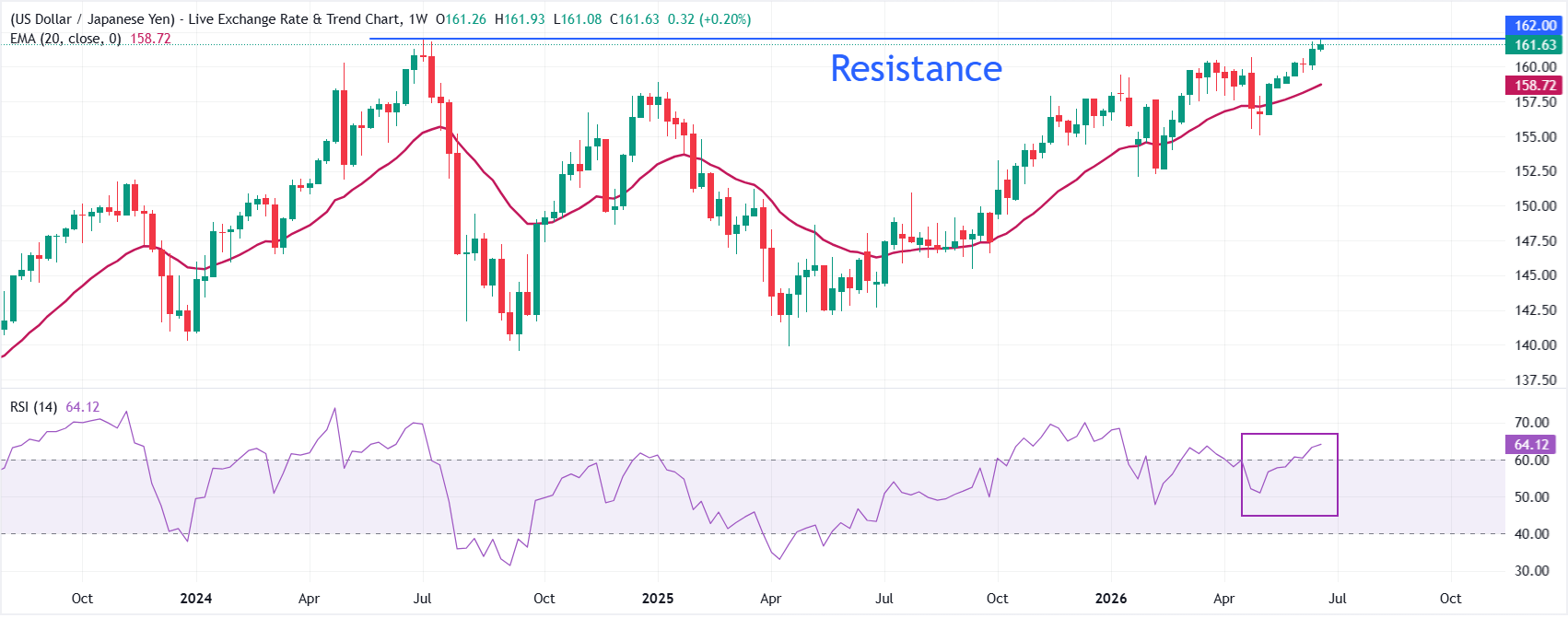
USD/JPY trades flat at around 161.65 at press time. The pair maintains a bullish near-term bias as price holds well above the 20-week exponential moving average (EMA) at 158.72, keeping the broader uptrend intact.
Weekly Relative Strength Index (RSI) at 64.11 stays in positive territory but below overbought levels, suggesting strong yet not extreme upside momentum.
On the downside, immediate support is seen at the round-level 160.00, followed by the 20-week EMA at 158.72. On the upside, the pair would enter uncharted territory if it breaks above the all-time high around 162.00.
(The technical analysis of this story was written with the help of an AI tool.)
Bank of Japan FAQs
The Bank of Japan (BoJ) is the Japanese central bank, which sets monetary policy in the country. Its mandate is to issue banknotes and carry out currency and monetary control to ensure price stability, which means an inflation target of around 2%.
The Bank of Japan embarked in an ultra-loose monetary policy in 2013 in order to stimulate the economy and fuel inflation amid a low-inflationary environment. The bank’s policy is based on Quantitative and Qualitative Easing (QQE), or printing notes to buy assets such as government or corporate bonds to provide liquidity. In 2016, the bank doubled down on its strategy and further loosened policy by first introducing negative interest rates and then directly controlling the yield of its 10-year government bonds. In March 2024, the BoJ lifted interest rates, effectively retreating from the ultra-loose monetary policy stance.
The Bank’s massive stimulus caused the Yen to depreciate against its main currency peers. This process exacerbated in 2022 and 2023 due to an increasing policy divergence between the Bank of Japan and other main central banks, which opted to increase interest rates sharply to fight decades-high levels of inflation. The BoJ’s policy led to a widening differential with other currencies, dragging down the value of the Yen. This trend partly reversed in 2024, when the BoJ decided to abandon its ultra-loose policy stance.
A weaker Yen and the spike in global energy prices led to an increase in Japanese inflation, which exceeded the BoJ’s 2% target. The prospect of rising salaries in the country – a key element fuelling inflation – also contributed to the move.
Author

Sagar Dua
FXStreet
Sagar Dua is associated with the financial markets from his college days. Along with pursuing post-graduation in Commerce in 2014, he started his markets training with chart analysis.















