USD/JPY Price Forecast: Flat 20-day EMA reflects continuation of sideways trend
- USD/JPY trades flat at around 159.15 as the US Dollar turns sideways.
- Hot US PCE Inflation data backs more Fed interest rate hikes.
- BoJ’s Tamura supports a faster rate tightening cycle, citing upside inflation risks.


The Japanese Yen (JPY) trades flat at around 159.15 vs. the US Dollar (USD) during the European trading session on Thursday. The pair consolidates as the US Dollar turns sideways after a slight recovery move.
As of writing, the US Dollar Index (DXY), which gauges the Greenback’s value against six major currencies, is flat at around 103.70 after a slight recovery move from 103.55 came on late Wednesday.
The outlook of the US Dollar appears bullish as strong United States (US) labor market data and hot inflationary pressures back more Federal Reserve (Fed) interest rate hikes.
US data underline still-elevated inflation alongside stronger growth
Analysts at Danske Bank note that October US PCE inflation “was broadly in line with expectations but remain elevated,” with “headline and core PCE both rose 0.3% m/m SA (cons: 0.3%, prior: 0.3%), taking core inflation to 3.3% y/y (cons: 3.2%, prior: 3.1%).” They highlight that while “energy price growth slowed as expected, core goods inflation picked up notably and core services inflation remains on the high side of what is consistent with 2% inflation,” underscoring persistent underlying price pressures.
On activity, Danske Bank points out that “Q3 GDP growth was revised up notably to 4.3% q/q SAAR from 3.4% (cons: 3.5%), driven by stronger private consumption and investment, with final sales to domestic purchasers rising to 5.8% y/y from 4.9%.” The combination of firmer growth and still-elevated core inflation reinforces the picture of a resilient US economy and a labour market that remains consistent with a solid demand backdrop.
On Tokyo front, Bank of Japan (BOJ) policy board member Naoki Tamura has called for accelerating interest rate hike pace to tame risks of inflation overshooting the 2% target.
BoJ hawk Tamura flags inflation risks as markets eye December rate hike
Analysts at Danske Bank note that hawkish BoJ board member Tamura has sharpened the policy debate in Japan, arguing that the central bank must “respond swiftly to signs of an inflation overshoot, including by accelerating the pace of rate hikes.” He highlighted “upside risks to inflation from the Middle East war, higher import costs from a weak yen and strong demand for AI-related goods,” and cautioned that Japan’s “inflation expectations are less firmly anchored than elsewhere.”
With “financial conditions still accommodative,” Tamura judged that the current “policy rate of 1.25% remains some way from neutral and should reach that level soon.” Danske Bank points out that recent data back his stance, with “core inflation excluding fresh food rising to 2.2% y/y in October,” and markets now “pricing around 75-80% likelihood for a hike to 1.50% at the December meeting.”
For more cues on Japan’s inflation, investors await Tokyo Consumer Price Index (CPI) data for November, which is scheduled for Friday.
Danske Bank highlights that “consensus expects inflation excluding fresh food to rise to 3.0% y/y from 2.6%, while inflation excluding both fresh food and energy is expected to edge slightly higher,” reinforcing the focus on upside inflation risks and the BoJ’s near-term policy path.
USD/JPY Technical Analysis
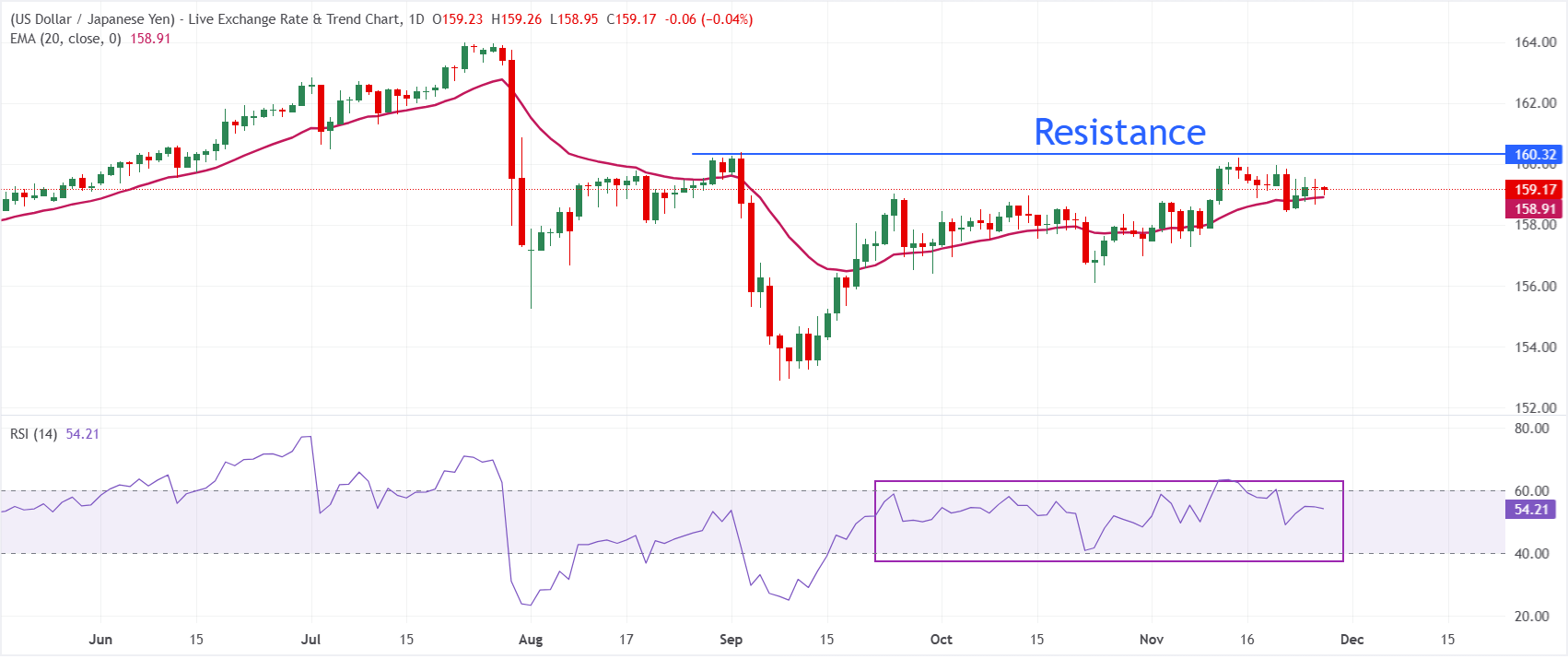
In the daily chart, USD/JPY trades at 159.17, holding above the 20-day exponential moving average (EMA) at 158.91, which keeps the near-term bias constructive. The pair is consolidating near recent highs, and the Relative Strength Index (RSI) at 54.20 sits in neutral territory, suggesting moderate bullish momentum without overbought stress.
On the downside, initial support is located at the 20-day EMA around 158.91, where buyers have room to defend the short-term trend. A fresh breakdown will likely if the pair falls below the November 6 low at 157.26. On the upside, the September high at 160.39might act as the major hurdle for the pair.
(The technical analysis of this story was written with the help of an AI tool. Know more.)
Economic Indicator
Tokyo CPI ex Food, Energy (YoY)
The Tokyo Consumer Price Index (CPI), released by the Statistics Bureau of Japan on a monthly basis, measures the price fluctuation of goods and services purchased by households in the Tokyo region. The index is widely considered as a leading indicator of Japan’s overall CPI as it is published weeks before the nationwide reading. The gauge excluding food and energy is widely used to measure underlying inflation trends as these two components are more volatile. The YoY reading compares prices in the reference month to the same month a year earlier. Generally, a high reading is seen as bullish for the Japanese Yen (JPY), while a low reading is seen as bearish.
Read more.Next release: Thu Nov 26, 2026 23:30
Frequency: Monthly
Consensus: 3%
Previous: 2.4%
Source: Statistics Bureau of Japan
Author
Sagar Dua
FXStreet
Sagar Dua is associated with the financial markets from his college days. Along with pursuing post-graduation in Commerce in 2014, he started his markets training with chart analysis.

















