USD/JPY Price Forecast: Eyes seven-week consolidation breakout
- USD/JPY holds onto previous day’s losses near 159.00 as the US Dollar outperforms.
- The expectations of a bigger Fed interest rate hike in December have also come into picture.
- Investors await Japan’s PPI data for October scheduled for Thursday.

The Japanese Yen (JPY) trades weakly against the US Dollar (USD) on Wednesday, with the USD/JPY pair hovering near its almost seven-week high of around 159.00. The pair reflects strength as the US Dollar outperforms due to fears that the Federal Reserve (Fed) could deliver a bigger interest rate hike in the December meeting.
As of writing, the US Dollar Index (DXY), which gauges the Greenback’s value against six major currencies, trades 0.1% higher to near 102.32.
Financial markets have started pricing in a Fed 50 basis points (bps) interest rate hike in the December meeting as United States (US) inflationary pressures grew at a faster pace in October.
US inflation surprise deepens Fed policy dilemma
Economists at Rabobank note that “yesterday’s US CPI print came in hotter than expected at 0.4% m-o-m headline vs. a consensus of 0.3% and 0.3% core vs. a 0.2% market view,” underscoring a renewed setback in the disinflation narrative.
Rabobank highlights that, in the words of the “usually dovish Fed voter Goolsbee, ‘it’s another distressing report, borderline disturbing. We’ve been hoping to get progress.’” Instead of further easing, Rabobank points to “an acceleration in grocery and food inflation, persistent housing/shelter price pressure, and a delayed pass-through from earlier energy shocks feeding into medical care, household furnishings, and other daily expenses,” all of which reinforce concerns that underlying price pressures remain stubbornly entrenched.
On Tokyo front, investors await the Producer Price Index (PPI) data for October, which is scheduled for Thursday. Japan’s inflation at the producer level is estimated to have grown 0.3% Month-on-Month (MoM) after declining at a similar pace in September.
USD/JPY Technical Analysis
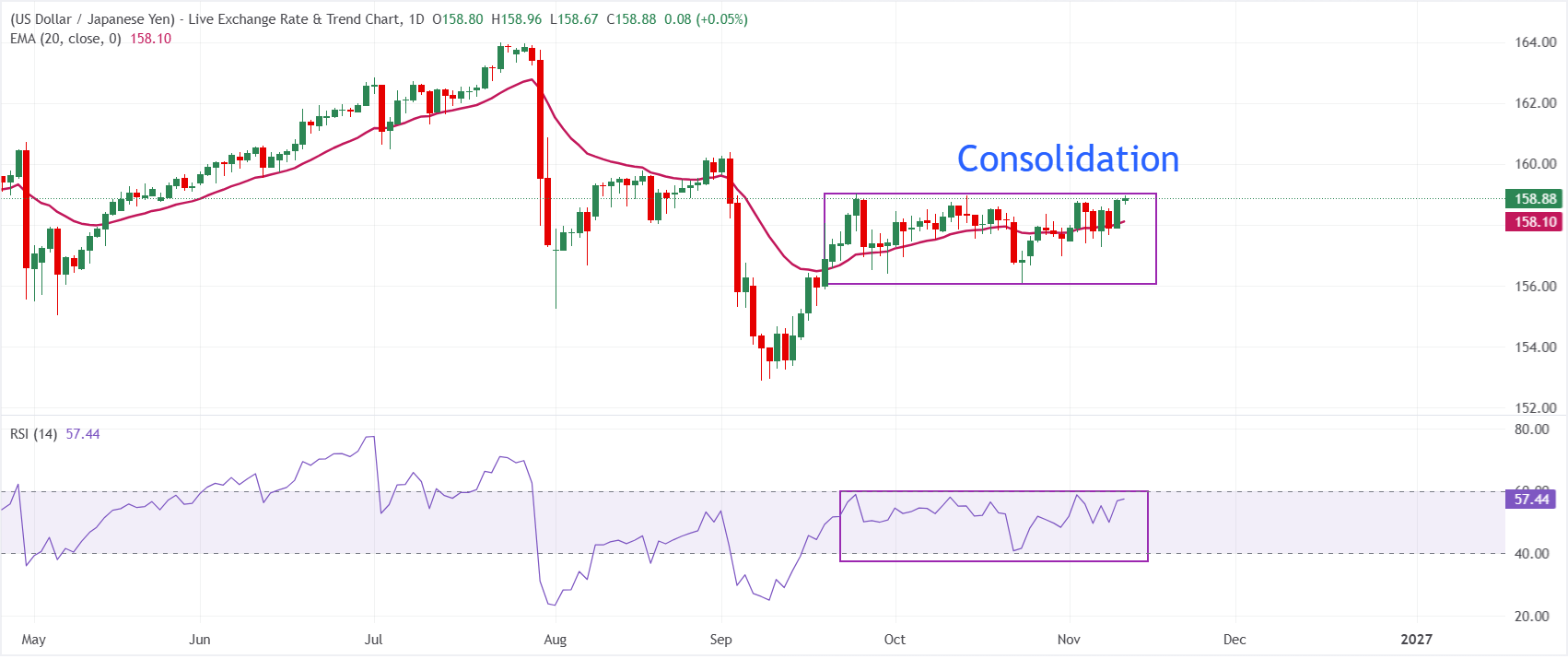
In the daily chart, USD/JPY trades at 158.88, close to the high of almost seven-week long consolidation range. The pair holds a bullish near-term bias as spot remains above the 20-day Exponential Moving Average (EMA) at 158.10. The pair is advancing away from that dynamic support, and the Relative Strength Index (RSI) at 57.38 rises in positive territory, which suggests buyers retain control without the market yet appearing overstretched.
On the downside, initial support is seen at the 20-day EMA at 158.10, where a daily close back below would hint at easing upside pressure and a deeper correction towards the lower-end of the consolidation range near 156.00. Looking up, the pair would enter a fresh upside leg if it decisively breaks above 159.00. Key resistance levels would be 160.00 and the September high at 160.39.
(The technical analysis of this story was written with the help of an AI tool. Know more.)
Fed FAQs
Monetary policy in the US is shaped by the Federal Reserve (Fed). The Fed has two mandates: to achieve price stability and foster full employment. Its primary tool to achieve these goals is by adjusting interest rates. When prices are rising too quickly and inflation is above the Fed’s 2% target, it raises interest rates, increasing borrowing costs throughout the economy. This results in a stronger US Dollar (USD) as it makes the US a more attractive place for international investors to park their money. When inflation falls below 2% or the Unemployment Rate is too high, the Fed may lower interest rates to encourage borrowing, which weighs on the Greenback.
The Federal Reserve (Fed) holds eight policy meetings a year, where the Federal Open Market Committee (FOMC) assesses economic conditions and makes monetary policy decisions. The FOMC is attended by twelve Fed officials – the seven members of the Board of Governors, the president of the Federal Reserve Bank of New York, and four of the remaining eleven regional Reserve Bank presidents, who serve one-year terms on a rotating basis.
In extreme situations, the Federal Reserve may resort to a policy named Quantitative Easing (QE). QE is the process by which the Fed substantially increases the flow of credit in a stuck financial system. It is a non-standard policy measure used during crises or when inflation is extremely low. It was the Fed’s weapon of choice during the Great Financial Crisis in 2008. It involves the Fed printing more Dollars and using them to buy high grade bonds from financial institutions. QE usually weakens the US Dollar.
Quantitative tightening (QT) is the reverse process of QE, whereby the Federal Reserve stops buying bonds from financial institutions and does not reinvest the principal from the bonds it holds maturing, to purchase new bonds. It is usually positive for the value of the US Dollar.
Author

Sagar Dua
FXStreet
Sagar Dua is associated with the financial markets from his college days. Along with pursuing post-graduation in Commerce in 2014, he started his markets training with chart analysis.