USD/JPY Price Forecast: 160.00 caps bulls as intervention risk lingers
- USD/JPY rises for the third day, testing weekly highs near 160.00.
- Flat 100-day SMA keeps buyers cautious below psychological resistance.
- A break below 159.00 exposes 158.88 and deeper downside support.

The USD/JPY pair drifts higher for the third straight day on Wednesday, up a modest 0.11% as buyers reaffirm their control over price action despite uncertainty over another round of intervention by Japanese authorities. The pair trades at 159.38 at the time of writing.
USD/JPY Price Forecast: Technical outlook
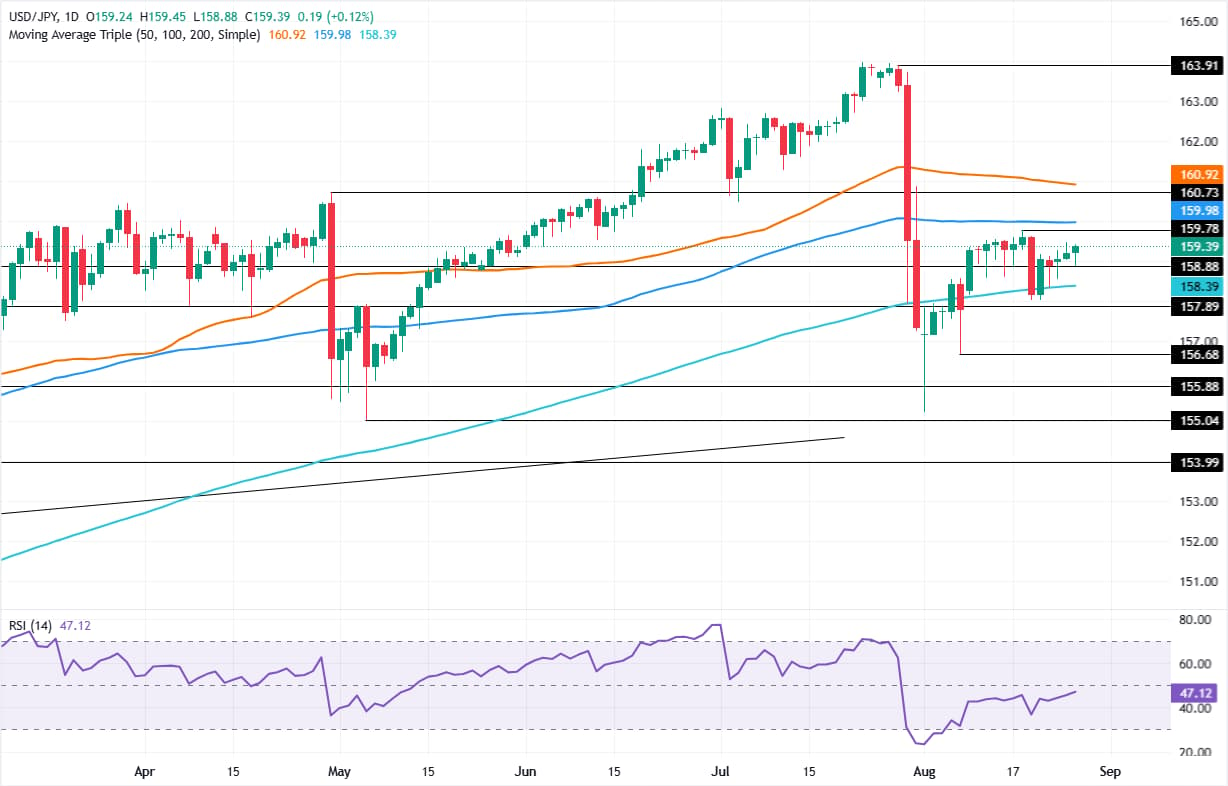
USD/JPY trades at weekly highs, though a flattish 100-day Simple Moving Average (SMA) caps upside at 159.98. This suggests buyers remain skeptical of achieving higher prices, as the 160.00 barrier remains intact, since the pair cleared that level on July 31.
The Relative Strength Index (RSI) shows that momentum remains neutral, meaning that neither buyers nor sellers are secure from opening fresh directional bets.
For a bullish continuation, USD/JPY must surpass the 100-day SMA and the 160.00 figure. Once cleared, buyers could challenge the 50-day SMA at 160.92, ahead of 161.00.
Conversely, if USD/JPY falls below 159.00, a move towards the 200-day SMA at 159.39 is on the cards. The next support emerges at the 159.00 milestone, before the pair aims for the August 7 daily low of 158.88.
USD/JPY Price Chart – Daily
Japanese Yen FAQs
The Japanese Yen (JPY) is one of the world’s most traded currencies. Its value is broadly determined by the performance of the Japanese economy, but more specifically by the Bank of Japan’s policy, the differential between Japanese and US bond yields, or risk sentiment among traders, among other factors.
One of the Bank of Japan’s mandates is currency control, so its moves are key for the Yen. The BoJ has directly intervened in currency markets sometimes, generally to lower the value of the Yen, although it refrains from doing it often due to political concerns of its main trading partners. The BoJ ultra-loose monetary policy between 2013 and 2024 caused the Yen to depreciate against its main currency peers due to an increasing policy divergence between the Bank of Japan and other main central banks. More recently, the gradually unwinding of this ultra-loose policy has given some support to the Yen.
Over the last decade, the BoJ’s stance of sticking to ultra-loose monetary policy has led to a widening policy divergence with other central banks, particularly with the US Federal Reserve. This supported a widening of the differential between the 10-year US and Japanese bonds, which favored the US Dollar against the Japanese Yen. The BoJ decision in 2024 to gradually abandon the ultra-loose policy, coupled with interest-rate cuts in other major central banks, is narrowing this differential.
The Japanese Yen is often seen as a safe-haven investment. This means that in times of market stress, investors are more likely to put their money in the Japanese currency due to its supposed reliability and stability. Turbulent times are likely to strengthen the Yen’s value against other currencies seen as more risky to invest in.
Author

Christian Borjon Valencia
FXStreet
Markets analyst, news editor, and trading instructor with over 14 years of experience across FX, commodities, US equity indices, and global macro markets.
















