USD/JPY falls on suspected intervention, US-Iran deal hopes weigh on USD
- USD/JPY rebounds modestly after another suspected intervention by Japanese authorities triggered a sharp intraday drop.
- Hopes for a US-Iran deal pressure the US Dollar, though lingering uncertainty limits deeper losses.
- Technically, USD/JPY trades below key SMAs on the daily chart as downside momentum builds.


USD/JPY stages a modest rebound on Wednesday after coming under pressure earlier in the day amid another suspected intervention by Japanese authorities. At the time of writing, the pair is trading around 156.42 after recovering from an intraday low near 155.00.
Despite the modest recovery, USD/JPY remains down nearly 0.90% on the day as the US Dollar (USD) softens broadly on hopes of a potential US-Iran deal following an Axios report suggesting Washington and Tehran are moving closer to an agreement aimed at ending the war and establishing a framework for detailed nuclear negotiations.
However, uncertainty over whether both sides can reach a final agreement is helping limit deeper losses in the Greenback. The US Dollar Index (DXY), which tracks the US Dollar’s value against a basket of six major currencies, trades around 98.04 after touching an intraday low of 97.62, though it remains down roughly 0.45% on the day.
Meanwhile, USD/JPY remains vulnerable to further intervention risks. While Tokyo has not officially confirmed any intervention, repeated warnings from Japanese authorities keep traders cautious.
Still, the Japanese Yen (JPY) has struggled to gain meaningful traction as ongoing Oil supply disruptions in the Middle East continue to weigh on sentiment, given Japan’s heavy dependence on imported energy, with a significant portion of shipments passing through the Strait of Hormuz.
Looking ahead, traders will continue to track developments surrounding the US-Iran negotiations, particularly any progress toward reopening the Strait of Hormuz.
Attention also turns to upcoming Japanese economic data, including Labor Cash Earnings and the Bank of Japan’s Monetary Policy Meeting Minutes due on Thursday. In the US, traders await weekly Initial Jobless Claims on Thursday, followed by the Nonfarm Payrolls (NFP) report on Friday.
Technical Analysis:
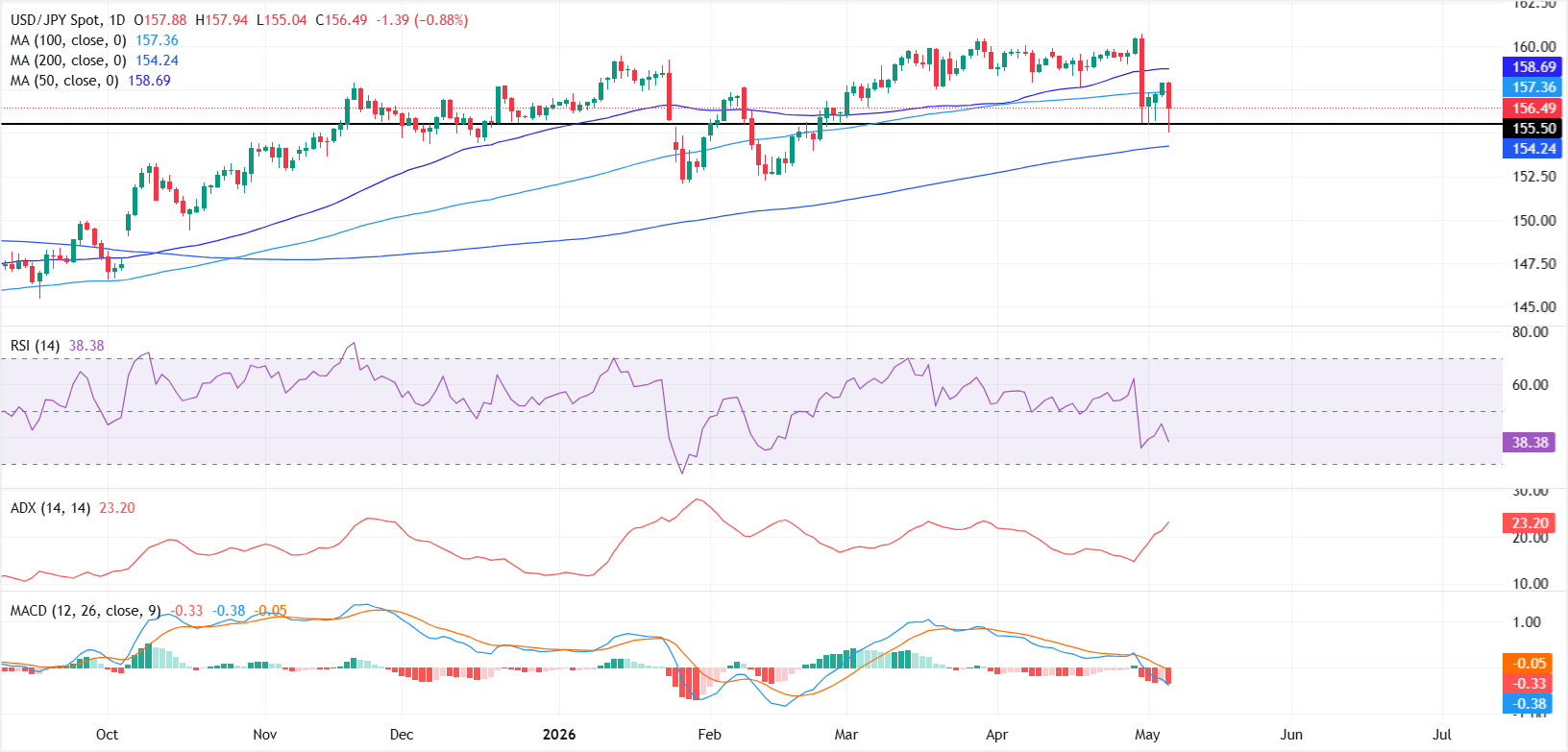
In the daily chart, USD/JPY keeps a bearish near-term tone as spot holds beneath the 100-day Simple Moving Average (SMA) at 157.36 and the 50-day SMA at 158.69, which now cap the upside. The pair is still supported by the 200-day SMA at 154.24, but the Relative Strength Index (RSI) near 38 and a negative Moving Average Convergence Divergence (MACD) suggests downside momentum is building while trend strength, reflected by the Average Directional Index (ADX) around 23, remains only moderate.
On the downside, initial demand is seen just below the market at the horizontal support around 155.50, ahead of the 200-day SMA at 154.24, which marks a more significant structural floor. On the topside, a recovery would first face resistance at the 100-day SMA at 157.36, with a sustained break needed to challenge the 50-day SMA at 158.69 and ease the current bearish pressure.
(The technical analysis of this story was written with the help of an AI tool.)
Economic Indicator
Labor Cash Earnings (YoY)
This indicator, released by the Ministry of Health, Labor and Welfare, shows the average income, before taxes, per regular employee. It includes overtime pay and bonuses but it doesn't take into account earnings from holding financial assets nor capital gains. Higher income puts upward pressures on consumption, and is inflationary for the Japanese economy. Generally, a higher-than-expected reading is bullish for the Japanese Yen (JPY), while a below-the-market consensus result is bearish.
Read more.Next release: Wed May 06, 2026 23:30
Frequency: Monthly
Consensus: -
Previous: 3.3%
Author
Vishal Chaturvedi
FXStreet
I am a macro-focused research analyst with over four years of experience covering forex and commodities market. I enjoy breaking down complex economic trends and turning them into clear, actionable insights that help traders stay ahead of the curve.