USD/INR extends upside, bolstered by US Dollar demand
- The Indian Rupee weakens in Tuesday’s early European session.
- Month-end USD demand and higher crude oil prices weigh on the INR.
- Traders await the US August CB’s Consumer Confidence ahead of the key events later this week.

The Indian Rupee (INR) trades on a weaker note on Tuesday. The US Dollar (USD) demand from local banks and corporates during the month-end, and a surge in crude oil prices are likely to cap the local currency’s gains. On the other hand, the upside of the pair might be limited due to the dovish remarks from US Federal Reserve (Fed) Chair Jerome Powell at the Jackson Hole Symposium, which have triggered the possibility of a deeper rate cut in the September meeting.
Investors will keep an eye on the US Conference Board’s Consumer Confidence for August on Tuesday. The advanced US Gross Domestic Product (GDP) Annualized for the second quarter (Q2) and Personal Consumption Expenditures (PCE) Price Index data will be closely watched this week. On the Indian docket, the GDP Quarterly for Q1 will be published on Friday.
Daily Digest Market Movers: Indian Rupee remains weak amid global factors and challenges
- “We expect the rupee to trade with a slight positive bias on risk in global risk sentiments amid dovish Fed speak and rising expectations of a rate cut by the Fed in September. However, geopolitical tensions in the Middle East and rising crude oil prices may cap the sharp upside,” said Anuj Choudhary, Research Analyst at Sharekhan by BNP Paribas.
- India's economic growth likely expanded at its slowest pace in a year in the April-June quarter due to lower government spending, according to a Reuters poll.
- San Francisco Fed President Mary Daly said on Monday that "the time is upon us" to cut interest rates, likely starting with a quarter-percentage point reduction in borrowing costs, per Reuters.
- Richmond Fed President Thomas Barkin stated on Monday that he will take a 'test and learn' approach to rate cuts.
- The US Durable Goods Orders increased $26.1 billion, or 9.9%, to $289.6 billion in July, from a -6.9% contraction in June. This figure was above the market consensus of a 4% increase and marked the most significant gain since May 2020.
- Futures are currently pricing in a near 40% odds of a half-percentage point cut in interest rates.
Technical Analysis: USD/INR remains bullish in the longer term
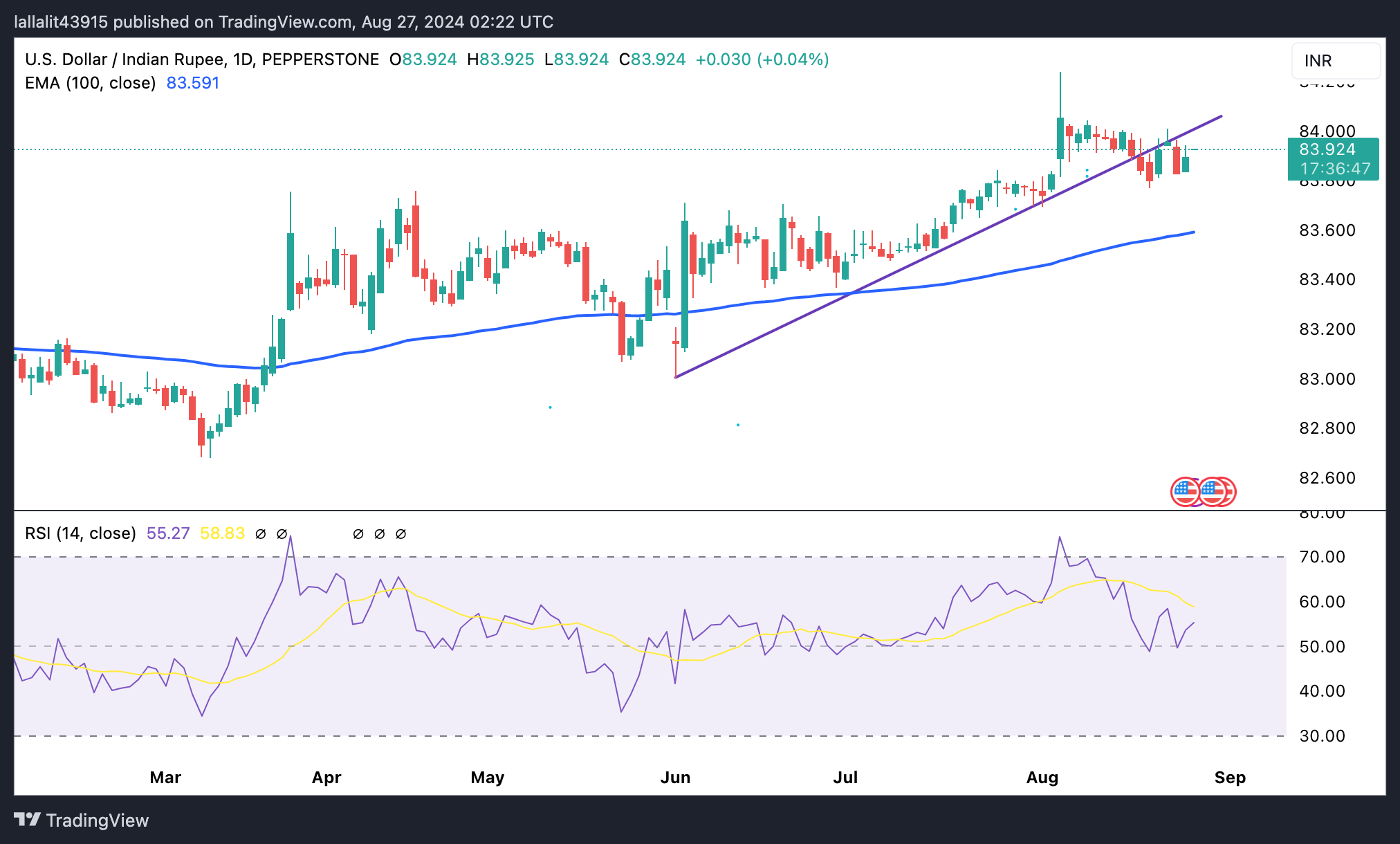
The Indian Rupee trades softer on the day. The USD/INR pair maintains a positive outlook above the key 100-day Exponential Moving Average (EMA) on the daily chart. However, the price has crossed below the three-month-old uptrend line, while the 14-day Relative Strength Index (RSI) hovers around the midline, suggesting further consolidation cannot be ruled out.
The support-turned-resistance level at the 84.00 psychological mark acts as an immediate upside barrier for USD/INR. Further north, the next target emerges at the record high of 84.24 en route to 84.50.
On the downside, the initial support level is located at 83.77, the low of August 20. A break below the mentioned level will see a drop to the 100-day EMA at 83.57.
US Dollar price in the last 7 days
The table below shows the percentage change of US Dollar (USD) against listed major currencies in the last 7 days. US Dollar was the weakest against the Swiss Franc.
| USD | EUR | GBP | CAD | AUD | JPY | NZD | CHF | |
| USD | -0.69% | -1.57% | -1.09% | -0.67% | -1.28% | -1.64% | -1.75% | |
| EUR | 0.68% | -0.87% | -0.40% | 0.00% | -0.60% | -0.95% | -1.06% | |
| GBP | 1.55% | 0.87% | 0.47% | 0.89% | 0.28% | -0.07% | -0.18% | |
| CAD | 1.08% | 0.40% | -0.47% | 0.42% | -0.20% | -0.54% | -0.65% | |
| AUD | 0.67% | -0.01% | -0.89% | -0.42% | -0.63% | -0.96% | -1.06% | |
| JPY | 1.22% | 0.60% | -0.27% | 0.21% | 0.61% | -0.41% | -9944.07% | |
| NZD | 1.62% | 0.94% | 0.08% | 0.54% | 0.97% | 0.34% | -0.06% | |
| CHF | 1.72% | 1.05% | 0.17% | 0.65% | 1.06% | 0.46% | 0.11% |
The heat map shows percentage changes of major currencies against each other. The base currency is picked from the left column, while the quote currency is picked from the top row. For example, if you pick the Euro from the left column and move along the horizontal line to the Japanese Yen, the percentage change displayed in the box will represent EUR (base)/JPY (quote).
Indian Rupee FAQs
The Indian Rupee (INR) is one of the most sensitive currencies to external factors. The price of Crude Oil (the country is highly dependent on imported Oil), the value of the US Dollar – most trade is conducted in USD – and the level of foreign investment, are all influential. Direct intervention by the Reserve Bank of India (RBI) in FX markets to keep the exchange rate stable, as well as the level of interest rates set by the RBI, are further major influencing factors on the Rupee.
The Reserve Bank of India (RBI) actively intervenes in forex markets to maintain a stable exchange rate, to help facilitate trade. In addition, the RBI tries to maintain the inflation rate at its 4% target by adjusting interest rates. Higher interest rates usually strengthen the Rupee. This is due to the role of the ‘carry trade’ in which investors borrow in countries with lower interest rates so as to place their money in countries’ offering relatively higher interest rates and profit from the difference.
Macroeconomic factors that influence the value of the Rupee include inflation, interest rates, the economic growth rate (GDP), the balance of trade, and inflows from foreign investment. A higher growth rate can lead to more overseas investment, pushing up demand for the Rupee. A less negative balance of trade will eventually lead to a stronger Rupee. Higher interest rates, especially real rates (interest rates less inflation) are also positive for the Rupee. A risk-on environment can lead to greater inflows of Foreign Direct and Indirect Investment (FDI and FII), which also benefit the Rupee.
Higher inflation, particularly, if it is comparatively higher than India’s peers, is generally negative for the currency as it reflects devaluation through oversupply. Inflation also increases the cost of exports, leading to more Rupees being sold to purchase foreign imports, which is Rupee-negative. At the same time, higher inflation usually leads to the Reserve Bank of India (RBI) raising interest rates and this can be positive for the Rupee, due to increased demand from international investors. The opposite effect is true of lower inflation.
Author

Lallalit Srijandorn
FXStreet
Lallalit Srijandorn is a Parisian at heart. She has lived in France since 2019 and now becomes a digital entrepreneur based in Paris and Bangkok.















