USD/INR rebounds as foreign outflows weigh on Indian Rupee
- The Indian Rupee weakens in Tuesday’s early European session.
- Significant foreign institutional investor (FII) outflows and higher US bond yields undermine the INR.
- The RBI's FX intervention might help limit the INR’s losses.

The Indian Rupee (INR) softens on Tuesday, pressured by sustained foreign outflows from domestic stocks and the rising US bond yields on the back of rising odds of Donald Trump winning the US presidential election. However, the fall in crude oil prices could provide some support to the local currency. The significant depreciation of the INR might be limited as the Reserve Bank of India (RBI) is likely to sell the USD via public sector banks to support the local currency.
Traders will closely monitor the key US economic data released this week, including the advanced US Gross Domestic Product (GDP) Annualized for the third quarter (Q3), the Personal Consumption Expenditures (PCE) Price Index for September and the highly anticipated US Nonfarm Payrolls (NFP).
Daily Digest Market Movers: Indian Rupee remains weak amid multiple headwinds
- "In the run-up to and immediate aftermath of U.S. elections, RBI's aim will be to curb volatility in the rupee," said A Prasanna, head of research at ICICI Securities Primary Dealership.
- Foreign investors have withdrawn $10 billion from India's equity and debt markets in October, the heaviest month of selling this year.
- Nomura said on Monday that the Indian economy has entered a phase of "cyclical growth slowdown" and the RBI's estimate of 7.2% GDP expansion is "overly optimistic."
- The RBI has estimated the Indian economy to grow at 7.2% in FY25, with Q2 at 7.0%, Q3 at 7.4%, and Q4 at 7.4%.
- The Indian economy is projected to expand between 6.5% and 7.0% in the current financial year, the Department of Economic Affairs stated in its monthly bulletin.
- According to the CME FedWatch tool, traders have priced in nearly 96.8% odds of a usual size rate cut of 25 basis points (bps) in November and expect a similar move in the December meeting.
Technical Analysis: USD/INR’s constructive outlook prevails in the longer term
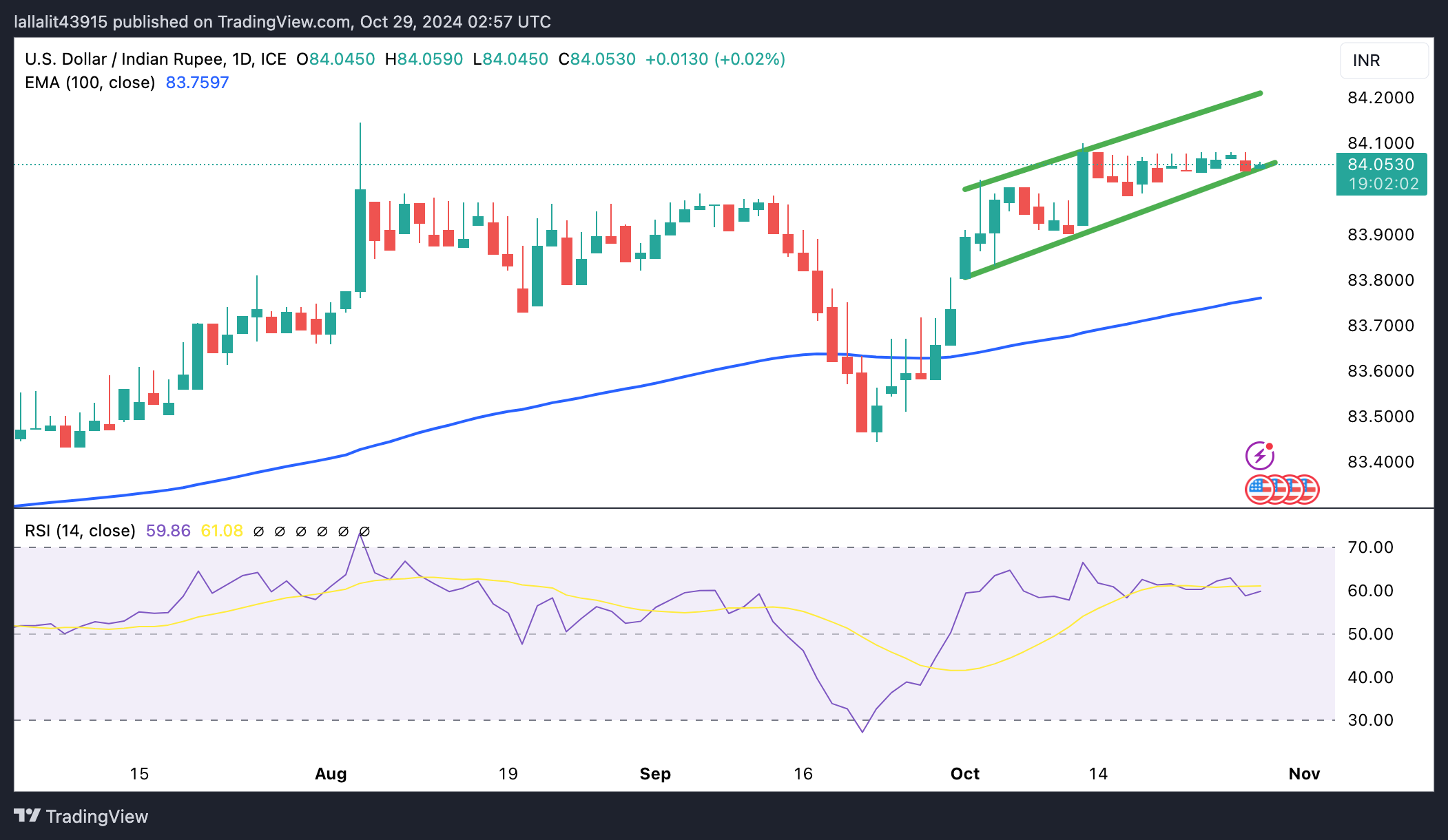
The Indian Rupee trades softer on the day. Technically, the USD/INR pair keeps the bullish vibe above the key 100-day Exponential Moving Average (EMA) on the daily chart. The upward momentum is supported by the 14-day Relative Strength Index (RSI), which stands above the midline near 60.15, indicating the support is likely to hold rather than break.
Bullish candlesticks and sustained trading above the upper boundary of the ascending trend channel of 84.22 could set USD/INR to 84.50, en route to the 85.00 psychological level.
On the downside, consistent trades under the lower limit of the trend channel near 84.05 could see a drop to 83.76, the 100-day EMA.
Indian Rupee FAQs
The Indian Rupee (INR) is one of the most sensitive currencies to external factors. The price of Crude Oil (the country is highly dependent on imported Oil), the value of the US Dollar – most trade is conducted in USD – and the level of foreign investment, are all influential. Direct intervention by the Reserve Bank of India (RBI) in FX markets to keep the exchange rate stable, as well as the level of interest rates set by the RBI, are further major influencing factors on the Rupee.
The Reserve Bank of India (RBI) actively intervenes in forex markets to maintain a stable exchange rate, to help facilitate trade. In addition, the RBI tries to maintain the inflation rate at its 4% target by adjusting interest rates. Higher interest rates usually strengthen the Rupee. This is due to the role of the ‘carry trade’ in which investors borrow in countries with lower interest rates so as to place their money in countries’ offering relatively higher interest rates and profit from the difference.
Macroeconomic factors that influence the value of the Rupee include inflation, interest rates, the economic growth rate (GDP), the balance of trade, and inflows from foreign investment. A higher growth rate can lead to more overseas investment, pushing up demand for the Rupee. A less negative balance of trade will eventually lead to a stronger Rupee. Higher interest rates, especially real rates (interest rates less inflation) are also positive for the Rupee. A risk-on environment can lead to greater inflows of Foreign Direct and Indirect Investment (FDI and FII), which also benefit the Rupee.
Higher inflation, particularly, if it is comparatively higher than India’s peers, is generally negative for the currency as it reflects devaluation through oversupply. Inflation also increases the cost of exports, leading to more Rupees being sold to purchase foreign imports, which is Rupee-negative. At the same time, higher inflation usually leads to the Reserve Bank of India (RBI) raising interest rates and this can be positive for the Rupee, due to increased demand from international investors. The opposite effect is true of lower inflation.
Author

Lallalit Srijandorn
FXStreet
Lallalit Srijandorn is a Parisian at heart. She has lived in France since 2019 and now becomes a digital entrepreneur based in Paris and Bangkok.