USD/INR approaches all-time high amid higher oil prices, FIIs selling
- The Indian Rupee continues to underperform against the US Dollar amid rising oil prices.
- US President Trump warns of extending the blockade on Iranian sea ports.
- The Fed is expected to leave interest rates unchanged.

The Indian Rupee (INR) extends its decline against the US Dollar (USD) on Wednesday. The USD/INR pair rallies further to near 94.85, as oil prices have extended their advance, following comments from United States (US) officials on late Tuesday that President Donald Trump has instructed aides to prepare for an extended blockade of Iran, The Wall Street Journal (WSJ) reported.
At the press time, the WTI Oil price trades flat around $97.00 but gained sharply in the late Tuesday’s session to near $99.50, the highest level seen in almost three weeks.
Currencies from economies, such as India, which rely heavily on oil imports to meet their energy needs, tend to underperform in a high oil price environment.
Investors fear extension of US blockade on Iranian ports
The WSJ report showed that the US President Trump has stated that the continuation of the blockade of Iranian sea ports is a preferred measure to push Tehran on the back foot in negotiating terms for a permanent ceasefire rather than bombing Iranian territory again.
The continuous US blockade of Iran means the prolonged closure of the Strait of Hormuz, a vital passage for almost 20% of global energy supply.
FIIs remain net sellers in Indian stock market
Overseas investors have emerged as net sellers for the seventh straight trading day on Tuesday, and have offloaded their stake worth Rs. 20,395.08 crore. Foreign Institutional Investors (FIIs) worry that “higher-for-longer” oil prices would be a major drag on India Inc.’s earnings projections by hitting their margins and diminishing households’ spending power.
Fed's policy takes center stage
On Wednesday, the major trigger for global markets will be the Federal Reserve’s (Fed) monetary policy announcement at 18:00 GMT, in which the central bank is expected to leave interest rates unchanged in the range of 3.50%-3.75%.
The Fed is expected to warn of upside inflation and downside economic risks amid escalated energy prices. This will likely be the last Fed policy meeting by Jerome Powell as Chairman. Investors will pay close attention to Fed Chair Powell’s speech to get fresh cues on the US interest rate outlook.
Technical Analysis: USD/INR remains above 20-day EMA
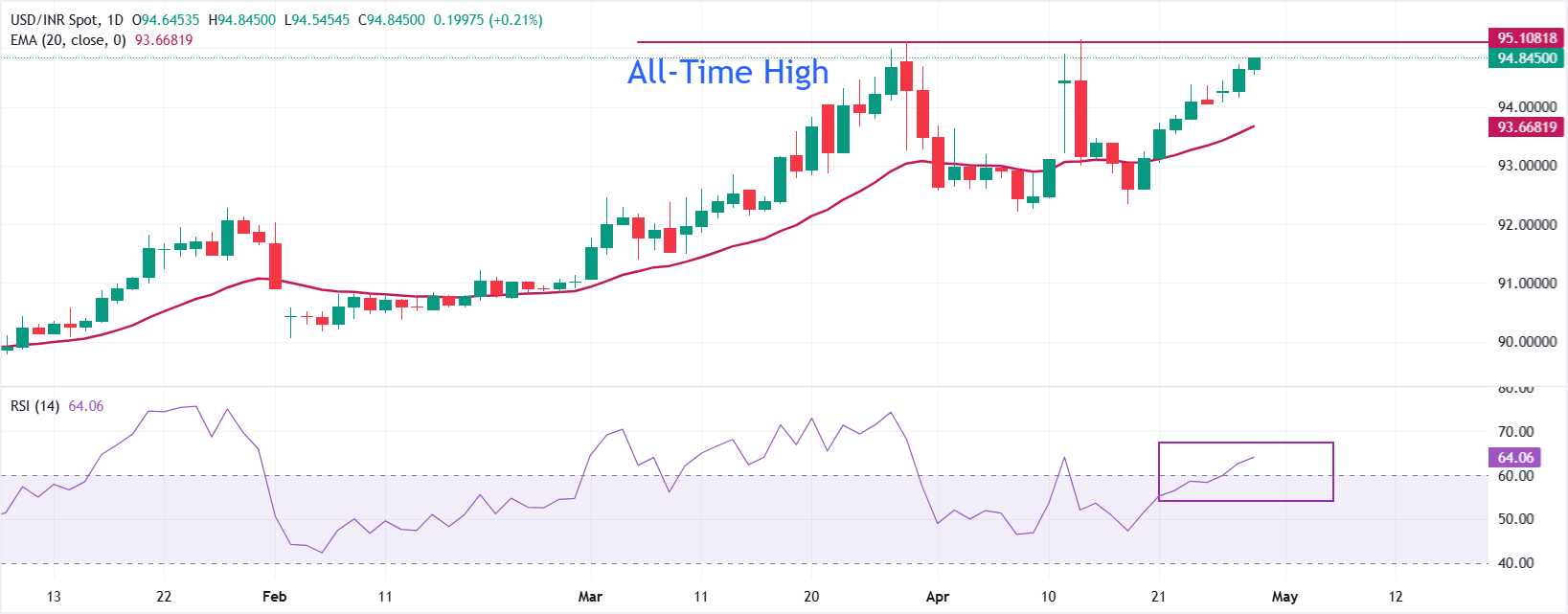
USD/INR trades higher at around 94.85 at the press time on Wednesday. The pair holds a bullish near-term bias as spot remains above the 20-day exponential moving average (EMA) at roughly 93.66, keeping the recent advance supported.
The Relative Strength Index (RSI) around 64 suggests firm but not yet overbought upside momentum, reinforcing the constructive tone while leaving room for additional gains.
On the downside, immediate support is seen at the 20-day EMA near 93.66. As long as USD/INR defends this moving average, dips are likely to attract buying interest, and the broader uptrend is expected to stay intact. Looking up, the spot is expected to revisit the all-time high slightly above 95.00.
(The technical analysis of this story was written with the help of an AI tool.)
Fed FAQs
Monetary policy in the US is shaped by the Federal Reserve (Fed). The Fed has two mandates: to achieve price stability and foster full employment. Its primary tool to achieve these goals is by adjusting interest rates. When prices are rising too quickly and inflation is above the Fed’s 2% target, it raises interest rates, increasing borrowing costs throughout the economy. This results in a stronger US Dollar (USD) as it makes the US a more attractive place for international investors to park their money. When inflation falls below 2% or the Unemployment Rate is too high, the Fed may lower interest rates to encourage borrowing, which weighs on the Greenback.
The Federal Reserve (Fed) holds eight policy meetings a year, where the Federal Open Market Committee (FOMC) assesses economic conditions and makes monetary policy decisions. The FOMC is attended by twelve Fed officials – the seven members of the Board of Governors, the president of the Federal Reserve Bank of New York, and four of the remaining eleven regional Reserve Bank presidents, who serve one-year terms on a rotating basis.
In extreme situations, the Federal Reserve may resort to a policy named Quantitative Easing (QE). QE is the process by which the Fed substantially increases the flow of credit in a stuck financial system. It is a non-standard policy measure used during crises or when inflation is extremely low. It was the Fed’s weapon of choice during the Great Financial Crisis in 2008. It involves the Fed printing more Dollars and using them to buy high grade bonds from financial institutions. QE usually weakens the US Dollar.
Quantitative tightening (QT) is the reverse process of QE, whereby the Federal Reserve stops buying bonds from financial institutions and does not reinvest the principal from the bonds it holds maturing, to purchase new bonds. It is usually positive for the value of the US Dollar.
Author

Sagar Dua
FXStreet
Sagar Dua is associated with the financial markets from his college days. Along with pursuing post-graduation in Commerce in 2014, he started his markets training with chart analysis.














