USD/CAD's post-FOMC spike fades during Powell's presser
- The Fed held the federal funds rate at 3.50% to 3.75% in the most divided FOMC vote since October 1992.
- Powell said the energy surge had not yet peaked and wanted to see energy and tariffs end before cuts.
- Powell flagged that the easing bias could be dropped as early as the next meeting, supporting the US Dollar.

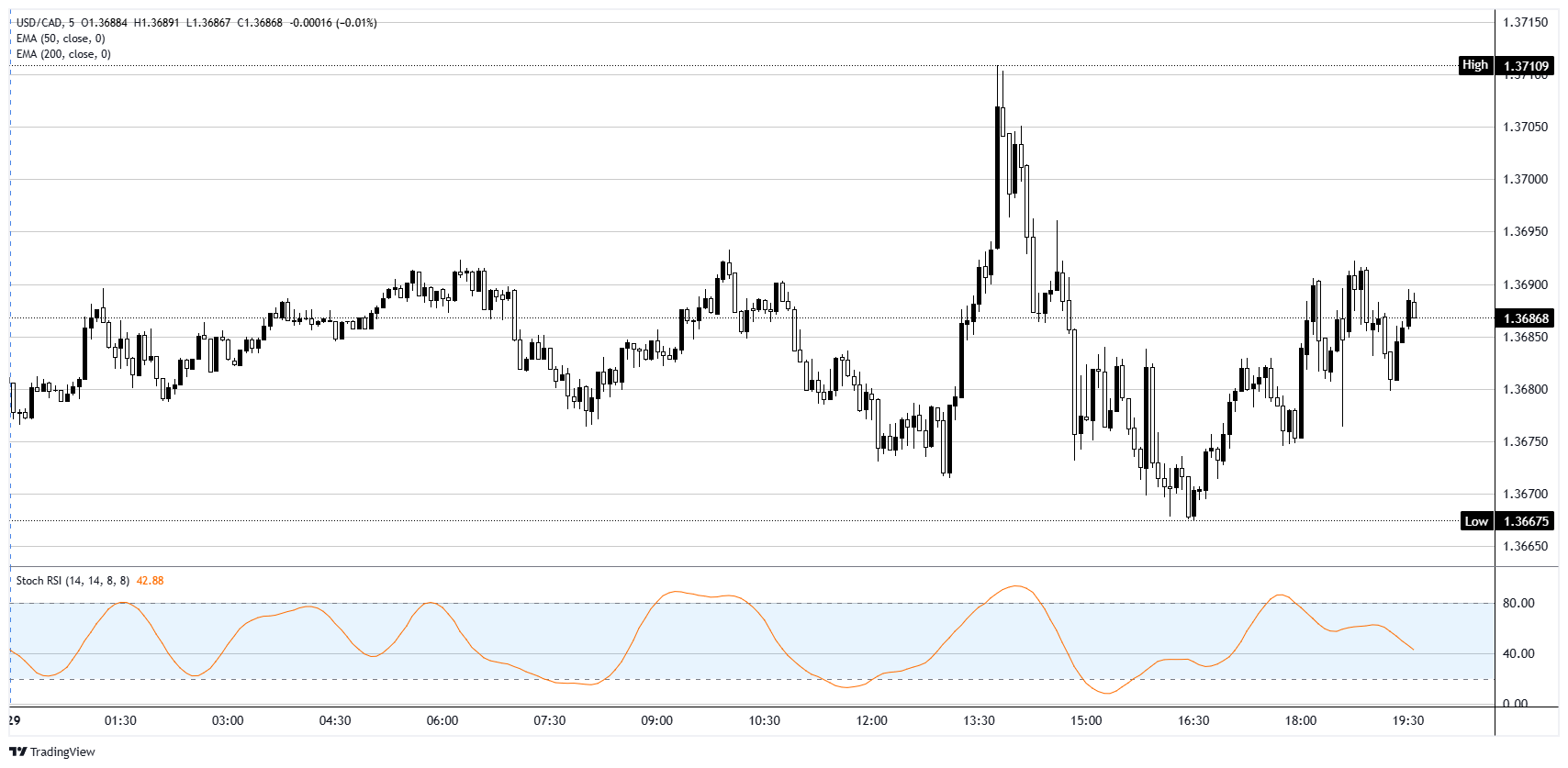
USD/CAD finished broadly unchanged on Wednesday, slipping less than 0.1% to trade close to 1.3688 after a volatile post-FOMC session. Price first spiked to a session high near 1.3711 ahead of the Fed's rate decision before sellers progressively reclaimed the move, with a session low about 1.3668 reached during the second half of Powell's press conference; a partial recovery in the final hour returned the pair to roughly 1.3690 by the close, leaving it in the upper portion of a wide intraday range.
The Federal Reserve (Fed) held the federal funds rate at 3.50% to 3.75% for a third consecutive meeting, hardening its inflation language to 'elevated' from 'somewhat elevated' while citing higher global energy prices and a high level of uncertainty around Middle East developments. The 8-4 Federal Open Market Committee (FOMC) vote drew the most dissents since October 1992, with Stephen Miran preferring a 25 basis points cut and Beth Hammack, Neel Kashkari, and Lorie Logan opposing the easing bias inserted into the statement. Chair Powell described the decision as 'a closer call than in March,' said the energy price surge had not yet peaked, and noted that the number of officials seeing a hike as likely as a cut had moved up. Powell added that a shift away from the easing bias could come as early as the next meeting and that he wanted to see energy and tariff pressures end before any rate cuts, lifting the US Dollar broadly even as the post-decision USD/CAD spike was fully retraced before a modest late-session bid returned price toward the middle of the day's range.
USD/CAD 5-minute chart
Canadian Dollar FAQs
The key factors driving the Canadian Dollar (CAD) are the level of interest rates set by the Bank of Canada (BoC), the price of Oil, Canada’s largest export, the health of its economy, inflation and the Trade Balance, which is the difference between the value of Canada’s exports versus its imports. Other factors include market sentiment – whether investors are taking on more risky assets (risk-on) or seeking safe-havens (risk-off) – with risk-on being CAD-positive. As its largest trading partner, the health of the US economy is also a key factor influencing the Canadian Dollar.
The Bank of Canada (BoC) has a significant influence on the Canadian Dollar by setting the level of interest rates that banks can lend to one another. This influences the level of interest rates for everyone. The main goal of the BoC is to maintain inflation at 1-3% by adjusting interest rates up or down. Relatively higher interest rates tend to be positive for the CAD. The Bank of Canada can also use quantitative easing and tightening to influence credit conditions, with the former CAD-negative and the latter CAD-positive.
The price of Oil is a key factor impacting the value of the Canadian Dollar. Petroleum is Canada’s biggest export, so Oil price tends to have an immediate impact on the CAD value. Generally, if Oil price rises CAD also goes up, as aggregate demand for the currency increases. The opposite is the case if the price of Oil falls. Higher Oil prices also tend to result in a greater likelihood of a positive Trade Balance, which is also supportive of the CAD.
While inflation had always traditionally been thought of as a negative factor for a currency since it lowers the value of money, the opposite has actually been the case in modern times with the relaxation of cross-border capital controls. Higher inflation tends to lead central banks to put up interest rates which attracts more capital inflows from global investors seeking a lucrative place to keep their money. This increases demand for the local currency, which in Canada’s case is the Canadian Dollar.
Macroeconomic data releases gauge the health of the economy and can have an impact on the Canadian Dollar. Indicators such as GDP, Manufacturing and Services PMIs, employment, and consumer sentiment surveys can all influence the direction of the CAD. A strong economy is good for the Canadian Dollar. Not only does it attract more foreign investment but it may encourage the Bank of Canada to put up interest rates, leading to a stronger currency. If economic data is weak, however, the CAD is likely to fall.
Author

Joshua Gibson
FXStreet
Joshua joins the FXStreet team as an Economics and Finance double major from Vancouver Island University with twelve years' experience as an independent trader focusing on technical analysis.