USD/CAD Price Forecast: Remains in tight range near 1.4200, eyes on US NFP
- USD/CAD remains sideways for over a week around 1.4200.
- The US NFP data will likely pave the way for a direction for the Loonie pair.
- Fed’s Warsh warned of upside inflation risks.

The USD/CAD pair trades flat around 1.4210 during the European trading session on Thursday. The Loonie pair has remained sideways for over a week, with investors seeking fresh cues regarding the United States (US) interest rate outlook. For the same, investors await the US Nonfarm Payrolls (NFP) data for June, which will be published at 12:30 GMT.
According to estimates, the US economy created 110K fresh jobs, lower than 172K in May. The Unemployment Rate is seen remaining steady at 4.3%. Average Hourly Earnings, a key measure of wage growth, is estimated to arrive at 3.5% Year-on-Year (YoY), higher from 3.4% in May, with monthly figures rising steadily by 0.3%.
Assuming that wage growth drives the US core inflation significantly, investors will pay close attention to the data to get cues regarding the price rise outlook.
On Wednesday, Federal Reserve (Fed) Chairman Kevin Warsh warned at the European Central Bank (ECB) Forum in Sintra that inflation remains “too high”, while stressing the need to bring price stability.
Meanwhile, lower oil prices due to progress in indirect talks between the US and Iran, held in Doha on Wednesday, have diminished the appeal of currencies from economies, such as Canada, which are net oil exporters.
Technical Analysis:
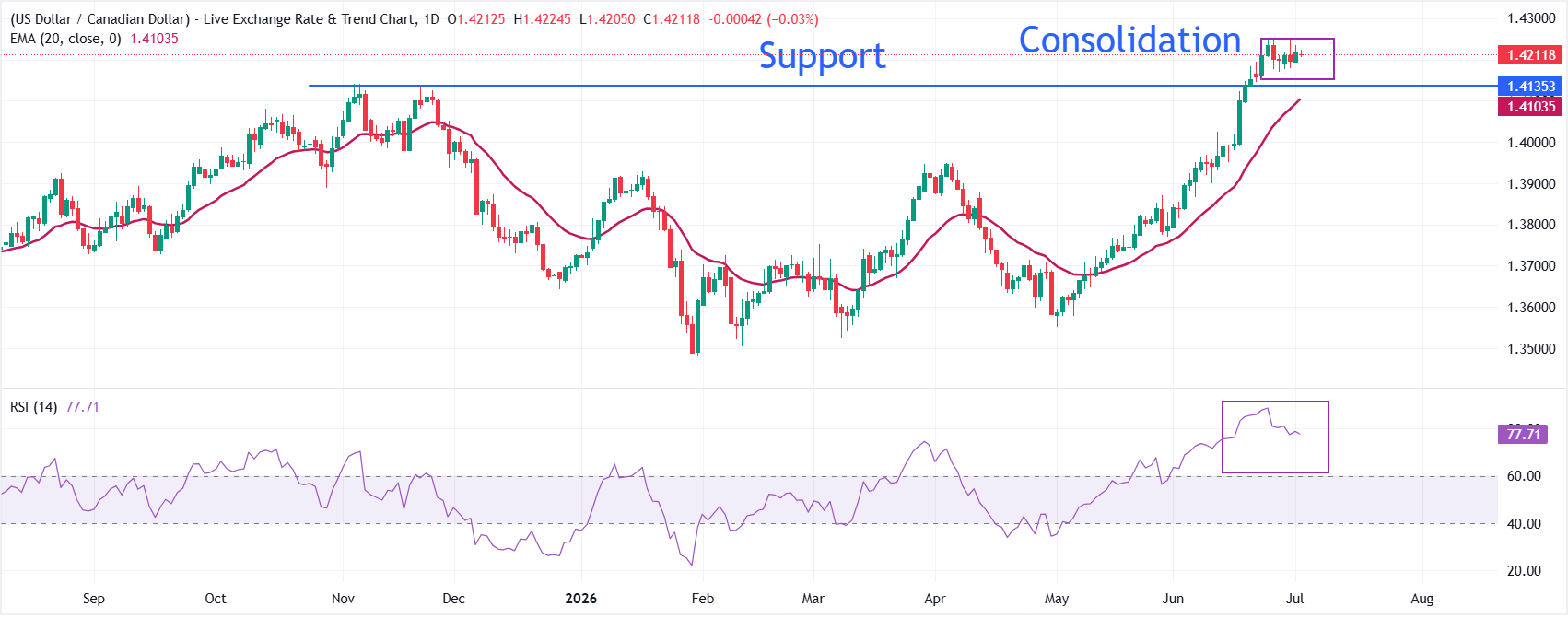
USD/CAD trades flat at around 1.4200, while holding a clear bullish bias as spot remains above the 20-day exponential moving average (EMA) at 1.4103.
The Relative Strength Index (RSI) at 77.7 signals overbought conditions that could temper immediate upside without yet undermining the broader constructive tone.
On the downside, initial support is located at the 20-day EMA near 1.4103, where buyers are likely to defend the prevailing uptrend on any pullback. Looking up, the pair could extend its advance towards the 1 April 2025 high at 1.4415 if it breaks the ongoing consolidation inside the 1.4169-1.4248 upwards.
(The technical analysis of this story was written with the help of an AI tool.)
Economic Indicator
Nonfarm Payrolls
The Nonfarm Payrolls release presents the number of new jobs created in the US during the previous month in all non-agricultural businesses; it is released by the US Bureau of Labor Statistics (BLS). The monthly changes in payrolls can be extremely volatile. The number is also subject to strong reviews, which can also trigger volatility in the Forex board. Generally speaking, a high reading is seen as bullish for the US Dollar (USD), while a low reading is seen as bearish, although previous months' reviews and the Unemployment Rate are as relevant as the headline figure. The market's reaction, therefore, depends on how the market assesses all the data contained in the BLS report as a whole.
Read more.Next release: Thu Jul 02, 2026 12:30
Frequency: Monthly
Consensus: 110K
Previous: 172K
Source: US Bureau of Labor Statistics
America’s monthly jobs report is considered the most important economic indicator for forex traders. Released on the first Friday following the reported month, the change in the number of positions is closely correlated with the overall performance of the economy and is monitored by policymakers. Full employment is one of the Federal Reserve’s mandates and it considers developments in the labor market when setting its policies, thus impacting currencies. Despite several leading indicators shaping estimates, Nonfarm Payrolls tend to surprise markets and trigger substantial volatility. Actual figures beating the consensus tend to be USD bullish.
Author

Sagar Dua
FXStreet
Sagar Dua is associated with the financial markets from his college days. Along with pursuing post-graduation in Commerce in 2014, he started his markets training with chart analysis.
















