USD/CAD Price Forecast: More downside likely towards 1.3970
- USD/CAD edges lower to near 1.4033 amid strength in the Canadian Dollar.
- The Red Sea closure could lift oil prices further.
- BoC’s Macklem keeps the door open for further interest rate hikes.

The USD/CAD pair trades marginally lower at around 1.4033 during the European trading session on Friday. The Loonie pair edges down as the Canadian Dollar (CAD) outperforms its major currency peers amid fears that oil prices could accelerate further.
Currencies from economies, such as Canada, that are net energy exporters tend to outperform in a high-oil-price environment.
The oil price outlook has improved amid threats from Iran that it will close the Red Sea if the United States (US) strikes on Iranian infrastructure.
On the monetary policy front, Bank of Canada (BoC) Governor Tiff Macklem said in the press conference, after leaving interest rates unchanged at 2.25%, that the central bank might need to raise interest rates if oil prices remain higher.
Meanwhile, the US Dollar holds Thursday’s recovery move amid fears of a resurgence in US inflation due to rising energy prices.
USD/CAD technical analysis
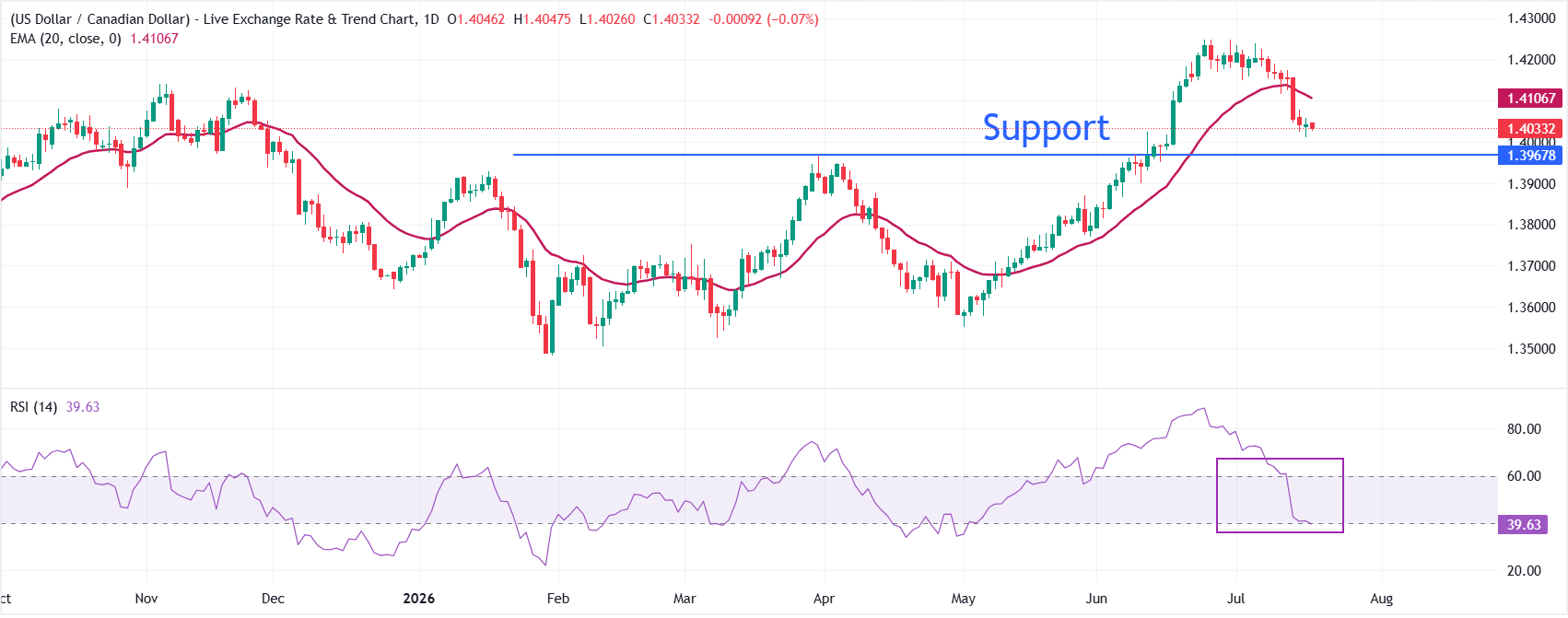
USD/CAD trades slightly lower at around 1.4033, extending a corrective tone after pulling back from recent highs. The pair now sits beneath the 20-day Exponential Moving Average (EMA) at 1.4107, suggesting a near-term bearish bias as price loses traction relative to the short-term trend benchmark.
The Relative Strength Index (RSI) at 39.6 has retreated from overbought territory and now leans toward the lower half of its range, suggesting that downside momentum is still in play but not yet oversold.
On the topside, immediate resistance is defined by the 20-day EMA at 1.4107, and a sustained recovery above this barrier would be needed to ease the current pressure. On the downside, the pair is expected to extend its decline towards the March 31 high at 1.3967.
(The technical analysis of this story was written with the help of an AI tool. Know more.)
Economic Indicator
BoC Interest Rate Decision
The Bank of Canada (BoC) announces its interest rate decision at the end of its eight scheduled meetings per year. If the BoC believes inflation will be above target (hawkish), it will raise interest rates in order to bring it down. This is bullish for the CAD since higher interest rates attract greater inflows of foreign capital. Likewise, if the BoC sees inflation falling below target (dovish) it will lower interest rates in order to give the Canadian economy a boost in the hope inflation will rise back up. This is bearish for CAD since it detracts from foreign capital flowing into the country.
Read more.Last release: Wed Jul 15, 2026 13:45
Frequency: Irregular
Actual: 2.25%
Consensus: 2.25%
Previous: 2.25%
Source: Bank of Canada
Author

Sagar Dua
FXStreet
Sagar Dua is associated with the financial markets from his college days. Along with pursuing post-graduation in Commerce in 2014, he started his markets training with chart analysis.