USD/CAD Price Forecast: Likely revisit five-month high at around 1.4250
- USD/CAD rises to near 1.4190 as the US Dollar trades higher.
- The Fed is expected to deliver two more interest rate hikes this year.
- Investors await Canadian GDP data for July and the US JOLTS Job Openings data for August.

The US Dollar (USD) is up 0.12% at around 1.4190 against the US Dollar (USD) during the European trading session on Tuesday. The Loonie pair trades higher as the US Dollar outperforms, with financial markets becoming increasingly confident that the Federal Reserve (Fed) will deliver two more interest rate hikes this year.
US Dollar Price Today
The table below shows the percentage change of US Dollar (USD) against listed major currencies today. US Dollar was the strongest against the Australian Dollar.
| USD | EUR | GBP | JPY | CAD | AUD | NZD | CHF | |
|---|---|---|---|---|---|---|---|---|
| USD | 0.18% | 0.14% | -0.02% | 0.09% | 0.40% | 0.25% | 0.16% | |
| EUR | -0.18% | -0.05% | -0.20% | -0.11% | 0.22% | 0.06% | -0.03% | |
| GBP | -0.14% | 0.05% | -0.17% | -0.03% | 0.25% | 0.11% | 0.01% | |
| JPY | 0.02% | 0.20% | 0.17% | 0.11% | 0.40% | 0.24% | 0.15% | |
| CAD | -0.09% | 0.11% | 0.03% | -0.11% | 0.29% | 0.14% | 0.06% | |
| AUD | -0.40% | -0.22% | -0.25% | -0.40% | -0.29% | -0.15% | -0.24% | |
| NZD | -0.25% | -0.06% | -0.11% | -0.24% | -0.14% | 0.15% | -0.08% | |
| CHF | -0.16% | 0.03% | -0.01% | -0.15% | -0.06% | 0.24% | 0.08% |
The heat map shows percentage changes of major currencies against each other. The base currency is picked from the left column, while the quote currency is picked from the top row. For example, if you pick the US Dollar from the left column and move along the horizontal line to the Japanese Yen, the percentage change displayed in the box will represent USD (base)/JPY (quote).
As of writing, the US Dollar Index (DXY), which gauges the Greenback’s value against six major currencies, trades 0.16% higher to near 101.35.
The CME FedWatch tool also shows a 60% probability of the Fed delivering a quarter-to-a-percent interest rate hike in both policy meetings remaining this year.
Later in the day, investors will focus on the Canadian monthly Grioss Domestic Product (GDP) data for July and the United States (US) JOLTS Job Openings data for August.
Economists expect the Canadian economy to have remained flat after expanding 0.3% in June.
The US Job Openings report will likely show that US employers posted 7.23 million fresh jobs, marginally lower than 7.271 million in July.
USD/CAD Technical Analysis
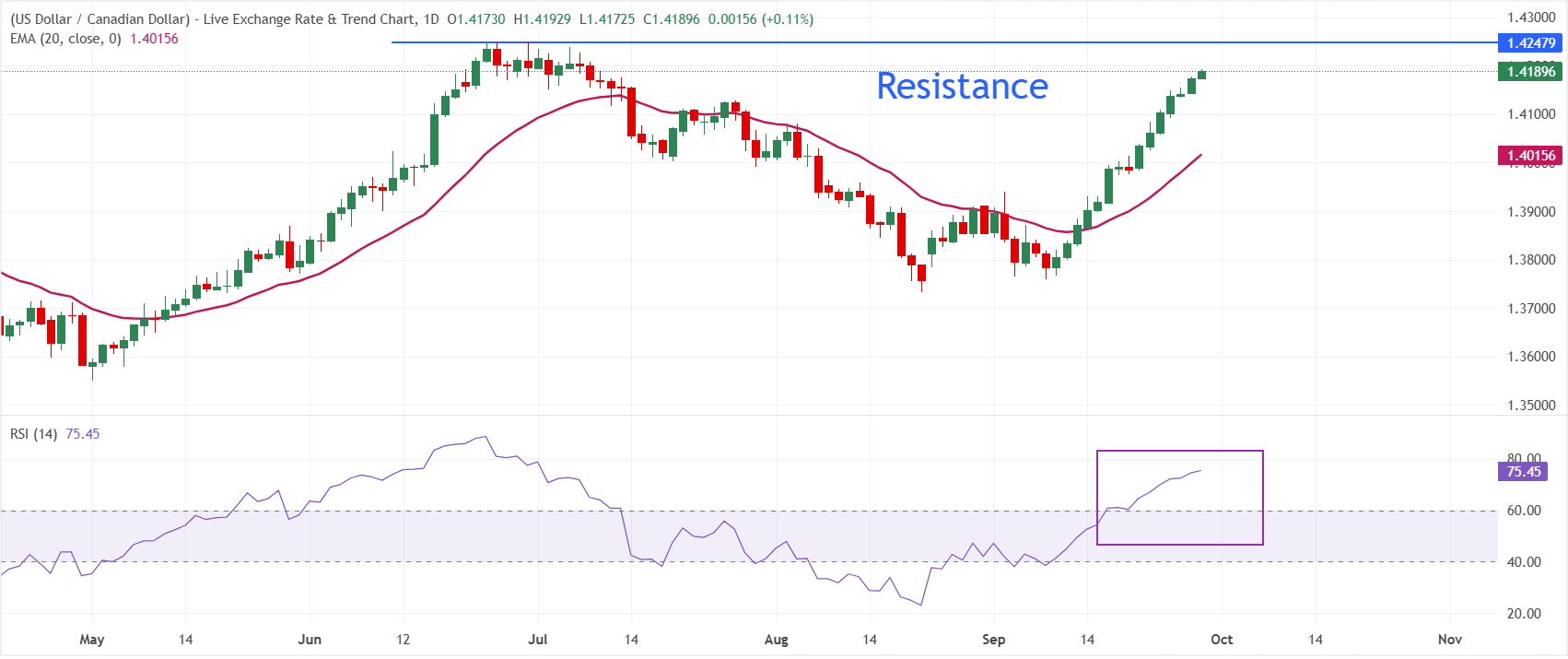
In the daily chart, USD/CAD trades at 1.4190, extending its advance well above the 20-period exponential moving average (EMA) at 1.4016 and reinforcing a bullish near-term bias. The pair has pushed into overbought territory, with the 14-period Relative Strength Index (RSI) at 75.45, which suggests that while buyers remain in control, the risk of a corrective pullback is rising as the latest leg higher stretches away from its dynamic support.
On the downside, immediate support is located at the 20-period EMA around 1.4020, where a deeper retracement could find underlying demand and preserve the broader positive structure as long as price holds above this level. With no clearly defined resistance levels in the current dataset, any further topside extension would be driven by momentum, though the elevated RSI hints that fresh gains from here could be more gradual and vulnerable to short-term consolidation phases.
(The technical analysis of this story was written with the help of an AI tool. Know more.)
Economic Indicator
Gross Domestic Product (MoM)
The Gross Domestic Product (GDP), released by Statistics Canada on a monthly and quarterly basis, is a measure of the total value of all goods and services produced in Canada during a given period. The GDP is considered as the main measure of Canadian economic activity. The MoM reading compares economic activity in the reference month to the previous month. Generally, a high reading is seen as bullish for the Canadian Dollar (CAD), while a low reading is seen as bearish.
Read more.Author

Sagar Dua
FXStreet
Sagar Dua is associated with the financial markets from his college days. Along with pursuing post-graduation in Commerce in 2014, he started his markets training with chart analysis.