US100: AI capital efficiency concerns trigger a critical trend breakdown

Fundamental setup
The technology selloff reflects a fundamental reassessment of AI investment returns rather than merely rising interest rates.
Amazon reported 39.3% AWS growth, yet trailing twelve-month free cash flow deteriorated to negative $42.4 billion, compared with positive $14.8 billion a year earlier. Its 2026 capital expenditure guidance remains approximately $220 billion.
Alphabet's 12.6% decline, followed by sharp after-hours losses in Amazon and Intel, illustrates the market's increasing sensitivity to the capital required to sustain AI growth.
Importantly, the US 10-year yield has declined toward 4.91%. Falling risk-free rates are therefore failing to support technology valuations, suggesting that deteriorating expected free cash flow and rising equity risk premiums are dominating the valuation equation.
Technical structure
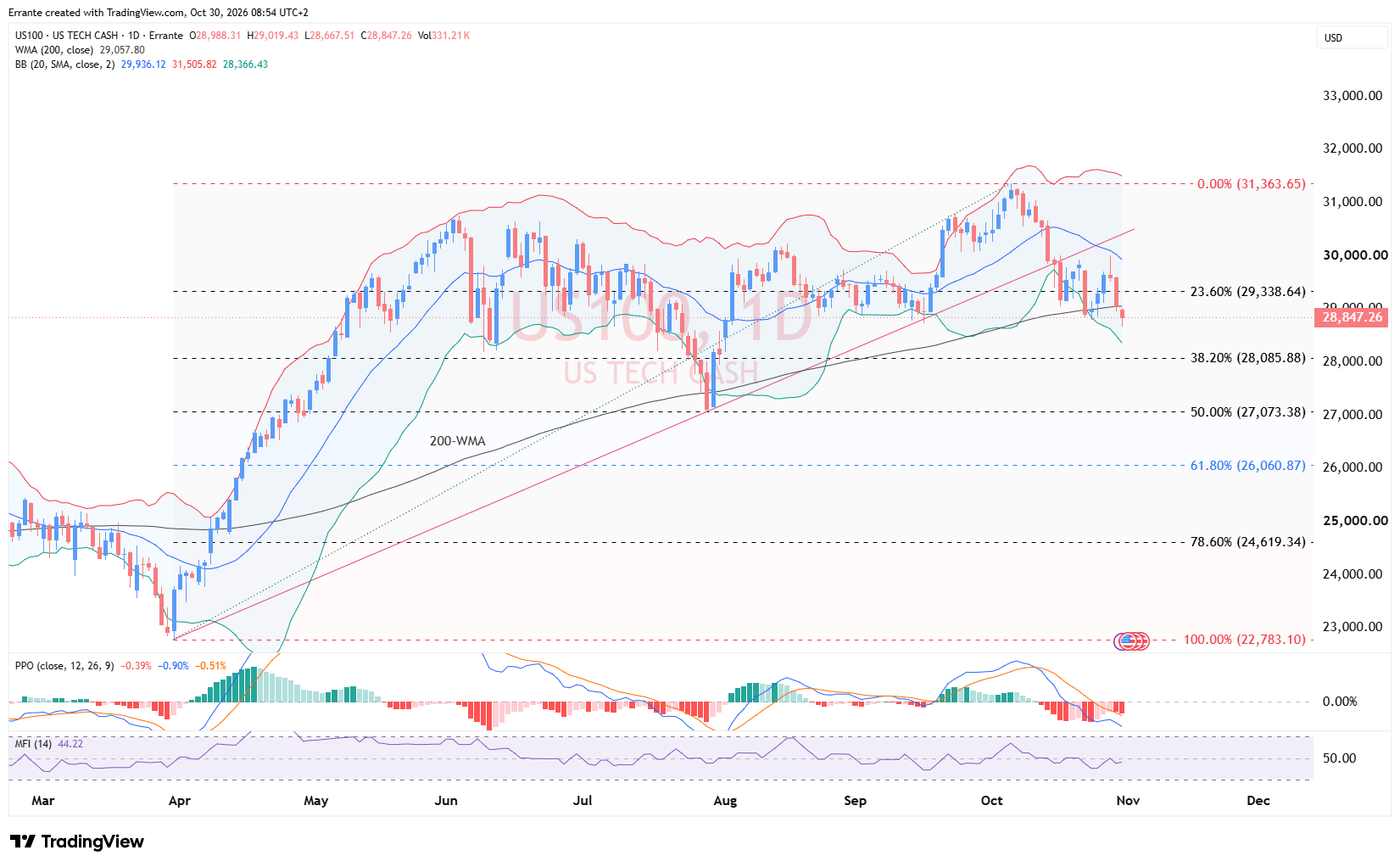
US100 has declined approximately 8% from October's 31,363 record, breaking its seven-month rising trendline, the 29,339 Fibonacci support and the rising 200-day WMA near 29,058.
The current decline represents approximately a 29% retracement of the April–October advance. Price is now testing the 28,667 intraday low, with the lower Bollinger Band near 28,366 providing the next potential volatility-defined support.
PPO at -0.90%, below its -0.51% signal, confirms bearish momentum expansion. MFI near 44 indicates weak participation without an extreme oversold condition.
Scenario | Technical trigger | Target / implication |
Main - bearish continuation | Remain below 29,058–29,339 and break 28,667 | 28,366, then 28,086 |
Alternative - bullish recovery | Daily close above 29,339 | 29,936; sustained recovery above that level strengthens the reversal case |
A breakdown below 28,086, the 38.2% retracement, would expose the deeper 27,073 support and materially weaken the intermediate bullish structure.
Educational point
Revenue growth and shareholder value creation are not equivalent. When incremental AI investment consumes cash faster than it generates economic profits, valuation can contract despite accelerating sales. The decisive measure is whether incremental return on invested capital exceeds the weighted average cost of capital, supported by sustainable free-cash-flow conversion.
Author

Ali Mortazavi
Errante
BEc, CMSA, Member of IFTA - International Federation of Technical Analysis, Associate Member of STA - Society of Technical Analysis (UK).

















