|

US stock market reels lower as Treasury yields soar

  • US 30-year Treasury yield rises to 5.11%.
  • Trump leaves China without major deals on chips and Hormuz.
  • UK political instability affects UK bond yields.
  • NY Manufacturing Index comes in extremely hot for May.

The US Treasury market is rearing its head once again on Friday, this time causing a broad sell-off in US market indices. The NASDAQ Composite opened up close to 1.4% lower, while the S&P 500 and Dow Jones Industrial Average (DJIA) are both off between 0.5% and 1.0%. All three indices sold off much worse in the futures market, so there is reason to believe the indices will fall further as the regular session gets underway.

Youtube preview

The culprit? Treasury yields.

The US 10-year has risen nearly 8 basis points to 4.57%, while the US 30-year yield is up about 1.6% to 5.11%.

Many observers are pointing to political instability in the leadership of Prime Minister Kier Starmer in the United Kingdom (UK). Upheaval in his own Labour Party has led to further calls for Starmer to resign, pushing up Gilt yields.

On the US side of the ledger, the NY Empire State Manufacturing Index for May came in Friday morning extremely hot at 19.6, several deviations above the consensus of 7.5 and the previous reading of 11. The hot reading gives the Federal Reserve (Fed) more impetus to raise interest rates in the face of a roaring economy and rising inflation.

Then there's US President Donald Trump's trip to China, which ended without a much-needed deal for US semiconductors or a decision to quickly open the Strait of Hormuz. Crude Oil (WTI) has risen 2.7% and is closing in on $104.

Even Thursday's hyper-bullish IPO by Cerebrus Systems (CBRS), which rallied 68% on its debut, is down some 4%.
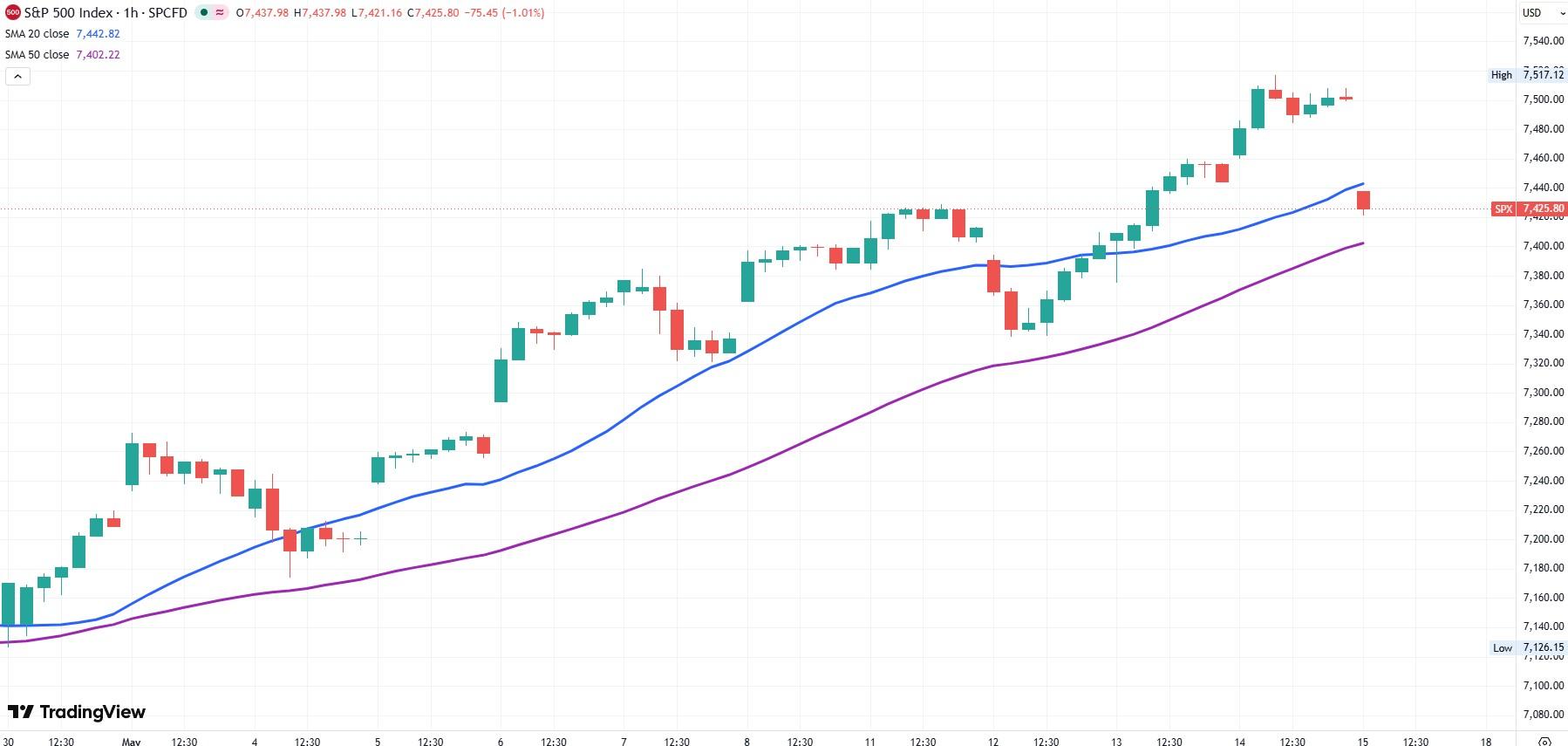
SP500 hourly chart
S&P 500 futures (SPX) 1-hour chart

Author

Clay Webster

Clay Webster

FXStreet

Clay Webster grew up in the US outside Buffalo, New York and Lancaster, Pennsylvania. He began investing after college following the 2008 financial crisis.


More from Clay Webster
Share:

Editor's Picks

AUD/USD bulls regain control above 0.6950 amid USD retreat

AUD/USD regains traction and extends the previous day's bounce from the weekly low, aiming for 0.7000 in Asia on Friday. The overnight pullback in US bond yields keeps the US Dollar below an 18-month high, which in turn offers some support to the pair. Meanwhile, hawkish RBA expectations also keep the major underpinned.

USD/JPY holds gains near 158.00 after Japan's weak Household Spending data

USD/JPY clings to gains around 158.00 after data showed on Friday that Japan's Household Spending fell for the ninth straight month, undermining the Japanese Yen. Meanwhile, the US Dollar remains depressed as the overnight fall in US bond yields counters a hawkish Fed and geopolitical uncertainties, could cap any downside in the pair.

Gold remains range-bound below $4,200

Gold has given up some ground after an initial bullish attempt to reach weekly highs, returning to below the $4,200 mark per troy ounce on Friday. The US Dollar’s strong upside momentum, combined with rising US Treasury yields across the curve, seems to keep further gains in the yellow metal under scrutiny.

Has Bitcoin really escaped the macro forces it was built to fight?
Over 17 years ago, Satoshi Nakamoto designed Bitcoin (BTC) on the back of a global financial crisis as an alternative to the global monetary system outside the control of central banks, governments and traditional intermediaries. This raises a key question: has Bitcoin really become independent of the macroeconomic forces it was built to challenge?
The Euro is not the sick man of Europe. France's bond market is
EUR/USD remains under pressure, near the 17-month low of 1.1161 reached on Monday. The pair has lost more than 7% since its yearly peak, as concerns over France's public finances increasingly weigh on the single currency. But behind the weakness of the Euro (EUR), the problem does not necessarily lie with the European economy as a whole.
Has Bitcoin really escaped the macro forces it was built to fight?
Over 17 years ago, Satoshi Nakamoto designed Bitcoin (BTC) on the back of a global financial crisis as an alternative to the global monetary system outside the control of central banks, governments and traditional intermediaries. This raises a key question: has Bitcoin really become independent of the macroeconomic forces it was built to challenge?














