US Dollar in quiet Monday with traders looking ahead to US GDP, NFP and geopolitics this week
- The US Dollar calm with traders assessing the pivotal week ahead in US data.
- Over the weekend, the Trump administration reiterated talks with China on trade are ongoing, China dismisses US claims.
- The US Dollar Index remains capped below the 100.00 round level and is looking for direction.

The US Dollar Index (DXY), which tracks the performance of the US Dollar (USD) against six major currencies, is going nowhere this Monday while residing near the 100.00-marker. Over the weekend, United States (US) Treasury Secretary Scott Bessent said trade deal negotiations with several Asian countries are underway, while US Agriculture Secretary Brooke Rollins added that the Trump administration is having “daily conversations” with China over tariffs.
However, China said on Monday that it is not engaged in trade negotiations with the US. The country reiterated that there are no winners in a tariff trade war and that the US should talk on a basis of mutual respect, Bloomberg reported. In a spillover effect, retailers Temu and Shein lifted prices by as much as 300% for US consumers on its websites, Reuters reports.
On the economic calendar front, a very packed week is ahead. The data will likely help traders assess if the Federal Reserve (Fed) will deliver an interest-rate cut in its upcoming policy meeting on May 7. The main attention this week will be on Wednesday, with the first reading of the US Gross Domestic Product (GDP) for the first quarter. Next, on Friday, the US Employment report for April – which includes the all-important Nonfarm Payrolls number – is the main event to close off the week.
Daily digest market movers: Quiet markets
- The Trump administration over the weekend has commented repeatedly that it is in talks with China on a trade deal. China said on Monday it is certainly not in any trade talks, Bloomberg reports.
- The US economic calendar is light on Monday. At 14:30 GMT, the Dallas Fed Manufacturing Business Index for April is due. No forecast available with the previous reading at -16.3.
- There are no scheduled Federal Reserve speakers this week as the blackout period has started ahead of the Federal Open Market Committee (FOMC) meeting and rate decision on May 7.
- Equities are trading marginally higher this Monday. The only outlier was the Japanese Topix, which closed nearly 1% up. European equities are broadly positive, while US equities have seen a mild positive opening at the bell.
- The CME FedWatch tool shows the chance of an interest rate cut by the Federal Reserve in May’s meeting stands at 8.9% against a 91.1% probability of no change. The June meeting has around a 61.9% chance of a rate cut.
- The US 10-year yields trade around 4.27%, looking for direction at the calm start the week.
US Dollar Index Technical Analysis: Stuck in tight range
The US Dollar Index (DXY) is not going anywhere as traders are keeping their powder dry for the US data later this week and amid constant woes over whether the US and China are in talks about trade.
On the upside, the DXY’s first resistance comes in at 100.22, which supported the DXY back in September 2024, with a break back above the 100.00 round level as a bullish signal. A firm recovery would be a return to 101.90, which acted as pivotal level throughout December 2023 and again as base for the inverted head-and-shoulders formation during the summer of 2024.
On the other hand, the 97.73 support could quickly be tested on any substantial bearish headline. Further below, a relatively thin technical support comes in at 96.94 before looking at the lower levels of this new price range. These would be at 95.25 and 94.56, meaning fresh lows not seen since 2022.
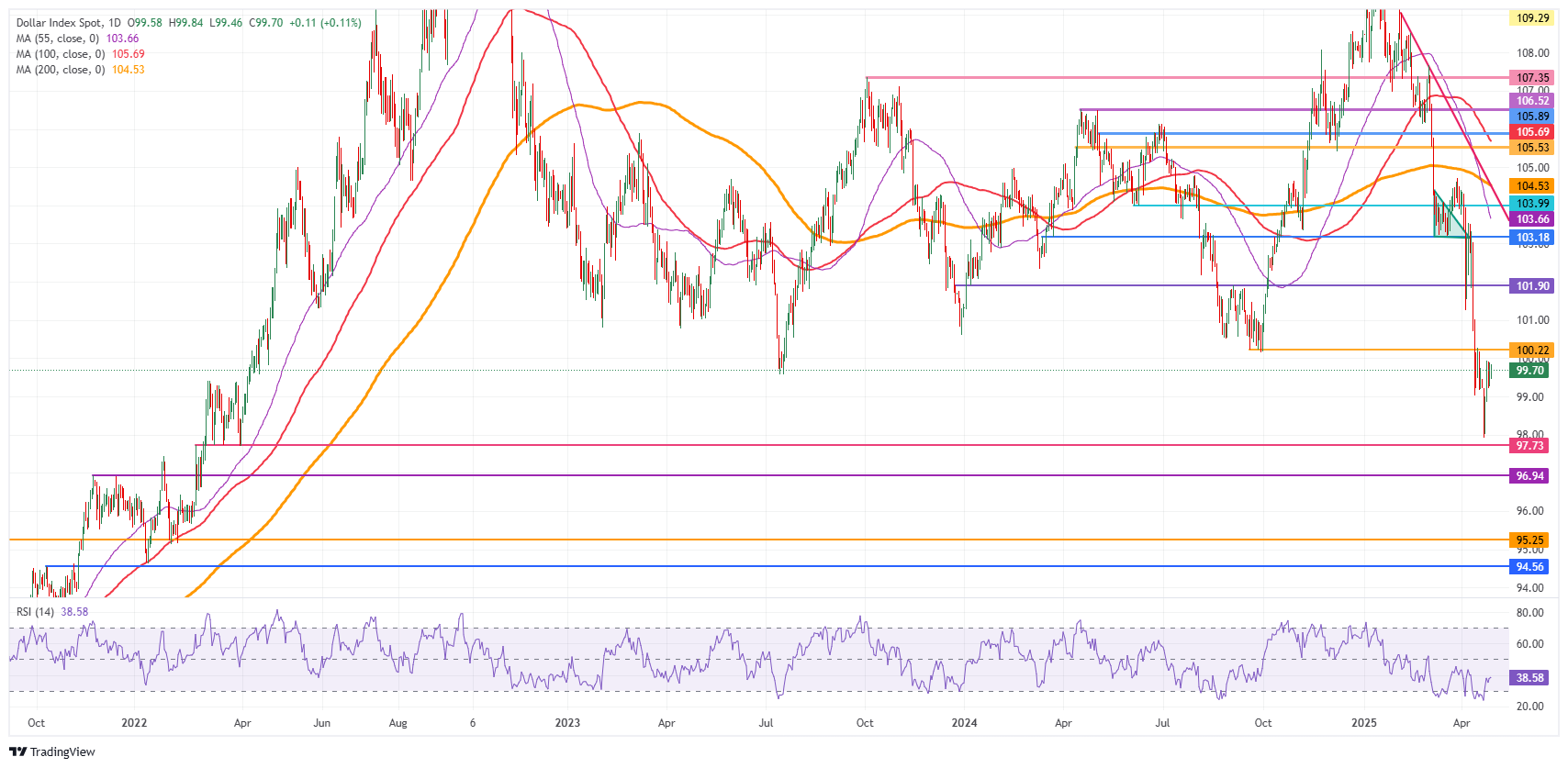
US Dollar Index: Daily Chart
Central banks FAQs
Central Banks have a key mandate which is making sure that there is price stability in a country or region. Economies are constantly facing inflation or deflation when prices for certain goods and services are fluctuating. Constant rising prices for the same goods means inflation, constant lowered prices for the same goods means deflation. It is the task of the central bank to keep the demand in line by tweaking its policy rate. For the biggest central banks like the US Federal Reserve (Fed), the European Central Bank (ECB) or the Bank of England (BoE), the mandate is to keep inflation close to 2%.
A central bank has one important tool at its disposal to get inflation higher or lower, and that is by tweaking its benchmark policy rate, commonly known as interest rate. On pre-communicated moments, the central bank will issue a statement with its policy rate and provide additional reasoning on why it is either remaining or changing (cutting or hiking) it. Local banks will adjust their savings and lending rates accordingly, which in turn will make it either harder or easier for people to earn on their savings or for companies to take out loans and make investments in their businesses. When the central bank hikes interest rates substantially, this is called monetary tightening. When it is cutting its benchmark rate, it is called monetary easing.
A central bank is often politically independent. Members of the central bank policy board are passing through a series of panels and hearings before being appointed to a policy board seat. Each member in that board often has a certain conviction on how the central bank should control inflation and the subsequent monetary policy. Members that want a very loose monetary policy, with low rates and cheap lending, to boost the economy substantially while being content to see inflation slightly above 2%, are called ‘doves’. Members that rather want to see higher rates to reward savings and want to keep a lit on inflation at all time are called ‘hawks’ and will not rest until inflation is at or just below 2%.
Normally, there is a chairman or president who leads each meeting, needs to create a consensus between the hawks or doves and has his or her final say when it would come down to a vote split to avoid a 50-50 tie on whether the current policy should be adjusted. The chairman will deliver speeches which often can be followed live, where the current monetary stance and outlook is being communicated. A central bank will try to push forward its monetary policy without triggering violent swings in rates, equities, or its currency. All members of the central bank will channel their stance toward the markets in advance of a policy meeting event. A few days before a policy meeting takes place until the new policy has been communicated, members are forbidden to talk publicly. This is called the blackout period.
BRANDED CONTENT
Finding the right broker for your trading strategy is essential, especially when specific features make all the difference. Explore our selection of top brokers, each offering unique advantages to match your needs.
Author

Filip Lagaart
FXStreet
Filip Lagaart is a former sales/trader with over 15 years of financial markets expertise under its belt.