US Dollar Index Price Forecast: Likely find direction after US NFP release
- The US Dollar Index trades sideways at around 99.92 ahead of the US official employment data.
- The US NFP data will likely have a significant impact on Fed interest rate prospects.
- Investors also await the terms of the Iran-Oman Hormuz deal.

The US Dollar (USD) consolidates against its major currency peers on Friday, with investors awaiting the United States (US) Nonfarm Payrolls (NFP) data for July, which will be published at 12:30 GMT.
In late European trade, the US Dollar Index (DXY), which tracks the Greenback’s value against six major currencies, flattens at around 99.92.
Investors will closely track the US NFP data on expectations that it will significantly influence Federal Reserve (Fed) interest rate expectations.
Dollar focus turns to US jobs data as FOMC hawkish tilt meets fragile expectations
Strategists at DBS highlight that "US non-farm payrolls for July are on tap tonight, with analysts expecting a read of 80k." They note that, "with the FOMC leaning hawkish and three of its members having voted for a hike in July, the labor market has become a more critical factor for the Fed’s next policy move." In this context, DBS cautions that "a sub-80k NFP could weigh on the USD, as it could douse expectations for another Fed rate hike this year."
On the global front, investors await clarity on the Iran-Oman deal on jointly managing navigation through the Strait of Hormuz, a vital passage to one-fifth of global energy supply.
US Dollar Index Technical Analysis
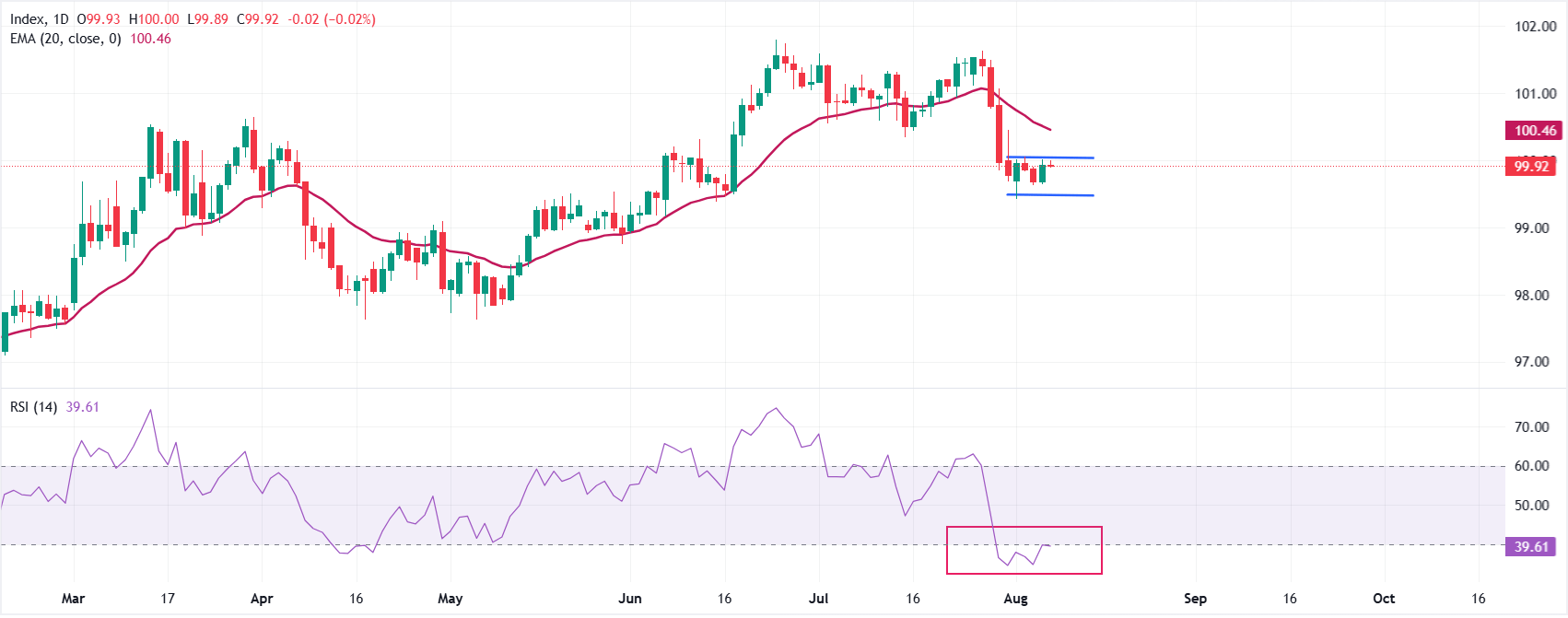
The Dollar Index Spot trades almost flat at around 99.92, maintaining a bearish near-term bias as it holds below the 20-day exponential moving average (EMA) at 100.46. Price sits inside a flat, while the Relative Strength Index (RSI) at 39.62 remains below the neutral 50 line, hinting that downside pressure still dominates despite the recent stabilization around the 100.00 area.
On the downside, immediate structural support is located near the lower band of the descending channel at 99.49–99.48, where prior lows and the channel floor converge to form a key demand zone; a break below that zone would expose the asset to 99.00. On the topside, initial resistance is seen at the channel top around 100.04, followed by stronger overhead supply at the 20-day EMA at 100.46; a daily close above these levels would be needed to ease the bearish tone and open the way for a more sustained recovery.
(The technical analysis of this story was written with the help of an AI tool. Know more.)
Nonfarm Payrolls FAQs
Nonfarm Payrolls (NFP) are part of the US Bureau of Labor Statistics monthly jobs report. The Nonfarm Payrolls component specifically measures the change in the number of people employed in the US during the previous month, excluding the farming industry.
The Nonfarm Payrolls figure can influence the decisions of the Federal Reserve by providing a measure of how successfully the Fed is meeting its mandate of fostering full employment and 2% inflation. A relatively high NFP figure means more people are in employment, earning more money and therefore probably spending more. A relatively low Nonfarm Payrolls’ result, on the either hand, could mean people are struggling to find work. The Fed will typically raise interest rates to combat high inflation triggered by low unemployment, and lower them to stimulate a stagnant labor market.
Nonfarm Payrolls generally have a positive correlation with the US Dollar. This means when payrolls’ figures come out higher-than-expected the USD tends to rally and vice versa when they are lower. NFPs influence the US Dollar by virtue of their impact on inflation, monetary policy expectations and interest rates. A higher NFP usually means the Federal Reserve will be more tight in its monetary policy, supporting the USD.
Nonfarm Payrolls are generally negatively-correlated with the price of Gold. This means a higher-than-expected payrolls’ figure will have a depressing effect on the Gold price and vice versa. Higher NFP generally has a positive effect on the value of the USD, and like most major commodities Gold is priced in US Dollars. If the USD gains in value, therefore, it requires less Dollars to buy an ounce of Gold. Also, higher interest rates (typically helped higher NFPs) also lessen the attractiveness of Gold as an investment compared to staying in cash, where the money will at least earn interest.
Nonfarm Payrolls is only one component within a bigger jobs report and it can be overshadowed by the other components. At times, when NFP come out higher-than-forecast, but the Average Weekly Earnings is lower than expected, the market has ignored the potentially inflationary effect of the headline result and interpreted the fall in earnings as deflationary. The Participation Rate and the Average Weekly Hours components can also influence the market reaction, but only in seldom events like the “Great Resignation” or the Global Financial Crisis.
Author

Sagar Dua
FXStreet
Sagar Dua is associated with the financial markets from his college days. Along with pursuing post-graduation in Commerce in 2014, he started his markets training with chart analysis.