US Dollar Index Price Forecast: Heading towards 102.00 as hawkish Fed bets intensify
- The US Dollar Index trades higher against its major currency peers amid intensifying hawkish Fed bets.
- Traders see a 58.5% chance that the Fed will deliver at least two interest rate hikes this year.
- Investors await the US flash S&P Global PMI and the PCE Inflation data.

The US Dollar (USD) outperforms its major currency peers amid growing expectations that the Federal Reserve (Fed) will deliver more than one interest rate hike this year.
US Dollar Price Today
The table below shows the percentage change of US Dollar (USD) against listed major currencies today. US Dollar was the strongest against the Japanese Yen.
| USD | EUR | GBP | JPY | CAD | AUD | NZD | CHF | |
|---|---|---|---|---|---|---|---|---|
| USD | 0.10% | 0.19% | 0.23% | 0.21% | 0.09% | 0.16% | 0.10% | |
| EUR | -0.10% | 0.08% | 0.13% | 0.09% | 0.03% | 0.08% | -0.01% | |
| GBP | -0.19% | -0.08% | 0.06% | 0.04% | -0.06% | -0.00% | -0.07% | |
| JPY | -0.23% | -0.13% | -0.06% | -0.02% | -0.13% | -0.07% | -0.11% | |
| CAD | -0.21% | -0.09% | -0.04% | 0.02% | -0.13% | -0.07% | -0.09% | |
| AUD | -0.09% | -0.03% | 0.06% | 0.13% | 0.13% | 0.08% | 0.02% | |
| NZD | -0.16% | -0.08% | 0.00% | 0.07% | 0.07% | -0.08% | -0.05% | |
| CHF | -0.10% | 0.00% | 0.07% | 0.11% | 0.09% | -0.02% | 0.05% |
The heat map shows percentage changes of major currencies against each other. The base currency is picked from the left column, while the quote currency is picked from the top row. For example, if you pick the US Dollar from the left column and move along the horizontal line to the Japanese Yen, the percentage change displayed in the box will represent USD (base)/JPY (quote).
As of writing, the US Dollar Index (DXY), which tracks the Greenback’s value against six major currencies, trades 0.17% higher to near 100.93.
According to the CME FedWatch tool, the odds of the Fed delivering at least two interest rate hikes this year is 58.5%, a significant acceleration from 17.1% seen a week ago.
The reasoning behind traders becoming confident about the Fed raising interest rates more than once is a shift observed in the approach of Federal Open Market Committee (FOMC) officials towards the monetary policy market.
The Fed’s Economic Projections released in the monetary policy announcement on Wednesday showed that nine out of 19 policymakers now expect an interest rate hike this year, a sharp turnaround from no officials supporting the need to tighten monetary policy conditions in the prior Economic Projections report released in March.
Going forward, investors will focus on the US preliminary S&P Global PMI data for June and the Personal Consumption Expenditure Price Index (PCE) data for May, which will be released on Tuesday and Thursday, respectively.
US Dollar Index technical analysis
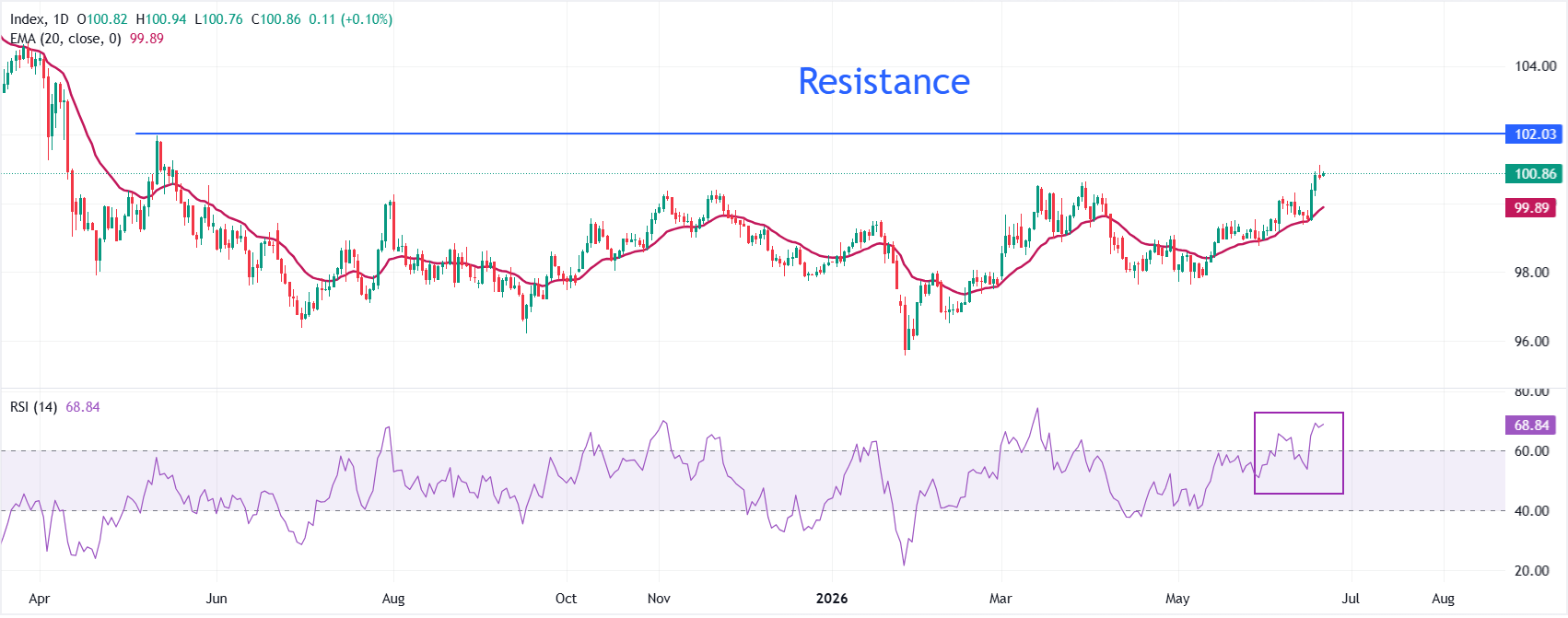
The Dollar Index Spot trades higher at around 100.93 at press time. The near-term bias is bullish as price holds above the 20-day exponential moving average (EMA) at 99.89, suggesting buyers maintain control after the recent advance.
The Relative Strength Index (RSI) at 68.93 hovers just below overbought territory, hinting that upside momentum remains strong but may be approaching a fatigue zone.
On the downside, initial support is aligned with the 20-day EMA near 99.89, where a pullback could find dip-buying interest and keep the broader constructive structure intact. A daily close below this moving average would signal waning bullish pressure and open the door to a deeper correction. The next major support zone would be the June 15 low at 99.38.
Looking up, the spot could extend the advance towards the one-year high around 102.00 if it manages to rise above the June 19 high at 101.13.
(The technical analysis of this story was written with the help of an AI tool.)
Fed FAQs
Monetary policy in the US is shaped by the Federal Reserve (Fed). The Fed has two mandates: to achieve price stability and foster full employment. Its primary tool to achieve these goals is by adjusting interest rates. When prices are rising too quickly and inflation is above the Fed’s 2% target, it raises interest rates, increasing borrowing costs throughout the economy. This results in a stronger US Dollar (USD) as it makes the US a more attractive place for international investors to park their money. When inflation falls below 2% or the Unemployment Rate is too high, the Fed may lower interest rates to encourage borrowing, which weighs on the Greenback.
The Federal Reserve (Fed) holds eight policy meetings a year, where the Federal Open Market Committee (FOMC) assesses economic conditions and makes monetary policy decisions. The FOMC is attended by twelve Fed officials – the seven members of the Board of Governors, the president of the Federal Reserve Bank of New York, and four of the remaining eleven regional Reserve Bank presidents, who serve one-year terms on a rotating basis.
In extreme situations, the Federal Reserve may resort to a policy named Quantitative Easing (QE). QE is the process by which the Fed substantially increases the flow of credit in a stuck financial system. It is a non-standard policy measure used during crises or when inflation is extremely low. It was the Fed’s weapon of choice during the Great Financial Crisis in 2008. It involves the Fed printing more Dollars and using them to buy high grade bonds from financial institutions. QE usually weakens the US Dollar.
Quantitative tightening (QT) is the reverse process of QE, whereby the Federal Reserve stops buying bonds from financial institutions and does not reinvest the principal from the bonds it holds maturing, to purchase new bonds. It is usually positive for the value of the US Dollar.
Author

Sagar Dua
FXStreet
Sagar Dua is associated with the financial markets from his college days. Along with pursuing post-graduation in Commerce in 2014, he started his markets training with chart analysis.